


Three siblings in Miami inherit their mother's house. One wants to sell fast and split the money. One wants top dollar on the MLS. One still has furniture in the bedrooms and isn't emotionally ready to let go. That is often the primary starting point for selling inherited property with multiple owners in South Florida. It is rarely just a real estate problem. It is a probate problem, a title problem, a communication problem, and sometimes a family litigation problem.
In Miami-Dade and Broward, I've seen the same friction points repeat. Heirs assume they can list the house because everyone “knows” who owns it. Then title work starts, probate status gets questioned, an HOA asks for documents, a lien surfaces, or one co-owner stops responding. A deal that looked simple turns technical very quickly.
If you're trying to get oriented, start with practical probate and inherited property guidance and a Florida-specific primer on how to sell inherited property. Then focus on the sequence that governs these transactions in the field: establish legal authority, confirm title, agree on valuation and sale terms, close with complete documentation, and distribute proceeds correctly.
Table of Contents
- At a Glance Inheriting and Selling a Florida Property
- The First Hurdle Florida Probate and Title Clarity
- Valuing the Property and Agreeing on a Path
- Resolving Disputes When Heirs Disagree
- Executing the Sale From Contract to Closing
- Dividing the Proceeds and Finalizing the Estate
- Frequently Asked Questions
At a Glance Inheriting and Selling a Florida Property
When a house passes to multiple heirs in South Florida, the inheritance creates an immediate co-ownership relationship whether the family is ready for it or not. In practice, that means siblings, cousins, or surviving relatives now share one asset with one roof, one tax bill, one insurance problem, and often very different goals.
In Miami-Dade, the pressure is often speed. In Broward, I often see a different version of the same stress. One heir lives nearby and deals with the property. Another lives out of state and only joins the conversation when an offer arrives. A third wants to wait because the house “might be worth more later.” None of those positions is irrational. They are just hard to reconcile when the title file is still incomplete and the family is grieving.
Practical rule: Treat the inherited home like a legal file first and a sale opportunity second.
Most families move through the same sequence:
- Legal authority first: Someone has to confirm who has authority to act for the estate and whether probate is still open.
- Ownership verification next: The deed, probate records, and title status have to line up before a buyer can close.
- Agreement among co-owners: The owners need a written understanding on price, timing, repairs, and who speaks for the group.
- Execution and closing: The contract is only the midpoint. HOA, title, payoff, permit, and insurance issues can still derail a clean closing.
- Distribution of proceeds: The money gets divided based on the ownership structure after valid debts, liens, and closing obligations are handled.
The families who get through this with the least damage usually do one thing early. They stop treating the house as an emotional symbol and start treating it as a shared asset with legal constraints.
The First Hurdle Florida Probate and Title Clarity
Florida inherited property deals fail early when heirs confuse family understanding with legal authority. They are not the same. A buyer can't close because everyone at Thanksgiving agreed to sell. A buyer closes when the seller has authority, title is clear, and the closing file satisfies the title company.
What has to happen before a sale
In inherited real estate, probate often controls the timing and the authority to sell. One legal summary notes that inherited property is often governed by probate, a court-supervised process that can take months to over a year depending on the estate, and multiple heirs usually can't finalize a sale until title is clear and all legal owners consent. It also notes that the sale may require a probate petition, title verification, and sometimes court approval before closing, especially when co-owners disagree, as explained in this overview of inherited property with multiple owners.

In Miami-Dade and Broward, the practical file usually includes the death certificate, the will if there is one, the petition opening probate, the court order appointing the Personal Representative, and the Letters of Administration if the estate administration requires them. If the property is exempt from full probate or passed in some other way, title still needs the supporting chain of documents. The issue is not what the family believes happened. The issue is what the public record and probate court file prove happened.
For families trying to avoid chaos around missing paperwork, a good starting point is planning for important family documents. Missing originals and incomplete estate records create avoidable delays.
Why title companies stop bad probate assumptions
Title companies don't work off verbal assurances. They check whether the seller in the contract matches the party with authority in the estate and the party reflected in the title chain. If those don't match, the closing stalls.
That is why heirs should get ahead of the probate side early, especially if they're dealing with a Florida property and haven't sold one before. This guide on how to sell a house in probate is useful because it focuses on the sale mechanics that come after court authority is established.
Inherited-home transfers are not ordinary listings. The legal process controls the sale, not the other way around.
A few field-tested points matter in South Florida:
- The Personal Representative matters: If the estate needs one, that person becomes the operational decision-maker subject to fiduciary duties and any court limits.
- Recorded title controls the closing table: A name missing from the deed history or probate chain can stop the transaction.
- Court supervision can become active again: If heirs argue over authority or sale terms, the closing file can turn back into a litigation file.
Families often want to “test the market first” and sort probate out later. That usually wastes time. Serious buyers, closing agents, and title underwriters want to know whether the seller has authority before they invest effort in inspections, underwriting, and contract work.
Valuing the Property and Agreeing on a Path
Once legal authority is in place, the emotional question becomes a business question. What is the house worth, and which sale path gives all owners a result they can live with?
Start with a valuation everyone can live with
A strong starting point is a neutral value anchor. One operational summary advises heirs to confirm legal authority, verify ownership and probate status, obtain a date-of-death or current appraisal to anchor fair-market value, align all co-owners on sale terms in writing, and close only after title, debts, and distribution rules are settled. It also notes that designating one lead contact materially reduces negotiation friction, as described in this guidance on how to sell an inherited house.
That sequence works because valuation fights usually aren't about valuation alone. They are proxy fights over fairness, control, and urgency.
In practice, families usually choose between two valuation approaches:
- Formal appraisal: Better when one heir suspects another is pushing a low or inflated number.
- Broker price opinion or market analysis: Useful when the owners are generally aligned and need a market range, not a courtroom-grade valuation.
Sale Option Comparison Inherited Property
The next decision is sale strategy. Inherited homes with multiple owners usually fit one of two lanes: a traditional MLS listing or a direct cash sale. The right answer depends less on abstract “maximum value” talk and more on whether the co-owners can survive the process without the deal collapsing.
| Factor | Listing on the MLS | Selling to a Cash Buyer (Property Nation) |
|---|---|---|
| Timeline | Usually longer because prep, showings, inspection negotiation, and buyer financing add stages | Usually simpler because there are fewer moving parts and fewer third-party approvals |
| Repairs and cleanup | Often creates disagreement because one heir wants updates and another won't fund them | Often works better for heirs who want an as-is exit without repair debates |
| Buyer certainty | Financing, appraisal, and inspection issues can reopen family conflict | More certainty when the buyer is not relying on retail mortgage underwriting |
| Showings and access | Hard when heirs live in different places or personal property is still inside | Easier when repeated access and staging are not central to the deal |
| HOA and condo friction | Retail buyers may react strongly to association restrictions and building condition issues | A direct buyer may be better equipped to underwrite administrative friction upfront |
| Emotional strain | Open houses, price reductions, and contract renegotiations often trigger new disputes | A cleaner process can reduce decision fatigue among co-owners |
| Net outcome | Can be attractive if the property shows well and the heirs cooperate | Can be attractive when speed, certainty, and as-is terms matter more than a full retail process |
The best sale path is the one all owners will still support after the first complication appears.
In Miami-Dade and Broward, I'd be especially careful with condos, deferred maintenance, and homes with unresolved occupancy issues. Those properties often look straightforward online and become contentious the moment the first inspection report lands.
Resolving Disputes When Heirs Disagree
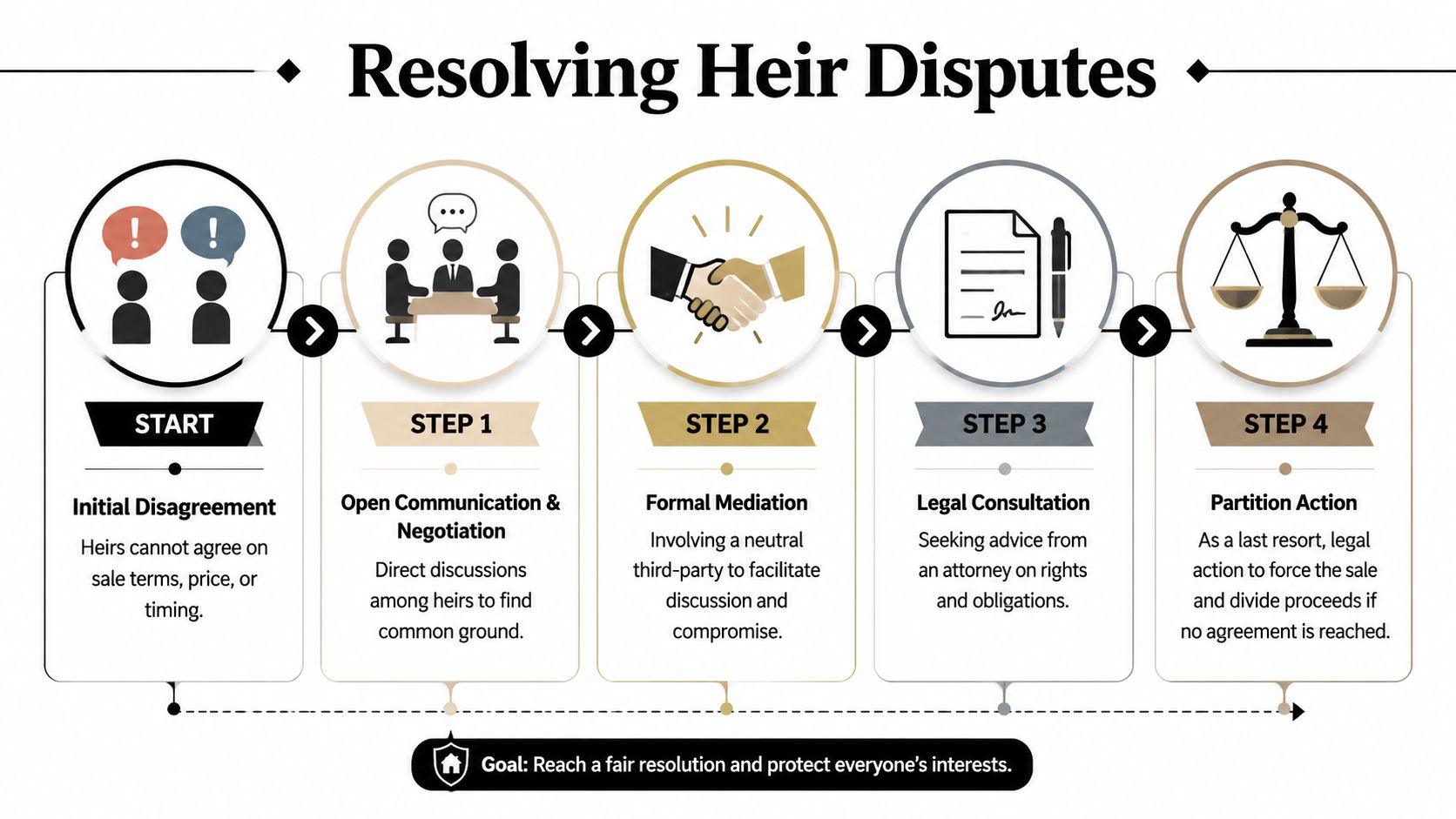
Deadlock is common in selling inherited property with multiple owners. One heir can't sign around the others and transfer the entire property.
A legal summary on unauthorized inherited-property sales states that a single heir generally can't sell the entire property without all co-owners' consent, and title companies often refuse to close without every owner signing. It also notes that court remedies or injunctions may be needed if someone attempts an unauthorized sale, as discussed in this analysis of whether an heir can sell inherited property without consent.
The lowest-cost way to break a deadlock
Most family disputes start with three pressure points: price, timing, and condition. The cheapest fix is usually structure, not argument.
Try this operating framework:
- Pick one lead contact: One person gathers documents, receives offers, and communicates with the attorney, title company, and buyers.
- Put decision rules in writing: Agree on a target price range, minimum acceptable terms, and who can authorize routine file requests.
- Use a neutral meeting: If emotions are high, a short attorney call or mediation session often saves a larger fight later.
A practical screening step helps too. Ask each heir to state, in writing, whether they want to keep, rent, or sell the property. Most “communication problems” are unspoken strategy conflicts.
Later in the process, this perspective on selling your inherited home to the right people becomes relevant because buyer selection can either calm a dispute or intensify it.
When a buyout works better than a listing
If one heir wants the home and the others want liquidity, a buyout can be cleaner than a public sale. The value anchor matters here. So do documented credits for carrying costs, debts, and any unequal contributions to the property.
A buyout usually works when:
- The retaining heir has financing or cash lined up
- Everyone accepts a defensible value method
- The written agreement addresses move-out dates, personal property, and release language
If one heir is emotionally attached to the house, a buyout is often the only path that preserves both family relationships and value.
Partition is the legal last resort
When no agreement is possible, Florida law provides a partition action. In plain terms, a co-owner asks the court to terminate the co-ownership relationship. That can lead to a forced sale and division of proceeds according to ownership rights.
This video gives a useful overview of the dispute dynamic:
Partition is not a strategy to use casually. It's litigation. It is slower, more expensive, more adversarial, and far less controllable than a negotiated sale. In residential inherited-property cases, it is often the moment when everyone realizes that being “right” is not the same thing as getting a good outcome.
Executing the Sale From Contract to Closing
Once the heirs agree on a path, the transaction becomes an execution problem. At this point, inherited deals in Miami-Dade and Broward either move smoothly or get trapped by paperwork, associations, permits, and title objections.
The file title wants before closing
Closing inherited real estate is document-heavy. One legal summary notes that sellers commonly calculate each heir's equity by taking the home's current value, subtracting debts and liens, and splitting the remainder by the number of co-owners or by recorded percentages. The same summary states that the process usually requires the deed, death certificate, probate records, and title documents before a buyer can close, as explained in this discussion of inherited property with multiple owners.

For inherited-property closings in South Florida, the usual file checklist includes:
- Core estate papers: deed, certified death certificate, probate orders, and any authority documents for the Personal Representative
- Payoff items: mortgage payoff, tax status, municipal balances, and any lien information
- Property-specific items: permit history, code issues, survey if needed, and occupancy information
- Association package if applicable: condo or HOA estoppel, governing documents if requested, and transfer application requirements
If a buyer is claiming to be ready to close quickly, ask for proof of funds early. It prevents wasted time with heirs who already have enough friction in the file.
South Florida issues that delay inherited closings
Miami-Dade and Broward closings have local friction points that families often underestimate.
First, HOA and condo associations can delay the file even when title is otherwise ready. Associations may require estoppel information, application packages, or other transfer-related paperwork before the transaction can close cleanly. If there are unpaid assessments or disputes, the closing statement becomes more contested.
Second, open permits and code matters can surface late. A roof permit, enclosed patio, electrical work, or old renovation that never fully closed can trigger title objections or buyer demands. Retail buyers are far less tolerant of these surprises than experienced as-is buyers.
Third, insurance and property condition still influence execution even after contract. In South Florida, an inherited house with vacancy issues, older systems, or deferred maintenance may create underwriting or inspection stress. That doesn't mean the sale can't close. It means the heirs need to understand early whether they are pursuing a retail buyer with lender constraints or a buyer prepared for as-is risk.
Clean execution in inherited sales comes from pre-closing diligence, not optimism.
Dividing the Proceeds and Finalizing the Estate
Once the sale closes, the family usually expects the hard part to be over. Legally and financially, there is still one more step. The money has to be accounted for correctly and distributed under the ownership structure.

How the math usually works
A practical rule used in inherited-property sales is straightforward. Start with the home's current value or actual sale price. Subtract debts and liens. The remaining equity is then divided by the number of co-owners or by their recorded ownership percentages, as noted in the legal summary cited earlier.
That means the final split is not based on emotion, effort, or who cleaned out the garage unless the parties separately agreed to credits or reimbursement. It is based on the ownership structure and the estate records.
Common deductions before distribution often include:
- Mortgage payoff
- Property taxes
- Recorded liens
- Closing costs
- Approved estate-related expenses
What heirs often miss at the very end
Heirs also need to think about tax reporting and estate accounting. In many inherited-home sales, the stepped-up basis concept can materially reduce capital-gains exposure if the sale occurs near the inherited value. The exact tax treatment is personal and should be reviewed with a qualified tax professional, especially if there was a long hold period, rental use, or improvement spending after inheritance.
The estate side matters too. Keep a clean final accounting. If the estate is still open, the Personal Representative and probate counsel should make sure distributions align with the governing documents and court requirements. Signed acknowledgments among heirs can help prevent later accusations that someone received the wrong amount or that an expense was hidden.
Frequently Asked Questions
| Question | Answer |
|---|---|
| What if one heir won't respond to emails or closing requests? | Don't let silence drift. Set a written deadline, route communications through counsel if needed, and document every request. If the person's nonresponse blocks the sale long enough, the matter may need a formal court remedy. |
| Can we sell before the house is emptied out? | Sometimes, yes. It depends on the buyer and the contract terms. For many inherited homes in Miami-Dade and Broward, an as-is sale can be structured around remaining personal property if everyone agrees in writing on what stays and what gets removed. |
| Who pays for maintenance while the home is waiting to sell? | Co-owners should address carrying costs early in writing. If they don't, routine expenses can become a second dispute layered on top of the sale dispute. |
| What if one heir lived in the property after the death? | Occupancy should be addressed directly. The family may need an agreement on possession, expense credits, insurance, and access for inspections or showings. |
| Can all heirs sign remotely? | Often yes, if the title company and closing process support remote execution and the probate authority documents are in order. Out-of-state heirs are common in South Florida inherited-property files. |
If you need a practical path for an inherited house in Miami-Dade or Broward, Property Nation can help you evaluate the cleanest exit based on probate status, title condition, HOA issues, property condition, and how aligned the heirs are. The goal is simple. Reduce friction, protect the closing, and help your family move forward without unnecessary delay.