


At-a-Glance: Selling a Probate Home in South Florida
Selling a house in probate is a court-supervised legal process, not a standard real estate transaction. As the Personal Representative, your primary duty is to settle the decedent's estate in compliance with Florida law. This involves obtaining legal authority from the court, managing estate assets, and liquidating property to pay debts and distribute the remaining assets to heirs. Key challenges in Miami-Dade and Broward counties include navigating strict 2026 insurance and HOA regulations, resolving title issues, and managing extended timelines. The two primary strategies are a traditional MLS listing, which is slow and costly, or a direct cash sale, which provides speed, certainty, and an as-is transaction.
Table of Contents
- At-a-Glance: Selling a Probate Home in South Florida
- Understanding the Florida Probate Process for Real Estate
- The Legal Steps for a Florida Probate Home Sale
- Choosing Your Sale Strategy: Traditional vs. Direct Cash
- Managing the Costs and Timelines of a Probate Sale
- FAQ: Selling a Florida Probate Home
Understanding the Florida Probate Process for Real Estate
When an individual passes away in Florida, their assets, including real estate, are legally processed through probate court. This ensures the decedent's debts are paid and assets are distributed according to their will or, if no will exists, state law. Selling a house within this framework requires strict adherence to the Florida Probate Code.
This process is especially complex in Miami-Dade and Broward counties. As a Personal Representative (executor), you are a fiduciary tasked with a significant legal and financial responsibility. Navigating this while grieving is a formidable challenge. Property Nation has extensive experience guiding families through this exact scenario, providing a clear, technical path forward.
Probate is the court’s mechanism for validating a will, settling creditor claims, and legally transferring title of assets. For a detailed legal perspective, these insights from Dewitt & Daniels on probate are an excellent resource.
Your Two Main Paths: A Technical Breakdown
The method you choose to sell the property dictates the timeline, costs, and complexity of the sale.
The Traditional Route (MLS Listing): This involves engaging a real estate agent to list the property on the Multiple Listing Service. This path often requires significant upfront capital from the estate for repairs to meet stringent 2026 Florida insurance underwriting standards, staging, and marketing. While it may achieve a higher gross sale price, it is the longest and most unpredictable option, subject to market fluctuations, buyer financing contingencies, and inspection negotiations.
The Direct Cash Sale: This is the expedited path. You sell the property directly to a professional homebuyer like Property Nation. The sale is conducted "as-is," eliminating the need for repairs, and involves no realtor commissions or public showings. This strategy provides absolute certainty and speed, which is often the highest priority for an estate needing to achieve finality and liquidity.
Selling a probate home isn't just a transaction; it's a fiduciary duty. The Personal Representative has a legal obligation to act in the best interest of the estate. This duty often prioritizes a guaranteed, swift closing over a potentially higher offer that carries the risk of failure.
There is no universally "right" answer. The optimal path depends on the estate's financial position, the liquidity needs of the heirs, and your capacity to manage a protracted sale process. Understanding what happens when you inherit a house is the critical first step in this analysis.
The Legal Steps for a Florida Probate Home Sale
Selling a house in probate in South Florida is a court-supervised process governed by a specific legal framework. The process commences when the designated Personal Representative or an heir files a petition to open a probate case with the court.
This initial petition is filed in the county of the decedent's residence, such as the Miami-Dade County Courthouse or the Broward County Judicial Complex. The filing must include the original will, if one exists, and a certified copy of the death certificate.
Upon accepting the petition, the court formally appoints the Personal Representative. The court then issues a critical legal document: the Letters of Administration. This document grants the representative the legal authority to manage and dispose of the estate’s assets, including the real property.
Authority to Sell: Full vs. Limited
The Letters of Administration will specify the scope of the Personal Representative's power, which is paramount for the property sale. This authority is designated as either "full" or "limited."
Full Authority: This is the more efficient path. It permits the Personal Representative to sell the property without requiring court approval for each step of the transaction. Notice must still be provided to all interested parties (heirs), but the process is significantly faster.
Limited Authority: This path involves substantial court oversight. With limited authority, the court must approve nearly every major action, including the listing price, acceptance of an offer, and the final sale. Each decision requires a court hearing, which introduces significant delays.
Once authority is granted, you must choose a sale strategy. This chart contrasts a traditional market listing with a direct cash sale.
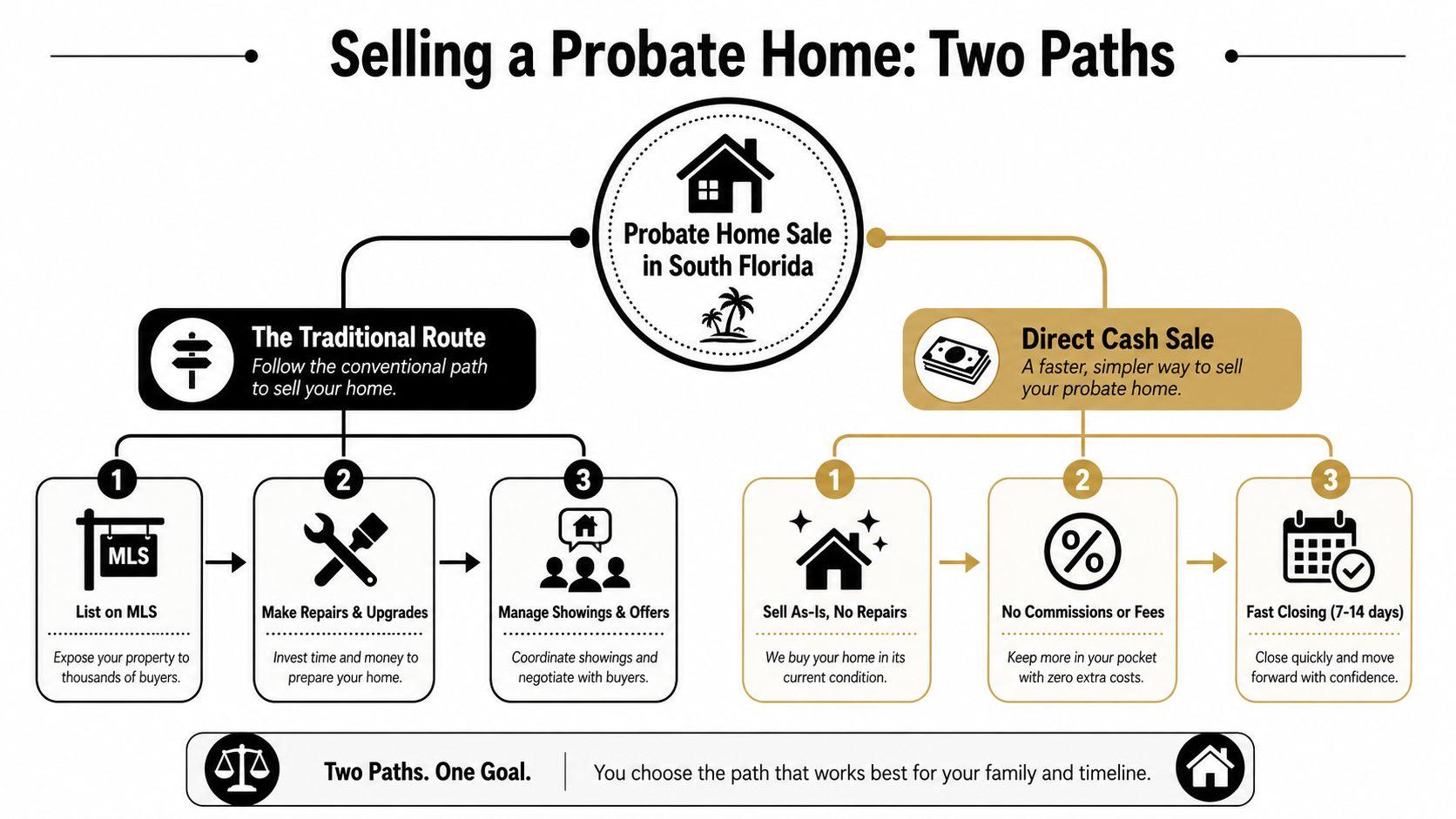
A direct cash sale bypasses many steps that complicate a traditional sale, which is a significant strategic advantage, especially when operating under the constraints of limited authority.
Regardless of the type of authority granted, your fiduciary duties are constant: secure the property, obtain a valuation, and execute a sale that maximizes the net benefit to the estate and its heirs. The level of authority simply dictates the degree of court supervision required. For a deeper analysis from an heir's viewpoint, our guide on how to sell inherited property is a valuable resource.
Choosing Your Sale Strategy: Traditional vs. Direct Cash
As the Personal Representative, your decision on how to sell the probate property is a critical juncture that will define the estate's timeline, net proceeds, and administrative burden. For estates in Miami-Dade and Broward counties, the choice is between a traditional MLS listing and a direct cash sale.
The traditional route necessitates hiring a realtor and preparing the home for the open market. This path requires significant upfront investment from the estate for repairs, deep cleaning, and staging—all before an offer is secured. This is followed by disruptive showings and the inherent risk of a buyer's financing failing prior to closing.
The alternative is a direct cash sale to a local, professional buyer like Property Nation. This approach is engineered for speed and certainty. It allows the estate to sell the property completely as-is. There are no repairs, cleanouts, realtor commissions, or delays waiting for buyer loan approval.
The core difference is control. A traditional sale subjects the estate to market volatility and buyer demands. A direct cash sale places control back with the Personal Representative, providing a guaranteed price and a firm closing date.

Comparing Your Options Head-to-Head
To fulfill your fiduciary duty, you must analyze the practical and financial realities of each option. A high list price on a traditional sale can be misleading once all holding costs, commissions, and repair expenses are deducted.
This table provides a direct comparison.
Probate Sale: Traditional MLS vs. Direct Cash Sale
| Factor | Traditional MLS Listing | Direct Cash Sale (Property Nation) |
|---|---|---|
| Repairs & Prep | Required. Estate pays for repairs, staging, and cleaning upfront to meet market and insurer demands. | None. We buy the property entirely as-is, including contents. |
| Realtor Commissions | 5% – 6% of the gross sale price. | $0. There are no commissions or agent fees. |
| Closing Costs | Seller typically pays 1% – 3% in closing costs. | We cover all standard closing costs for the seller. |
| Timeline to Close | 60-120+ days post-court approval, contingent on market conditions and buyer financing. | As fast as 7-10 days after court approval is secured. |
| Certainty of Sale | Low. Subject to failure from inspections, appraisals, or buyer financing denial. | High. Our cash offers are firm and guaranteed. The sale is certain. |
| Showings & Access | Requires continuous access for public showings and open houses. | Just one confidential, private property walk-through. |
| HOA & Insurance Compliance | Estate must resolve all issues to satisfy buyer's lender and 2026 standards. | We assume responsibility for all compliance issues post-closing. |
The data makes the trade-offs explicit. While the MLS list price may appear higher, the net proceeds to the estate are often lower and take significantly longer to realize.
We have assisted hundreds of families who decided to sell their house as-is to avoid the complexities of a public market listing. This is especially true for inherited properties in South Florida requiring substantial updates to meet strict 2026 insurance or HOA regulations. We specialize in executing these complex sales with speed and precision.
Managing the Costs and Timelines of a Probate Sale
A probate sale in South Florida operates on a judicial timeline, not a real estate market one. This reality introduces significant delays and holding costs that can erode an estate's value.
Understanding these pressures—time and money—is essential for setting realistic expectations. The probate court dictates the pace, and it is rarely swift.
In Miami-Dade and Broward, the entire process from filing the initial petition to closing the property sale can easily extend from six months to over a year. A standard real estate transaction closes in 30-45 days. This extended probate timeline is not merely an inconvenience; it is a direct financial drain on the estate, which remains liable for all property-related expenses. You can read more about what homebuyers should know about probate sale timelines.

Breaking Down the Expected Expenses
The expenses associated with a probate sale reduce the net inheritance for the heirs. The Personal Representative must meticulously track these costs.
As a benchmark, total probate costs often range from 3% to 8% of the estate's gross value. For a $500,000 home in South Florida, this translates to $15,000 to $40,000 in administrative and legal expenses.
These costs include:
- Attorney and Court Fees: A probate attorney is necessary to navigate the court system, which has its own mandatory filing fees.
- Property Holding Costs: These are recurring expenses, including property taxes, insurance, utilities (essential to prevent mold), and landscape maintenance.
- Appraisal and Bond Costs: The court requires a formal appraisal to establish the property’s fair market value. It may also require the Personal Representative to post a bond.
- Repairs and Maintenance: To be marketable for a traditional sale, a property must often undergo significant repairs to meet Florida's stringent 2026 insurance requirements (e.g., roof age, electrical panels), which can be prohibitively expensive for an estate.
Navigating Common Local Hurdles
South Florida presents unique challenges that can delay a sale and increase costs. A restrictive Homeowners Association (HOA) in a Broward County community, for instance, can have a lengthy and complex buyer approval process that stalls a traditional sale.
A frequent scenario we resolve involves unrecorded liens or open code enforcement violations on a Miami-Dade property. These title defects will halt a traditional sale, as conventional buyers and their lenders cannot proceed. The Property Nation team specializes in resolving these exact title issues, enabling the sale to close without further delay.
A direct cash sale serves as a strategic solution in these situations. It eliminates many variable costs and timeline uncertainties, providing the estate with a clear and predictable path to liquidation.
FAQ: Selling a Florida Probate Home
Can I sell a house during probate in Florida?
Yes, a house can be sold during probate, but the sale must be executed by the court-appointed Personal Representative. The authority to sell is granted by the court via the Letters of Administration. If the letters grant "full authority," the representative can proceed with the sale with minimal court intervention, though notice to beneficiaries is required. If the court grants "limited authority," every major decision, including the sale price and acceptance of an offer, requires court approval, which significantly extends the timeline.
How long does it take to sell a house in probate in Florida?
The timeline is strategy-dependent. A traditional MLS listing typically takes 6 to 12 months from the start of probate to closing, due to court schedules, marketing periods, and buyer financing contingencies. A direct cash sale to a professional buyer like Property Nation fundamentally alters this timeline. Once the Personal Representative has the legal authority to sell, we can close the transaction in as few as 7-10 days. This speed is a critical advantage when an estate has pressing debts or heirs awaiting distribution. For more on the court process, understanding probate details the steps governing these timelines.
Do I have to make repairs or clean out the house?
This depends entirely on your sale strategy. For a traditional MLS listing, the answer is yes. The estate must fund a full cleanout and any repairs needed to pass inspections and meet Florida's demanding 2026 insurance standards (e.g., roof condition, four-point inspection items). When you sell directly to Property Nation, you do nothing. The sale is completely "as-is." You are not required to clean, remove personal belongings, or make any repairs. You take what you want, and we handle the rest.
What if there are multiple heirs involved?
When multiple heirs exist, strict legal compliance and clear communication are mandatory. Florida law requires that all beneficiaries receive formal notification of the proposed sale. Depending on the terms of the will and the court's orders, their written consent may also be required. Engaging a qualified probate attorney is essential. The attorney will manage all legal notices, secure necessary consents, and ensure every action complies with the Florida Probate Code, thereby preventing disputes that could jeopardize the sale. If the property has outstanding debts, you should read also: our guide on selling a house with a lien to understand how those liabilities are managed.
Selling a probate home in South Florida presents unique legal and logistical challenges. If you are a Personal Representative seeking a fast, certain sale without the associated costs and delays of a traditional listing, Property Nation can provide a solution. We deliver a fair cash offer and close on your schedule, enabling you to settle the estate with efficiency and confidence. Contact us today for a confidential consultation.