


If you’re holding keys to a house in Miami-Dade or Broward after a death in the family, you’re probably dealing with two problems at once. You’re grieving, and you’re suddenly responsible for a piece of real estate that may have unpaid bills, insurance issues, HOA pressure, deferred maintenance, or siblings who don’t agree on what to do next.
Selling inherited property in Florida is rarely just a sales problem. It’s a title problem, a probate problem, a tax-record problem, and sometimes a family-negotiation problem. In South Florida, those issues get sharper because vacant homes attract risk fast, condo and HOA rules can complicate access, and a delayed decision usually means more carrying costs and more friction.
Table of Contents
- At-a-Glance Your First Steps After Inheritance
- Navigating Florida Probate in 2026
- Valuing and Preparing the Property for Sale
- Comparing Your South Florida Sale Options
- Managing Taxes Liens and Financial Hurdles
- Common Pitfalls When Selling an Inherited Home
- Frequently Asked Questions About Florida Inherited Properties
- Can I sell an inherited house if there are tenants living there?
- What if we discover unpermitted work?
- What documents should I have ready for closing?
- Do I need to empty the house before selling?
- Can I sell before probate is fully over?
- What if I’m out of state and can’t manage the property in person?
At-a-Glance Your First Steps After Inheritance
The first mistake heirs make is treating the house like a normal family asset. It isn’t. Until you know who has authority, what debts are attached, and whether probate is required, every informal decision creates risk.
Inherited property is also far more common than many families realize. In the 12 months ending August 2025, 340,000 homes transferred through inheritance in the United States. In Florida, the inheritance rate was 4.10 percent, and in Miami it was 3.69 percent according to Cotality’s analysis of inherited home transfers. That means many South Florida families are facing the same issue you are, but speed still matters.

Secure the house before you decide anything
Start with possession and liability. Change or rekey access if appropriate, confirm who currently has keys, collect garage remotes, and document the home’s condition with photos and video. If the house is vacant, check insurance immediately and make sure mail is being monitored.
For Miami-Dade and Broward properties, also confirm whether the home is in a condo or HOA community. Gate access, management approvals, parking rules, and vacant-property requirements can interfere with cleanout, inspections, and showings if you ignore them early.
Practical rule: Protect the asset first. Debating sale price before securing the property is backwards.
Find the will and the ownership documents
You need the will, trust documents if any exist, the death certificate, deed, mortgage statements, tax notices, insurance information, and any HOA or condo correspondence. If you can’t locate the deed, a title company or probate attorney can usually help trace the vesting history.
If you need a broader overview of what happens immediately after a transfer, this guide on what happens when you inherit a house is a useful starting point.
Confirm who has legal authority to act
Being an heir doesn’t automatically mean you can sign a contract to sell. In many Florida estates, the person with legal power is the personal representative once the probate court appoints that person.
Use this quick triage list in the first two days:
- Identify the decision-maker. Check whether a will names a personal representative.
- Check title posture. Determine whether the property was held individually, in a trust, or with survivorship rights.
- Pause major decisions. Don’t promise a buyer, sign a listing, or remove major assets until legal authority is clear.
That discipline prevents a common South Florida problem. Families move fast on a cleanup or an off-market deal, then discover the person negotiating had no authority to convey title.
Navigating Florida Probate in 2026
Probate is the legal gatekeeper. If title can’t move, the sale can’t close. That’s why heirs who ask how to sell inherited property in Florida usually need a probate answer before they need a pricing answer.
What probate actually controls
Probate establishes who has authority, what debts must be addressed, and when the property can legally transfer. In practical terms, the court process is what turns a family understanding into marketable title.
For a technical legal overview, heirs often benefit from reviewing a lawyer-written explanation of the probate process in Florida. It helps clarify why title companies and buyers insist on probate documents instead of family agreements or unsigned wills.
Summary administration versus formal administration
The timeline depends heavily on the estate type. Florida probate averages 9 to 12 months for straightforward estates, while summary administration for estates under $75,000 in equity can reduce the timeline to 1 to 3 months, based on the process benchmarks described by Raleigh Realty’s inherited home probate guide.
That distinction matters in Miami-Dade and Broward. If the estate qualifies for summary administration and there are no active disputes, the path to sale can be far shorter. If the estate requires formal administration, you should expect a more document-heavy process with creditor procedures and court supervision.
A good working rule is this:
- Summary administration fits smaller estates with cleaner facts.
- Formal administration is more common when there is significant equity, unresolved debt, title issues, or multiple parties.
The court doesn’t care that a buyer is ready today. It cares that the estate has authority to sell.
If the house is already in probate and you’re trying to understand sale logistics, this guide on how to sell a house in probate in Florida gives a practical transaction view.
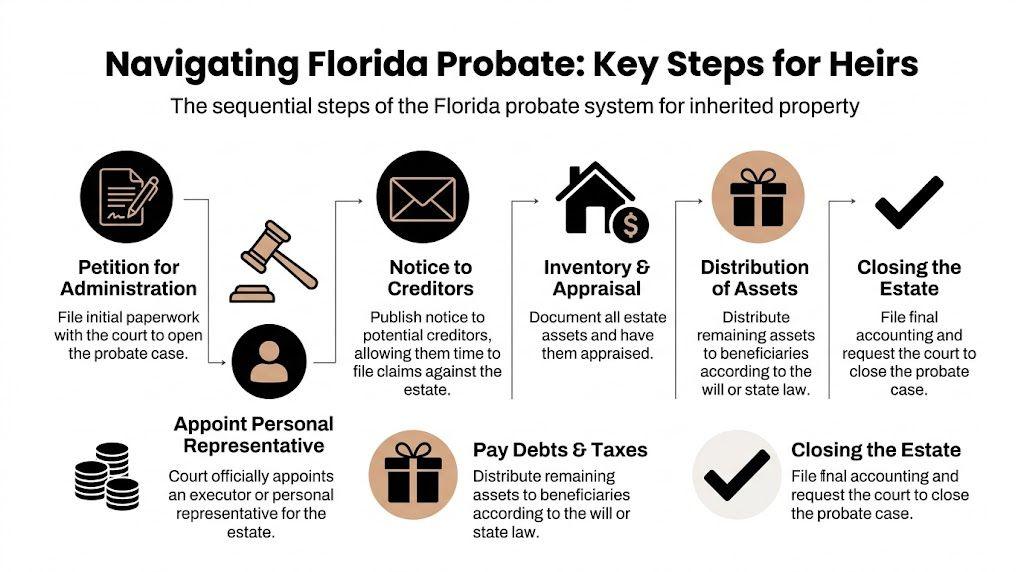
Core filing sequence in Miami-Dade and Broward
The filing sequence is procedural, but the mistakes are predictable.
- Open the estate. The will is filed with the court, and the probate case begins.
- Appoint the personal representative. The court issues the authority documents that let someone act for the estate.
- Notify creditors and gather records. Hidden balances often start to surface.
- Inventory and appraise the assets. The house must be accounted for correctly.
- Resolve debts, claims, and transfer conditions. Unpaid items can block title.
- Sell or distribute under court authority. Only then does closing become routine.
Miami-Dade and Broward estates often slow down because families assume the house can be marketed immediately. Sometimes it can be prepared in parallel, but legal authority still drives closing. If there is a mortgage, a code issue, or a condo association demanding records, those need to be routed through the person the court recognizes.
Valuing and Preparing the Property for Sale
Most heirs ask one question too early. “What’s it worth?” The answer has two parts. You need a tax value and a sale value, and they are not the same thing.

Start with two values not one
First, get the time-of-death appraisal or equivalent valuation support your tax advisor wants for basis purposes. Second, get a current market opinion based on present condition, location, and likely buyer pool.
Those two numbers can diverge sharply in South Florida. A house in Broward may have decent land value but a dated interior, an older roof, open permits, or insurability issues that reduce what a retail buyer will pay without concessions.
Decide whether repairs make business sense
Emotion often destroys net proceeds. Families often say, “Let’s just fix it up first,” without pricing the full scope. About 60 percent of inherited properties need $10,000 to $50,000 in updates to be market-ready for a traditional sale, according to this inherited property sale guide.
That doesn’t mean you should never renovate. It means you should run the numbers before touching anything.
Use a simple decision screen:
- Repair for retail if the property is in a price range and condition where buyers expect financing-ready presentation.
- Sell as-is if the house has deferred maintenance, unclear permits, heavy contents, or heirs who want a faster split.
- Price for land or lot value if the structure is functionally obsolete and the location is stronger than the house itself.
If you’re deciding between putting money in or selling in current condition, this breakdown of renovate a house for sale or sell as-is what’s better is the right framework.
A cleanout is often the first physical hurdle. If the home is packed with furniture, paperwork, or decades of personal belongings, this practical guide on how to handle an estate cleanout after a family member passes away is worth reviewing before you start moving items around.
Here’s a quick visual overview of inherited property sale decisions and timing considerations:
What preparation actually matters in South Florida
Cosmetic touch-ups matter less than risk reduction. Before spending on finishes, confirm the property can be insured, accessed, and conveyed cleanly. In Miami-Dade and Broward, unresolved condo documents, roof concerns, water intrusion, and unpermitted enclosures can matter more than paint colors.
Clean title and a realistic price beat a partially renovated house with unresolved problems.
For many inherited homes, the best preparation is not a remodel. It’s document control, trash-out, hazard removal, and deciding whether the next buyer should be a financed homeowner or an as-is buyer.
Comparing Your South Florida Sale Options
Once authority is in place and you know the property’s condition, the sale path becomes a strategy decision. You’re usually choosing between a traditional listing and a direct cash sale. Neither is automatically right. The right option depends on time, condition, conflict level among heirs, and whether title or liens are still being resolved.
Which path fits your actual situation
A traditional listing can make sense when the house shows well, the estate has time, and the heirs are aligned. A direct sale makes more sense when the property is vacant, distressed, inherited with complications, or tied to a family that wants a clean exit.
| Factor | Traditional Agent Listing | Cash Sale to Property Nation |
|---|---|---|
| Primary goal | Maximum market exposure and retail pricing | Speed, certainty, and simplified execution |
| Property condition needed | Usually cleaner, more presentable, and easier for financed buyers | Can work for inherited homes in as-is condition |
| Repairs and cleanout | Seller often handles prep, debris, and buyer objections | Typically far less prep before closing |
| Showings and access | Repeated showings, inspections, and staging pressure are common | Limited access disruption compared with a listing |
| Timeline profile | Longer, with market time and buyer underwriting layered in | Faster closing path when title is ready |
| Closing certainty | Depends on buyer financing, inspections, and appraisal | Depends mainly on title and estate authority |
| Heir coordination | Harder if heirs disagree on pricing, repairs, or offers | Often easier when the family values a simple split |
| Lien resolution | Can be handled, but delays often surface mid-transaction | Often better suited to a problem-solving closing structure |
| Costs | Agent fees and seller-side transaction costs usually apply | Structure varies, but direct buyers often simplify fees and process |
| Best fit | Clean house, cooperative heirs, and no urgency | Distressed property, out-of-state heirs, probate friction, or urgency |
The practical trade-off is straightforward. Listings usually ask you to optimize value through time, presentation, and buyer competition. Cash sales ask you to trade some upside for certainty, reduced prep, and a shorter path from contract to closing.
This is the one place where a local direct buyer can be useful as one option among several. Property Nation buys inherited homes in South Florida for cash, in as-is condition, and can close once title is clear, which fits estates where the family wants speed rather than a full listing cycle.
If heirs are local, cooperative, and willing to manage contractors, a listing may still be the stronger path. If the home has code issues, a lien problem, old contents, or a family dispute over repair spending, the direct route usually creates fewer moving parts.
Managing Taxes Liens and Financial Hurdles
Most heirs fear taxes first and liens second. In practice, both are manageable if you get the paperwork right early.
How stepped-up basis changes the tax picture
Inherited real estate gets one major tax advantage. The basis steps up to the fair market value at the date of death, and any sale is treated as a long-term capital gain or loss regardless of holding period under the explanation provided in Beratung Advisors’ discussion of inherited asset sales.
A simple example shows why that matters. If the inherited value is $500,000 and the property sells for $510,000, tax is generally calculated on the $10,000 gain, not on decades of appreciation before the inheritance. That is a major difference from gifted property.
There is still a trap. The principal residence exclusion is not automatic for inherited property just because the deceased lived there. If you didn’t satisfy the occupancy rules yourself, don’t assume that exclusion is available. That’s a tax-preparer conversation, not a guess.
Get the date-of-death valuation into the file early. Tax cleanup is much harder when the estate waits until after closing to reconstruct basis.
How liens surface and how they get cleared
A lien rarely appears at the worst possible time by accident. It was usually discoverable earlier through title work, HOA statements, tax records, or payoff requests. Order title as soon as you know a sale is likely.
Common inherited-property obstacles include:
- Mortgage balances that must be paid through closing
- HOA or condo arrears that trigger estoppel or approval friction
- Contractor or judgment liens that cloud title
- Utility and municipal issues tied to code enforcement or open balances
The clean approach is to let the title company and probate counsel map every encumbrance before the property goes fully to market. If you’re specifically dealing with title defects or payoff issues, this guide on can you sell a house with a lien on it outlines the transaction mechanics.
In Miami-Dade and Broward, lien resolution often dictates the timeline. A buyer may be ready. The estate may be ready. But if title shows unpaid association charges, a clouded deed history, or a probate authority gap, that issue controls closing.
The right mindset is operational. Treat every debt, claim, and encumbrance as a file item to clear, not as a surprise that makes the house unsellable.
Common Pitfalls When Selling an Inherited Home
The hardest inherited-home sales usually don’t fail because of the house. They fail because people delay decisions, assume agreement, or let family tension replace a process.

When siblings want different outcomes
One heir wants to keep the house. Another wants top dollar. A third wants cash immediately. That is the most common friction point in inherited property sales.
If the disagreement hardens, the legal system offers a blunt tool. Any heir can force a partition action, and that process often adds 6 to 12 months and legal fees averaging $5,000 to $15,000, as noted in this discussion of inherited property disputes.
The better move is usually to force clarity before marketing starts:
- Set a decision deadline. Open-ended family discussions create drift.
- Choose one valuation method. Competing opinions from different people create distrust.
- Write down the sale plan. Confirm whether the family is optimizing for speed, price, or minimal effort.
When delay becomes the real problem
A second scenario is quieter. No one says no. No one says yes either. The property sits. Insurance questions remain unresolved. Mail piles up. The lawn gets cited. A condo association starts asking for records. Months pass.
That kind of drift is common when one child lives in Broward, one is out of state, and no one wants to be the bad guy who pushes the sale. The practical fix is to assign roles. One person handles probate communication. One person handles title and records. One person approves cleanout decisions. Everyone gets deadlines.
Families don’t need perfect agreement. They need a process that prevents the house from becoming a second crisis.
Emotional attachment is real, but it can’t run the file. If certain belongings matter, inventory them, distribute them, and move on. The house itself should be treated like an asset with carrying obligations, not a storage unit for unresolved decisions.
Frequently Asked Questions About Florida Inherited Properties
Can I sell an inherited house if there are tenants living there?
Yes, but the tenancy has to be reviewed before the property goes to market. You need the lease, payment history, deposit records, and any notices already served. A buyer will want to know whether the tenants are month-to-month, whether rent is current, and whether access for inspections is realistic.
In Miami-Dade and Broward, inherited rentals often become harder to sell when heirs assume they can just remove the tenants informally. They usually can’t. Review the tenancy as part of the title and probate file, then decide whether you’re selling occupied or negotiating a vacancy plan first.
What if we discover unpermitted work?
Treat unpermitted work as a title and underwriting issue, not just a construction issue. Screen enclosures, converted garages, additions, and interior reconfigurations come up often in South Florida inherited homes.
The practical order is simple. Confirm what exists, check county or municipal records, and decide whether the issue should be disclosed, cured, priced in, or left for an as-is buyer who is comfortable taking it on. Trying to hide it usually creates a worse problem later.
What documents should I have ready for closing?
Have the probate authority documents, death certificate, deed information, government-issued ID, payoff statements for debts tied to the property, HOA or condo information if applicable, and any trust or court documents that affect authority. If there are multiple heirs, make sure signature authority is clear long before closing is scheduled.
Title companies don’t like ambiguity. The more complete the estate file is, the smoother the closing.
Do I need to empty the house before selling?
Not always. For a traditional listing, full cleanout usually helps. For an as-is sale, it may not be required. What matters is whether the buyer is expecting a broom-clean retail property or is prepared to handle contents after closing.
If personal property has sentimental or legal importance, separate it first. Don’t mix estate administration with house disposal at the last minute.
Can I sell before probate is fully over?
Sometimes the property can be marketed or prepared while probate is active, but the closing itself still depends on legal authority and clean title. In practice, that means you should line up title work and sale planning early, then coordinate the actual closing around the estate’s authority to convey.
What if I’m out of state and can’t manage the property in person?
That is common. The key is to centralize communication. Use one probate attorney, one title contact, and one decision-maker for the estate. Remote heirs usually run into trouble when three different family members give conflicting instructions to vendors, agents, or buyers.
A clear file beats physical proximity. If you’re dealing with an inherited house in Miami-Dade or Broward and need a direct path through probate, title issues, or an as-is sale decision, Property Nation can help you evaluate the next step and move on a timeline that fits the estate.