

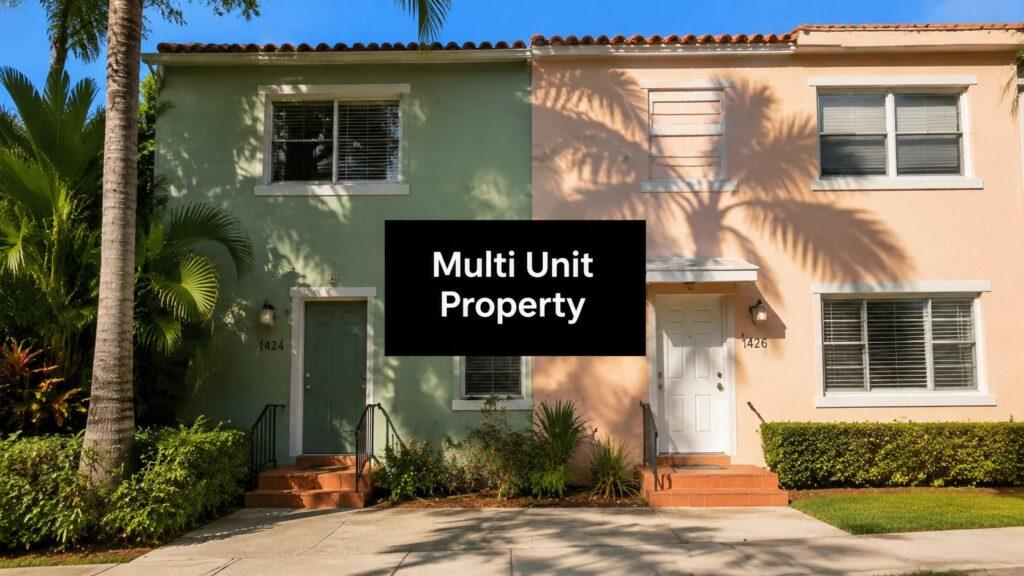
If you own a duplex, triplex, or fourplex in Miami-Dade or Broward, you may be at the point where the property still looks good on paper but feels heavy in real life. Rent comes in, but so do insurance renewals, repair calls, tenant disputes, probate issues, HOA notices, and questions about whether the use is even fully compliant under current local rules. That tension is common in South Florida.
Sellers usually don't need another buyer-focused primer. They need a clean read on what they own, what can go wrong before closing, and which exit path creates the least friction. A multi unit property can be a strong asset. It can also become a legal and operational project that drains time and cash right when you want certainty.
Table of Contents
- At a Glance Your Guide to Multi Unit Properties
- Defining a Multi Unit Property in Florida
- Navigating Zoning and Ownership in Miami and Broward
- Valuation Methods and Income Realities in 2026
- Pros and Cons of Multi Unit Property Ownership
- Selling Your Property A Traditional vs Direct Sale
- South Florida Seller Checklist and FAQ
At a Glance Your Guide to Multi Unit Properties
A South Florida multi unit property often starts as a practical investment. A landlord buys a duplex in Hollywood, inherits a fourplex in Miami, or keeps a former primary residence and rents the extra units. Years later, the exit becomes harder than the acquisition. Tenants are still in place. Insurance is expensive. Repairs are deferred. The title may need cleanup. The zoning file may not match the current layout.
Sellers require a technical view, not generic encouragement. The important questions are basic but serious. Is the use legal and documented. Will buyers' lenders force repairs. Are leases transferable without drama. Is the property best sold vacant, occupied, or strictly as-is. Those answers affect speed, price certainty, and closing risk.
For owners who want a broader investor-side perspective before making a sale decision, Property Scout 360 on multi-family investing is a useful reference because it shows how buyers typically evaluate these assets. That matters when you're trying to anticipate objections before listing.
Defining a Multi Unit Property in Florida
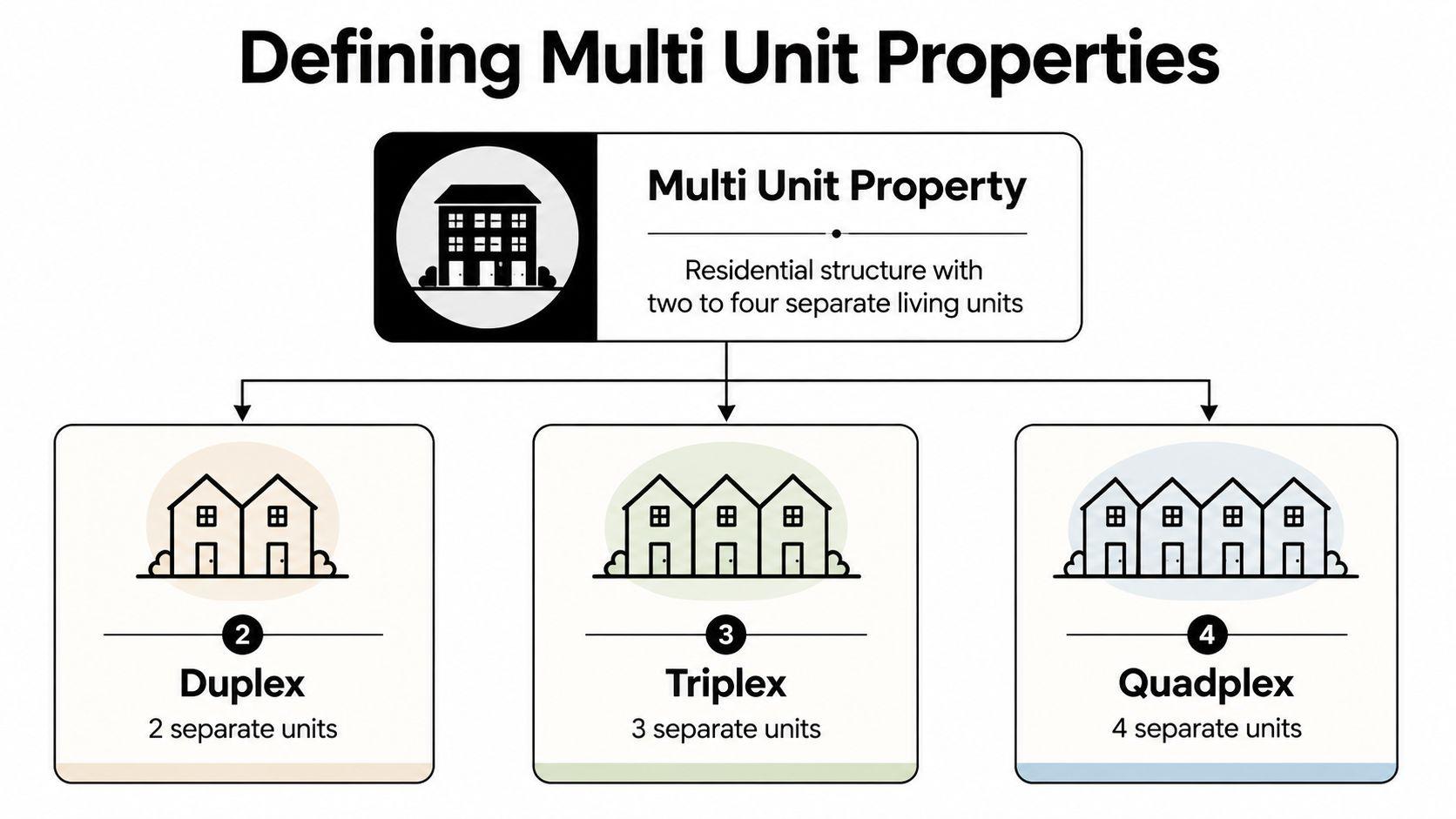
A multi unit property in the seller context usually means a residential building with two to four separate living units on one parcel and under one ownership structure. In plain terms, that's the duplex, triplex, and fourplex category most owners in Miami-Dade and Broward recognize immediately.
What counts and what does not
A few distinctions matter because sellers often use the right nickname for the wrong legal asset.
- Duplex means two separate units in one structure.
- Triplex means three.
- Quadplex or fourplex means four.
- Condo conversion is different. You may see a building that looks like a duplex, but if units were legally split into separate condominium ownership, you are not selling one multi unit property. You are dealing with separate units and shared governance.
- Illegal extra unit is not a true multi unit property just because there's an added kitchen or separate entrance.
A Coral Gables duplex with two lawful units on one deed is a different asset from a Fort Lauderdale building that was converted into separate condo units years ago. The street view can fool people. The deed, zoning history, tax records, and permit trail usually tell the truth.
Why the category matters to a seller
This is not a niche corner of housing. According to the National Association of Home Builders summary of American Housing Survey and U.S. Census Bureau data, about 43.9 million residences in the United States were multifamily units in 2019, representing 31.4% of all U.S. housing. That scale matters because buyers, lenders, appraisers, and public agencies already treat this as a major asset class with established underwriting logic.
A seller gets better outcomes when the property is described by its legal structure, not by its appearance.
In Florida practice, classification affects marketing, financing, inspections, and buyer pool. Residential owner-occupant buyers may look at a duplex one way. Income investors look at the same property through rent rolls, expenses, vacancy risk, and deferred maintenance. Once the building crosses into a more commercial profile in the buyer's eyes, the conversation changes quickly.
Navigating Zoning and Ownership in Miami and Broward
The first serious question isn't what the property could sell for. It's whether the current use is lawful, documented, and insurable. In Miami-Dade and Broward, sellers run into trouble when the building has been used one way for years but the file tells a different story.
Legal use matters more than layout
A property can function as a duplex in daily life and still create closing problems if the zoning, permits, or municipal records don't support that use. Miami-Dade owners often hear zoning labels such as RU-2 for two-family residential use. Broward municipalities use their own code language, but the practical issue is the same. You need to confirm that the number of units, parking, life-safety features, and occupancy pattern are allowed where the property sits.
Start with these checks:
- Verify zoning and land use through the municipality or county records.
- Match the legal unit count against tax records, permits, and current layout.
- Confirm rental compliance including any required local registration or Certificate of Use.
- Review open permits or violations before you negotiate with a buyer.
- Check whether additions were legalized or tolerated.
If title work is going to be part of the sale, the seller should understand how deed issues, probate signatures, and recorded interests can slow closing. Property owners dealing with chain-of-title questions can review the title transfer process before the property goes under contract.
Practical rule: If the city file and the rent roll disagree, the buyer will underwrite the risk, not your explanation.
A common South Florida problem is the older “grandfathered” structure. Owners use that phrase loosely. Some properties are lawful nonconforming uses. Others are undocumented. Those are not the same thing. Lawful nonconforming status may preserve use rights, but buyers and insurers still want documentation. If you can't prove status, the buyer may price the asset as a compliance problem.
Ownership structure changes the sale path
Ownership also affects how the exit works.
- Fee simple multi unit property usually gives the seller the clearest path.
- Property inside an HOA or association framework adds estoppel requests, approval issues, account balances, and governing-document review.
- Inherited property often adds probate authority, multiple heirs, or affidavit work.
- Subsidized or program-linked property may trigger added review before the lease file can transfer cleanly.
HUD's assisted multifamily property data and program context is especially relevant when tenants are in place because federal program rules, CARES Act eviction contexts, notice periods, and lease assignment constraints can complicate a sale. A seller shouldn't assume that occupied means marketable on ordinary timelines.
In Miami-Dade and Broward, zoning mistakes can often be fixed. The issue is time. If you want a clean retail listing, fix them first. If you want speed, your exit strategy has to account for them instead of pretending they aren't there.
Valuation Methods and Income Realities in 2026
Owners often anchor value to nearby sales and stop there. That works poorly with a multi unit property because two buildings on the same block can trade very differently once income quality, expenses, tenant stability, and repair exposure come into focus.

Comps and income tell different stories
Most sellers deal with two valuation lenses.
The first is the sales comparison approach. Appraisers and agents look at similar duplexes, triplexes, and fourplexes that sold nearby. This works best when unit mix, condition, zoning, and neighborhood are genuinely comparable.
The second is the income approach. Investors ask different questions. What is the gross rent. What are the actual expenses. How stable are the leases. How much work is buried in the building systems. If the rent roll looks strong but the insurance, roof, plumbing, and turnover burden are ugly, the income story weakens quickly.
For a better understanding of how local data is assembled before pricing a property, review a comparable market analysis with the income side in mind rather than relying on square-foot averages alone.
National apartment conditions also matter because buyer sentiment doesn't develop in a vacuum. According to multifamily housing statistics published in this market summary, the U.S. apartment market's vacancy rate fell to 4.1% by Q2 2025, implying about 94.5% occupancy, and 2025 was described as the third-strongest year for apartment demand in the past 25 years. Strong occupancy supports investor interest, but it doesn't excuse weak property-level operations.
Expense pressure changes what buyers will pay
South Florida sellers run into a simple truth. Revenue gets attention. Expenses control the offer.
A buyer usually adjusts value downward when these issues show up:
- Insurance strain that compresses net income.
- Deferred maintenance such as old drain lines, aging HVAC systems, roof concerns, or unresolved leaks.
- Tenant friction including short payment history, incomplete leases, or occupancy disputes.
- Utility inefficiency where owner-paid expenses are too high.
- Financing difficulty if the condition pushes the deal out of standard lending.
For owners trying to understand the financing mindset on the other side of the table, hard money for multi-family acquisitions gives useful context on how investors bridge condition and timing issues when conventional debt doesn't fit.
Buyers don't pay for potential if they have to spend the first months solving code, systems, and collections problems.
In 2026, realistic valuation means accepting that a property isn't worth what gross rent suggests if the operating structure is unstable. Sellers who understand that early choose better exits and waste less time.
Pros and Cons of Multi Unit Property Ownership
Some owners should keep the asset. Others should exit before one more renewal cycle, one more roof leak, or one more tenant dispute turns a manageable property into an expensive obligation. The pros are real. So are the burdens.
Where ownership still works well
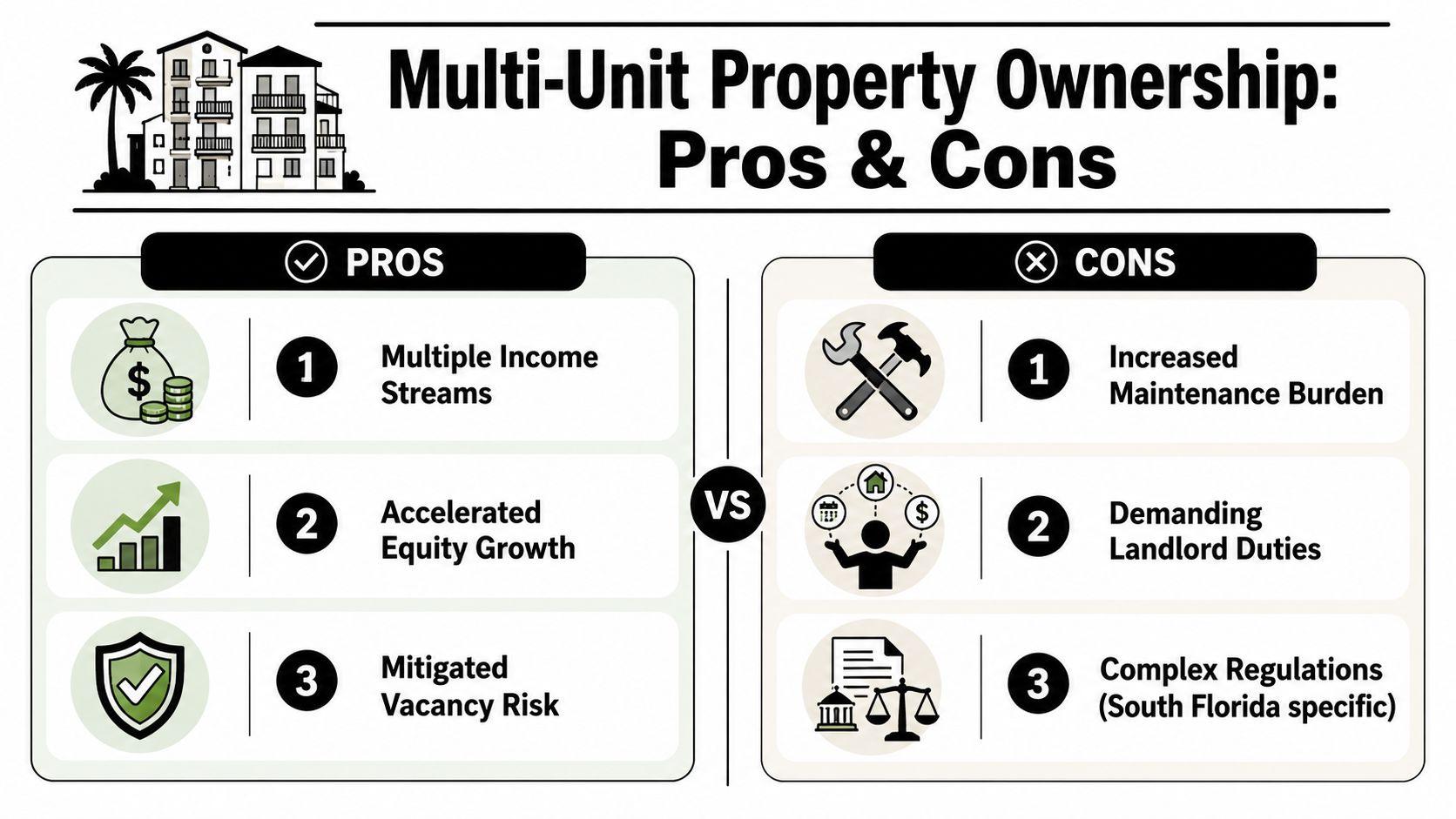
A well-run multi unit property can outperform a single-tenant asset in one critical way. Vacancy risk is spread across multiple units instead of resting on one lease. If one tenant leaves, the income doesn't drop to zero.
Other advantages are practical:
- Multiple rent streams can stabilize monthly cash flow.
- One parcel, several units can simplify long-term hold strategy.
- Owner-occupant flexibility exists in some duplex and triplex situations.
- Operational scale can work in your favor when maintenance is organized.
This video gives a useful visual overview of the ownership model and why many investors still like the category:
Where sellers get trapped
The downside in South Florida usually isn't theory. It's workload. One leaking stack can affect several tenants. One bad lease file can derail underwriting. One unresolved city issue can kill financing late in the deal.
For buildings with older plumbing or recurring drain and supply issues, a seller should get a real condition read before listing. Firms with Good Boy Plumbing's commercial expertise are useful because commercial-style system problems in small multifamily properties often look minor until buyer inspections begin.
The hardest ownership problem is often occupied units during a sale. HUD's program-related guidance discussed earlier makes the larger point. Tenant-occupied sales can involve lease assignment constraints, notice questions, federal rule overlays, and regulatory screening. That can turn a normal listing into a file-heavy transaction with avoidable delays.
A blunt way to frame it:
| Ownership upside | Ownership burden |
|---|---|
| Income comes from more than one unit | Repairs often affect more than one unit |
| Vacancy in one unit may be manageable | Tenant disputes can spread operational stress |
| Scale can improve holding efficiency | Compliance, records, and turnover are harder to manage |
If your building is fully documented, professionally maintained, and easy to insure, holding may still make sense. If it's occupied, under-repaired, and legally messy, the holding cost is often larger than owners admit.
Selling Your Property A Traditional vs Direct Sale
The exit path matters as much as the price. Many sellers lose time by choosing the wrong process for the condition, occupancy, and paperwork attached to the property.
Why the listing route breaks down
A traditional MLS listing works best when the building is presentable, records are complete, tenants cooperate, and buyer financing is likely to survive inspections. That is not every Miami-Dade or Broward multi unit property.
Traditional sales usually create pressure in these areas:
- Showings with tenants in place can be difficult to schedule and easy to disrupt.
- Inspection findings often trigger repair requests.
- Lender standards may push the buyer to demand corrections before funding.
- Association, probate, or title issues can stall a contract deep into escrow.
Federal multifamily rehabilitation standards illustrate why older buildings can become expensive to “fix for the buyer.” Under HUD's mandatory multifamily design standards, post-construction work requires a HERS score of 65 or less, low-flow plumbing fixtures at no more than 2.0 gallons per minute when replaced, along with hardwired energy-efficient lighting, low- or no-VOC paints and sealants, and ENERGY STAR appliances. An older property may need more than cosmetic work to satisfy a lender-driven renovation standard.
When a direct sale is the cleaner move
A direct cash sale is not just for distressed owners. It's often the rational move when speed, privacy, and certainty matter more than testing the market for a perfect financed buyer.
The trade-off is straightforward.
| Factor | Traditional MLS Listing | Direct Cash Sale (Property Nation) |
|---|---|---|
| Property condition | Usually needs prep, cleanup, and buyer-ready presentation | Typically sold as-is |
| Tenants in place | Showings and inspections are harder to manage | Fewer access demands |
| Financing risk | Buyer loan, appraisal, and lender conditions can fail | No conventional lending contingency |
| Repair exposure | Seller may be pushed into repairs or credits | Seller can avoid pre-sale renovation work |
| Timeline certainty | Less predictable | More controlled and direct |
| Transaction complexity | More parties and more moving parts | Simpler process for many sellers |
For owners weighing that option, this guide on why selling to home investors is ideal lays out the transaction logic clearly.
If the property is old, occupied, inherited, noncompliant, or difficult to finance, certainty usually has more value than a theoretical top-line listing price.
South Florida Seller Checklist and FAQ
Sellers close better deals when they assemble the file before they start taking calls. A buyer can work with bad condition. A buyer struggles with missing records, unclear authority, and inconsistent income history.

Documents to gather before you sell
Use this as a working seller file for a Miami-Dade or Broward multi unit property.
- All leases and amendments. Include renewal terms, deposits, concessions, and any notices already served.
- Rent roll and payment history. Keep it simple and accurate. Unit number, monthly rent, occupancy status, and recent collection pattern matter.
- Operating expense summary. Insurance, taxes, utilities, repairs, association dues if any, and routine service contracts.
- Certificate of Use or local rental compliance records where required.
- Permit history and known violations. Buyers will search this anyway.
- Repair records for roof, plumbing, electrical, HVAC, and water intrusion.
- Association documents if the property sits in an HOA or similar structure.
- Probate or estate authority documents if the owner is deceased.
- Title issue notes including judgments, unpaid balances, or liens.
Sellers facing title clouds or recorded claims should also review whether they can close with those issues in place. This guide on selling a house with a lien on it is useful if encumbrances may surface during title review.
Frequently asked questions
How do 2026 insurance conditions affect my sale price in Miami-Dade or Broward?
They affect buyer underwriting more than seller expectations. When insurance is difficult or expensive, investors push harder on expenses and reserves. That lowers the number they can justify, especially if the building has older systems or a disputed roof history. Sellers who can provide clear loss history, maintenance records, and recent major repairs usually create a smoother review.
Can I sell a multi unit property with tenants still living there?
Yes, but occupied sales require discipline. You need current leases, payment records, deposit information, and a plan for access. If the property has any federal program overlay, subsidized component, or unusual eviction history, the review becomes more technical. In occupied sales, confusion is what kills momentum.
Can I sell if the property is inside an HOA or association?
Yes. The issue isn't whether you can sell. The issue is whether the association documents, balances, restrictions, and estoppel response create delay. Sellers should order governing documents and account information early. In South Florida, association paperwork often becomes a timing issue rather than a legal impossibility.
What if I inherited the building and probate is still open?
You may still be able to prepare for sale, but authority to close depends on the estate posture and who has legal power to sign. If there are multiple heirs, disagreements and missing signatures can delay everything. The cleanest approach is to confirm authority first, then market the asset once the sale path is documented.
Should I renovate before selling?
Only if the work is likely to survive inspection, improve financeability, and create more net proceeds than delay. Cosmetic updates alone rarely solve actual problems in an older multi unit property. If the bigger issues are permits, plumbing, roof age, tenant access, title defects, or insurance questions, repainting units won't fix the transaction.
What is the most efficient exit strategy for a stressed multifamily seller?
For a seller with deferred maintenance, tenant friction, probate complications, zoning uncertainty, or urgency, an as-is cash exit is often the cleanest path. Not because the property has no value. Because complexity has value too, and someone has to absorb it.
If you own a duplex, triplex, or fourplex in Miami-Dade or Broward and need a clear exit path, Property Nation offers a direct way to sell as-is without listings, repairs, showings, or commissions. For landlords, heirs, and owners dealing with tenants, probate, liens, or outdated property conditions, that can be the fastest route to certainty.
Meta title: Florida Multi Unit Property Seller Guide | Property Nation