

Your tenant stopped paying. Or worse, the rent is late, the property is getting damaged, and neighbors in Miami-Dade or Broward are calling you instead of the police. That’s usually when landlords start searching how to evict a tenant in florida, and most of what they find is either too generic, too vague, or too casual about mistakes that can sink a case.
Florida eviction law is technical. Chapter 83 gives landlords real remedies, but only if the notice, timing, filing, service, and court steps are done exactly right. A bad notice can kill a valid case. A rushed lockout can create liability. A sloppy filing can turn a short matter into a drawn-out court fight.
This guide is written for the landlord who needs precision, not theory. It focuses on the actual pressure points in Miami-Dade and Broward, where volume, service issues, and contested filings often change how fast a case moves. For a broader landlord-facing overview, Edinhart’s eviction guide for landlords is also a useful companion read.
Table of Contents
- At-a-Glance Your Guide to Florida Eviction
- The Critical First Step Florida Eviction Notices
- Eviction Paths Non-Payment vs Lease Violations
- Filing an Unlawful Detainer in a Florida Court
- From Court Hearings to Sheriff Removals
- The Alternative Bypassing the Eviction Battle
- Florida Eviction FAQs
At-a-Glance Your Guide to Florida Eviction
If you own a rental in South Florida and the tenant has stopped performing, the first question isn’t whether you’re frustrated. It’s whether you’re on the right legal track. Florida law treats nonpayment of rent, curable lease violations, and serious non-curable violations differently, and using the wrong notice at the beginning can wreck everything that follows.

The two main lanes landlords use
Most residential evictions fall into one of these lanes:
- Unpaid rent: This starts with a 3-Day Notice to Pay or Vacate under Florida Statute § 83.56(3).
- Lease breach: This starts with a 7-Day Notice, either with a chance to cure or without one, depending on the violation.
That distinction matters because the tenant’s legal options change based on the notice. In a rent case, the tenant can stop the immediate eviction path by paying the full rent due within the notice period. In a curable lease case, the tenant can correct the breach. In a serious non-curable case, the issue is usually proof, not correction.
What a practical Florida eviction looks like
In real practice, the flow is simple on paper and unforgiving in execution:
- Serve the correct notice
- Wait the required statutory period
- File the complaint in the correct county court
- Get the tenant formally served
- Respond fast if the tenant answers
- Obtain judgment and writ
- Let the sheriff complete the final removal
Florida gives landlords a structured remedy. It does not forgive shortcuts.
For landlords in Miami-Dade and Broward, speed often comes down to paperwork quality, service quality, and whether the tenant knows how to use the court registry to slow the case down. The process can work. It also demands discipline.
The business question most landlords ask too late
A legally winnable eviction isn’t always the best financial move. If the tenant is destroying the property, the house needs major work, or the unit has become a drain on your time, some owners decide not to keep fighting over possession at all. In those cases, a direct sale can be the cleaner exit.
The Critical First Step Florida Eviction Notices
The notice is where many landlords win or lose the case before the complaint is even filed. Florida courts expect exact compliance, especially in high-volume counties where clerks and judges see the same notice mistakes every day.

Under Fla. Stat. § 83.56(3), nonpayment cases require a strict 3-Day Notice to Pay or Vacate. According to Florida eviction filing data summarized here, nonpayment evictions represent over 80% of filings statewide, Miami-Dade sees about 1,200 eviction complaints per month on average, and the path from notice to writ of possession averages 3 to 6 weeks.
The 3-day notice for unpaid rent
This notice must demand the rent that is due and give the tenant exactly the legal period to pay in full or leave. The timing rules are strict. The day of delivery does not count. Weekends and legal holidays do not count.
What belongs in the notice:
- Tenant and property identification: Use the full names used in the lease and the complete rental address.
- The rent demand: State the unpaid rent clearly. Don’t mix in fees or charges unless your form and claim are legally supportable.
- The deadline: Count the three business days correctly.
- Your delivery proof: Keep a copy, photo, and record of how and when service happened.
Practical rule: If you have to guess whether your notice wording is “close enough,” it probably isn’t.
A simple rent notice usually works better than an aggressive one. Courts care more about legal compliance than tone.
You are hereby notified that you are indebted to me in the sum of $_____ for rent and use of the premises located at __________, Florida, now occupied by you, and that I demand payment of the rent or possession of the premises within three business days, excluding the day of delivery, weekends, and legal holidays.
The 7-day notice for lease breaches
Lease cases split into two categories.
For curable violations, Florida law allows a 7-day notice to cure or quit. This is commonly used for issues like an unauthorized pet, failure to maintain the unit as required, or another breach the tenant can fix.
For serious or repeated violations, Florida law allows a 7-Day Unconditional Quit Notice. That’s used when the tenant doesn’t get another chance to fix the problem.
The line between curable and non-curable matters. A messy unit may be curable. Intentional property damage usually isn’t. Repeated violations inside a short period can also move a landlord from warning mode to termination mode.
This video gives a basic visual walk-through of notice and filing mechanics:
How to serve the notice without creating a future problem
Florida allows service methods such as hand-delivery, posting on the property, or mail, but the method only helps you if you can prove what happened later. That’s why careful landlords create a paper trail from day one.
A clean notice file usually includes:
- A signed copy of the notice
- A photo of the posted notice on the door
- A date-stamped rent ledger
- Any relevant lease pages
- A mailing record if you also mail a copy
What doesn’t work well is improvising. Text messages alone don’t replace the statutory notice. Verbal warnings don’t replace the statutory notice. Anger definitely doesn’t replace the statutory notice.
Eviction Paths Non-Payment vs Lease Violations
Not every bad tenancy should be handled as a rent case. Some landlords default to nonpayment because it feels simpler, then discover the bigger problem is occupants, damage, criminal behavior, or repeated misconduct. The strongest case is usually the one that matches the actual breach.
Florida Eviction Paths Compared 2026
| Criteria | Non-Payment of Rent | Lease Violation |
|---|---|---|
| Primary notice | 3-Day Notice to Pay or Vacate | 7-Day Notice to Cure or 7-Day Unconditional Quit |
| Tenant's immediate option | Pay all past-due rent in full or leave | Cure the violation if curable, or vacate if non-curable |
| Best use case | Straight rent default with clean ledger records | Damage, unauthorized occupants, repeated breaches, disturbances |
| Key evidence | Lease, ledger, notice, proof of service | Lease clause, photos, videos, police reports, witness statements, notices |
| Typical litigation pressure point | Tenant answer and rent registry deposit | Whether the notice is specific and whether the evidence is strong |
| Practical weakness | Partial-payment mistakes can muddy the claim | Vague allegations often fail to persuade the court |
For serious lease breaches, Florida permits a 7-Day Unconditional Quit Notice with no opportunity to cure. These non-curable cases make up about 15% to 20% of Florida eviction filings, and in Broward, 70% of unconditional quit evictions succeeded at first hearings when landlords had strong evidence such as photos or police reports, according to this Florida eviction law summary.
Which path usually works better
A clean nonpayment case is often the most efficient path because the issue is binary. Rent was due or it wasn’t. The notice was valid or it wasn’t. The ledger supports the claim or it doesn’t.
A lease-violation case can be stronger when rent is only part of the problem. If the primary issue is deliberate damage, threatening behavior, illegal subletting, or repeated disturbances, forcing the case into a rent-only frame can leave useful facts out of play.
Landlords dealing with chronic tenant issues should also think beyond the courtroom. These practical ways to deal with problem tenants are useful when you’re deciding whether to enforce, negotiate, or exit.
The fastest legal route is usually the one backed by the cleanest evidence, not the one that feels most satisfying.
Filing an Unlawful Detainer in a Florida Court
A lot of South Florida landlords assume the hard part was serving the notice. In practice, the filing stage is where weak cases start to fall apart. County court judges in Miami-Dade and Broward expect the paperwork to be exact, especially when possession of the property is on the line.
What goes into the court filing
The case is filed in the county where the property sits. For landlords in Miami-Dade or Broward, that usually means county court in the same county as the rental.
Your filing package usually includes the complaint, the lease if there is one, the notice you served, and proof of how that notice was delivered. The complaint also has to match the legal theory you are using. A nonpayment claim should line up with the rent ledger and the notice amount. A lease-violation claim should describe the conduct clearly enough that the judge can see why possession should return to the owner.
Details matter here.
If the tenant is not a traditional renter and is holding over without a lease, or if the occupancy issue looks more like a possession dispute than a standard eviction, landlords should compare the claim carefully before filing. Florida now treats some unauthorized occupancy situations differently, and this summary of how to remove squatters in Florida under HB 621 helps draw that line.
How the case gets started after filing
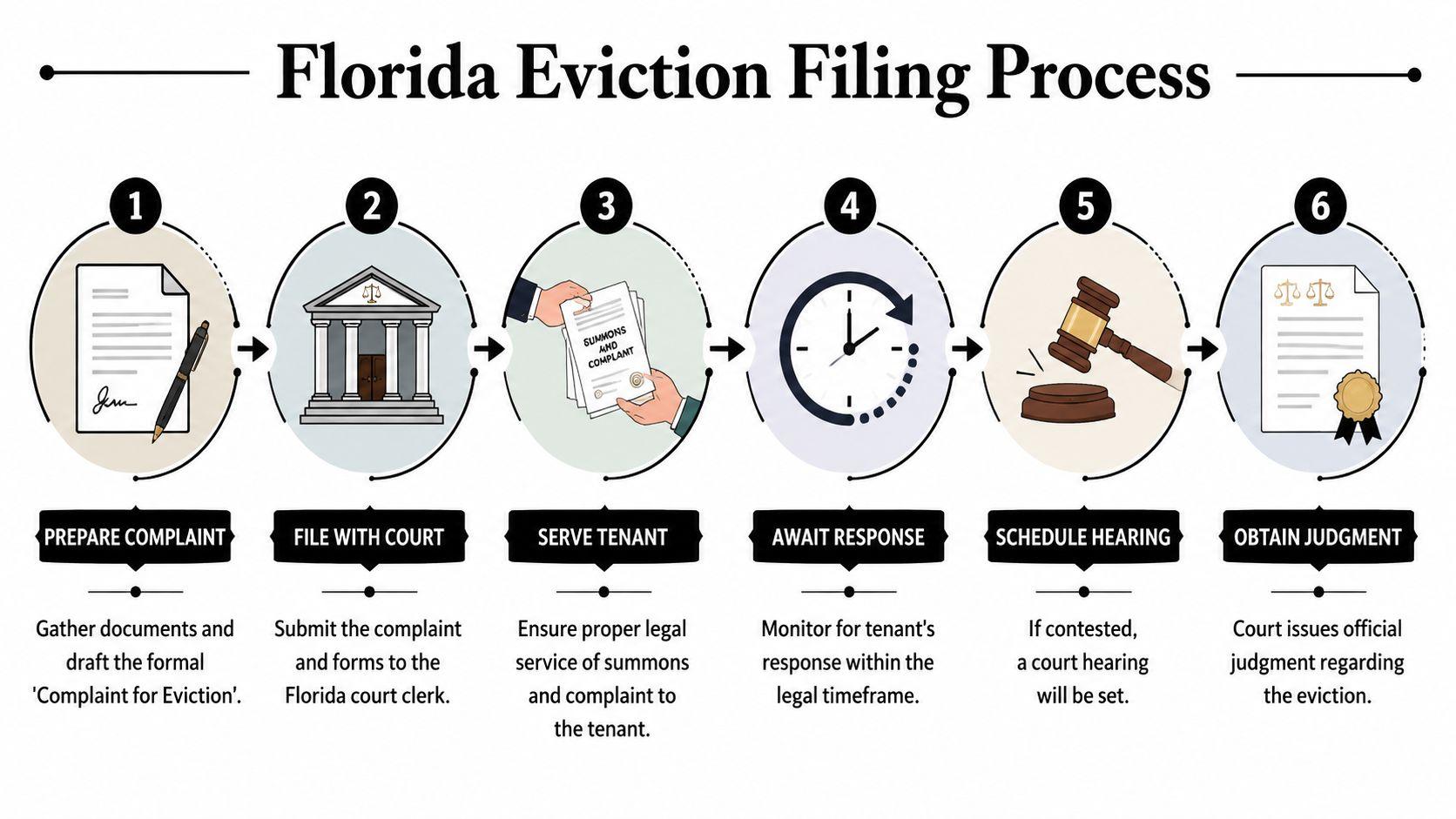
After the complaint is filed, the clerk issues the summons. The summons and complaint then have to be formally served by the sheriff or a certified process server. Landlords should not serve the lawsuit themselves.
Once service is completed, the tenant’s answer deadline starts to run. In many eviction cases, the tenant has 5 business days to respond, excluding the day of service, weekends, and legal holidays. In nonpayment cases, a tenant who wants to contest possession may also have to pay alleged rent into the court registry. That one step changes the posture of the case fast, because it often prevents an easy default and pushes the matter toward a hearing.
The filing sequence is straightforward on paper:
- Prepare the complaint package with the correct parties, notice, lease, and supporting records.
- File in the county where the property is located.
- Have a summons issued for each named defendant.
- Use lawful service through the sheriff or an authorized process server.
- Calendar the response deadline immediately and act if no answer is filed.
Where Miami-Dade and Broward landlords usually get tripped up
The mistakes are usually small and expensive. A wrong middle initial. An outdated ledger. A three-day notice that does not match the amount claimed in the complaint. An LLC owner trying to handle a filing that requires counsel. A property manager naming the wrong occupants.
I see this often with inherited problem properties in South Florida. The landlord is already behind on rent, the tenant knows the system, and every paperwork error buys the occupant more time in the unit.
Registry issues also create delay. If the tenant contests a nonpayment case and raises defenses, the court may need to sort out whether rent was properly demanded, whether payments were accepted, and whether the registry requirement was met. That is where a case stops being clerical and starts becoming a litigation problem.
Strong eviction filings are plain, organized, and hard to argue with. Every date matches. Every attachment supports the claim. Nothing gives the other side an opening.
For some owners, that business reality matters more than the legal theory. If the property is distressed, the tenant problem is only one of several problems, or you are done carrying the house through months of court procedure, selling for cash can be the better decision. In South Florida, that is not giving up. It is sometimes the cleaner exit.
From Court Hearings to Sheriff Removals
Court is the point where a slow file becomes an expensive one. In Miami-Dade and Broward, a tenant who knows how to delay can turn a basic possession case into weeks of extra carrying costs, missed rent, and more wear on the property.

If the tenant defaults
A default does not end the case by itself. The landlord still has to file for clerk’s default or court default where required, submit the final judgment package, and make sure the paperwork matches the complaint, the notice, and the rent claim.
That sounds simple. It often is not.
I have seen South Florida landlords lose time at this stage because the judgment packet had the wrong amounts, the military status affidavit was missing, or the proposed final judgment did not line up with the lease and ledger already filed. Judges notice those details. So do defense attorneys when they appear late and ask the court to set the default aside.
If the tenant contests the case
A contested hearing usually turns on documents, timing, and credibility. The landlord with organized records has the advantage. The landlord explaining dates from memory usually does not.
Bring a file that answers the judge’s next question before it is asked:
- The signed lease, renewals, or month-to-month tenancy records
- A payment ledger that matches the amount demanded
- The exact notice served, with dates
- Proof of service for the notice and the summons
- Text messages, emails, or written warnings if they support the claim
- Photos, inspection reports, or police reports if nuisance, damage, or unauthorized occupants are involved
- A short chronology of missed rent, notices, payments, and violations
South Florida cases also get messy when the occupant claims tenant status and the owner says otherwise. That line matters. A holdover tenant, a guest who never left, and a squatter can trigger different procedures. Landlords sorting out that distinction should review this guide on removing squatters in Florida under HB 621, especially if the occupancy problem does not fit a normal lease default.
Final judgment, writ of possession, and sheriff removal
If the landlord wins, the court enters final judgment for possession. After that, the landlord requests the writ of possession. The sheriff posts the 24-hour notice to vacate, then returns to restore possession if the occupants do not leave.
That last phase is where stressed owners make the worst mistake. They change locks early, cut off utilities, remove doors, or pressure the tenant to leave before the sheriff completes the writ. Florida law treats that as self-help, and self-help can create liability fast.
Let the sheriff finish the removal. Then secure the property, document its condition immediately, and follow the lease and Florida rules for any personal property left behind if they apply to your case.
For some landlords, winning in court still feels like losing on the business side. If the property has gone sideways, needs repairs, or has become a drain on cash and attention, forcing possession may not be the only rational move. In South Florida, plenty of owners decide the cleaner answer is to exit the property instead of carrying it through every final step of enforcement.
The Alternative Bypassing the Eviction Battle
Some cases are legally straightforward and still financially ugly. The tenant is behind. The property needs repairs. The case may be winnable, but the owner is already carrying insurance, taxes, HOA pressure, vacancy risk, and the possibility of additional damage before possession is restored.
When an eviction is legally correct but financially wrong
This usually happens when the rental has stopped behaving like an investment and started behaving like a liability. The landlord is spending time on notices, service, calls, hearings, contractor bids, and property checks, while the asset continues to deteriorate or underperform.
Even when the statute is on your side, there are trade-offs:
- Time drain: You still have to manage documents, deadlines, and court movement.
- Emotional drag: Tenant disputes have a way of absorbing attention for weeks.
- Property risk: Some tenants leave without notice. Others don’t.
- Operational disruption: If the long-term plan is to sell anyway, the eviction may just be one more layer before the final decision.
Why some landlords exit instead
A direct sale can make sense when the primary objective is liquidity, not another round of tenant enforcement. Owners who are tired of chasing possession often decide the better move is to sell the property as-is, even with the tenant still in place, and stop carrying the legal burden themselves.
For landlords weighing that option, this guide on selling a house with tenants is a practical starting point.
That choice isn’t surrender. It’s asset triage. When the numbers, stress, and condition of the property all point in one direction, exiting cleanly is often the more disciplined business move.
Florida Eviction FAQs
Can I keep the security deposit after an eviction
Maybe, but only if your deductions are lawful and documented. Eviction does not give a landlord a blank check against the deposit. If the tenant owes unpaid obligations or caused damage beyond ordinary wear and tear, document the condition carefully and follow Florida deposit procedures exactly. Photos, move-in records, repair invoices, and a final accounting matter.
Security deposit disputes are usually won with records, not opinions.
What if the tenant damages the property during the case
Treat that as both a possession problem and an evidence problem. Photograph the damage immediately, preserve videos, save vendor estimates, and keep all messages. If the conduct supports a non-curable violation, your notice and complaint strategy may need to reflect that. If the priority is minimizing loss instead of pursuing the tenancy any further, some landlords move toward disposition of the asset instead of continued conflict.
How do I remove unauthorized occupants or a guest who won’t leave
This is one of the most common South Florida headaches. Standard guides often oversimplify it. Florida Statute § 83.56(2)(b) can allow immediate action for illegal subletting, and a Florida landlord guide discussing unauthorized occupants notes that 28% of Miami-Dade evictions involved unauthorized occupants in 2025 and that these cases can be delayed 10 to 14 days if all parties are not properly served by summons.
That means two things in practice:
- Name and serve the right people: If multiple occupants are in possession, service problems can derail the case.
- Use proof, not suspicion: Save messages, visitor patterns, utility evidence, parking records, neighbor statements, or any lease-based proof showing occupancy beyond a temporary guest situation.
If you’re done acting like a property manager, this landlord exit option for tired owners is worth reviewing.
If you own a rental in Miami-Dade or Broward and the tenant situation has become a legal, financial, or emotional drain, Property Nation offers a clean exit. We buy Florida houses as-is, including properties with problem tenants, lease violations, damage, clutter, liens, probate issues, or pending landlord headaches. You don’t need to repair the property, clean it out, or wait for the tenancy to stabilize before exploring your options.