


A lot of South Florida landlords reach the same point the same way. A tenant is still in the property. The roof may need work. Insurance has become harder to place. An HOA or condo association is asking for records. Probate may be involved. Or the owner wants out without turning an occupied house into a months-long project.
In Miami-Dade and Broward, selling an occupied property isn't just a standard sale with an extra phone call to the tenant. It changes access, timing, underwriting, lease obligations, repair strategy, and closing logistics. Buyers want certainty. Tenants want stability. Sellers want the transaction to move without creating a legal mess.
There are usually two paths. One is the traditional route, with listing photos, scheduled showings, financing contingencies, inspection negotiations, and constant coordination with the occupant. The other is a direct sale where the buyer is prepared to take the property subject to the existing tenancy. If you're trying to buy a house with tenants or sell one without forcing vacancy first, the right path depends on the lease, the property's condition, the tenant's cooperation, and how much friction you can tolerate.
Table of Contents
- At-a-Glance Your Guide to Tenant-Occupied Sales
- The Legal Framework for Florida Tenant-Occupied Sales
- Buyer Due Diligence for Occupied Properties
- Navigating Financing and Insurance Hurdles in 2026
- Seller Strategies Traditional Sale vs Direct Cash Sale
- The Closing Process and Post-Sale Transition
- Frequently Asked Questions
At-a-Glance Your Guide to Tenant-Occupied Sales
A Miami landlord calls because the tenant pays on time, but the owner needs to sell before another insurance renewal. The property isn't vacant. The tenant works nights. The house needs deferred maintenance. The owner doesn't want conflict, and doesn't want to wait through a financed buyer's inspection process only to hear that the buyer now wants the property empty before closing.
That is a common South Florida setup.
The first path is the conventional market. You prepare the property as best you can, coordinate every showing around the tenant's schedule, disclose the occupancy and lease terms, wait for buyer feedback, and then negotiate through inspections, financing, and appraisal. That path can work well when the tenant is cooperative, the house shows cleanly, and the lease supports the buyer's plan.
The second path is a direct sale to a buyer who is willing to take the property occupied. That removes much of the theater from the process. Fewer people walk through the house. The transaction is usually document-driven. The focus shifts from staging to lease review, rent history, title, access, and a clean transfer of deposits and notices.
For many owners, the primary question isn't whether they can sell. It's how much disruption they want to absorb to get there. If you're weighing those options now, this guide on selling a house with tenants in Florida gives a useful baseline before you decide which route fits your timeline.
If you're on the buy side, the same principle applies. Buying an occupied house can be efficient when the paperwork is clean. It becomes expensive when the lease file is sloppy, the tenant was promised things off the record, or the seller can't document the deposit and payment history.
The Legal Framework for Florida Tenant-Occupied Sales
The first legal point is the one most owners and first-time investors underestimate. Selling the house doesn't erase the tenant's rights.
The lease follows the property
A buyer acquiring a tenant-occupied home inherits the existing lease and landlord obligations. The lease "runs with the land," so the new owner generally must honor the remaining term, follow local landlord-tenant law, preserve the tenant's rights, and can't unilaterally change rent or terms until the lease ends, as explained in Rocket Mortgage's discussion of buying a house with tenants.
Critical legal principle: If the lease is valid and still in force, the closing doesn't wipe it out. The buyer steps into the landlord's position.
In practice, that means the contract package matters more than many sellers think. You need the current lease, every signed renewal, every addendum, records of concessions, notices previously served, and anything that affects possession, pets, parking, maintenance, or appliances. If you're reviewing forms and trying to confirm what should be in the file, this lease agreement guide for property owners is a useful reference point.
A lot of disputes start because someone relied on a summary instead of the signed document. In Miami-Dade and Broward, that mistake gets expensive fast when an occupant claims a renewal option, a repair promise, or an occupancy right that the buyer never underwrote.
Access, notice, and day-to-day boundaries
Florida landlords do have rights of access, but a sale doesn't create unlimited entry. Showings, inspections, appraisals, insurance inspections, and contractor visits should be handled carefully and consistently with the lease and Florida landlord-tenant rules. A cooperative tenant can make a transaction smooth. An angry tenant can slow every step without technically blocking the sale.
The practical rule is simple:
- Set access expectations early: Don't wait until the property is under contract to explain how showings or inspections will work.
- Keep requests specific: Give clear time windows and identify who is coming.
- Document everything: Email and text logs matter when disputes arise over notice or missed access.
- Don't use the sale as a backdoor eviction tactic: If vacancy is your objective, handle that lawfully and separately.
If the tenancy is already deteriorating, owners should understand the proper legal process before trying to pressure the tenancy situation through the sales process. This guide on how to evict a tenant in Florida is a better starting point than improvising.
Security deposits and successor landlord duties
Security deposits are not a side issue. They have to be accounted for cleanly at closing. The seller should confirm the amount held, where it's held, whether any lawful claims are pending, and how the transfer will be reflected in the closing package.
The cleanest tenant-occupied closings are boring. Every lease document is signed, the deposit amount matches the ledger, and the tenant gets clear written instructions after closing.
In South Florida, I also tell buyers to check the property against county realities, not just state law. Miami-Dade and Broward deals often involve association approvals, municipal inspection histories, open permits, or code issues that affect an occupied transfer even when the lease itself is valid. The legal side of buying a house with tenants isn't hard when the paper trail is organized. It becomes difficult when everyone assumes the closing agent will sort it out later.
Buyer Due Diligence for Occupied Properties
Buying a house with tenants means you're purchasing two things at once. You are buying real estate, and you are buying an existing operating arrangement. If you underwrite only the house and ignore the tenancy, you're missing half the deal.

Documents that matter before you go hard on the deal
Avail notes a practical acquisition workflow: verify the active lease, collect rent-payment receipts and tenant credit reports, confirm the security-deposit transfer, and perform a professional inspection and title check for liens or covenants in its guide on buying or selling a rental property with current tenants.
That checklist is the baseline, not the ceiling.
Request these items before your inspection period expires:
- The full lease file: Current lease, prior renewals, addenda, notices, and any written side agreements.
- A rent ledger you can follow: Not just screenshots of a payment app. You want a ledger that shows dates, amounts, and whether partial payments were accepted.
- Deposit backup: Proof of the actual security deposit collected and any pet deposit or prepaid rent.
- Tenant estoppel certificate: The tenant confirms the rent, deposit, term, and any claims of landlord default.
- Open issue disclosures: Repairs promised, insurance claims, code cases, HOA disputes, or maintenance problems that may carry over.
A verbal "tenant is great" means nothing without records. A quiet file is often a strong file. A messy file usually signals a messy takeover.
What inspections should uncover
A tenant-occupied inspection isn't the same as walking a vacant flip. Occupants may be storing furniture against walls, hiding leaks with rugs, or living in a way that limits visibility. You still need a professional inspection, and you should pair it with permit and title research.
This is also where South Florida judgment matters. In Miami-Dade and Broward, insurance carriers care about roofs, plumbing, electrical systems, water intrusion history, and condition issues that affect habitability and underwriting. If you want a practical pre-inspection primer, these 7 home inspection red flags are a useful reminder of the kinds of defects buyers shouldn't gloss over.
After the initial document review, it helps to hear another investor-oriented breakdown of occupied acquisitions:
The tenant file is part of the asset
The best occupied deals have predictable tenants and clear boundaries. The worst ones come with undocumented concessions, chronic late payments that were never enforced, or personal arrangements between seller and tenant that don't appear anywhere in writing.
Buy the paper before you buy the property.
Buyers should also ask one uncomfortable question directly. Is the tenant functioning as a stable occupant, or has the seller stopped enforcing the lease? Those are very different risk profiles. If the property already has recurring payment problems or conduct issues, this overview of ways to deal with problem tenants is worth reading before you assume the income stream is reliable.
In occupied acquisitions, optimism is expensive. Documentation is what keeps the deal real.
Navigating Financing and Insurance Hurdles in 2026
A tenant-occupied property can make sense on paper and still fail in underwriting. In South Florida, financing and insurance often prove to be the gatekeepers.
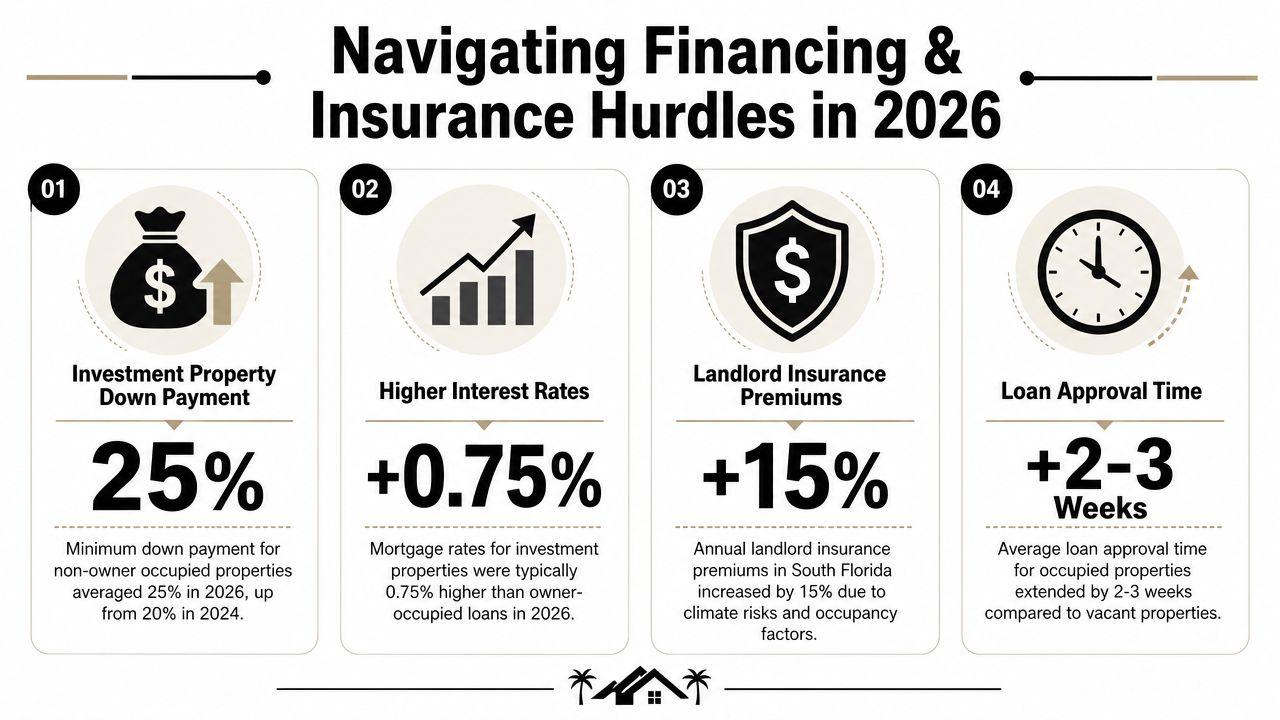
How lenders look at occupancy intent
Lenders don't just ask what you're buying. They ask how you intend to hold it after closing. If you're buying a house with tenants and plan to keep it as a rental, the loan file will usually be treated differently than a primary residence purchase. If you intend to occupy the home later, the existing lease and possession timeline matter because they affect when you can realistically move in.
That distinction matters because occupied single-family rentals aren't a niche corner of the market. By 2021, the United States had 14.3 million single-family renter households, representing about 33% of all renters, according to the Joint Center for Housing Studies of Harvard University's overview of investor activity in the single-family rental market.
In practical underwriting, lenders often want consistency between the contract, lease, rent roll, insurance quote, and borrower intent. If one document says owner-occupant, another shows a fixed-term lease in place, and the insurer is quoting landlord coverage, the file can stall.
Why insurance can derail an otherwise good deal
Insurance is where many South Florida deals get shaky. Miami-Dade and Broward carriers scrutinize condition, prior claims, roof age, wind exposure, water damage history, and occupancy type. An occupied property with deferred maintenance can be harder to insure than a clean vacant home that will be renovated immediately.
That is especially true when the tenant's housekeeping habits have masked leaks, mold conditions, or unauthorized alterations. Insurers don't care that the rent is current if the property condition doesn't meet their standards.
A few practical moves help:
- Order the insurance quote early: Don't wait until the last week before closing.
- Match the intended use: The policy type should fit the post-closing occupancy.
- Review loss history and repairs: Ask what was claimed and what was fixed.
- Check tenant insurance requirements: If the lease requires tenant coverage, confirm whether the tenant complied.
For landlords inheriting an occupied unit with a high-friction tenant profile, resources on how to find renters insurance with bad credit can help frame what compliance conversations may look like after closing.
The same market conditions that support rental demand also keep investors interested in occupied stock. SmartMove notes that in 2024, 34% of Americans rented their homes, and renters spent about 29.1% of household income on rent, according to its summary of rental statistics for landlords. That demand is real. But demand alone won't save a file if the lender or carrier can't get comfortable.
If you're evaluating whether financing risk is worth absorbing, it's useful to understand how a cash offer on a house changes the equation on occupied transactions.
Seller Strategies Traditional Sale vs Direct Cash Sale
For sellers, the central decision is not legal. It's strategic. Do you expose the property to the open market and accept the friction that comes with an occupied listing, or do you choose a direct sale built around certainty and reduced tenant disruption?
When a traditional listing still makes sense
A traditional MLS listing can work well when the tenant is cooperative, the lease terms are easy to explain, the property is insurable, and the condition supports financed offers. If the occupant keeps the house clean, allows showings, and the buyer pool includes investors looking for immediate rental income, the listing path can produce strong interest.
That matters because rentals remain a large part of the housing market. SmartMove, citing broader rental market data, notes that the rental market has remained historically strong, including 36.6% of U.S. households renting, described as more than at any point in 50 years, and also reports that 22.4 million U.S. households spent more than 30% of income on rent while 12.1 million spent more than 50% in its roundup of rental statistics landlords should know.
Still, the traditional route asks more from everyone involved. Tenants must tolerate access. Sellers must manage scheduling and condition. Buyers may ask for vacancy, credits, or post-inspection concessions once they see how the property has been maintained.
When a direct occupied sale solves the bigger problem
A direct sale is often the cleaner choice when the property has tenant friction, deferred repairs, insurance concerns, title complications, probate overlap, HOA headaches, or a landlord who doesn't want a public listing process.
This route usually works best when the seller values these outcomes:
- Certainty over exposure: Fewer moving parts, fewer strangers in the unit, fewer failed contracts.
- As-is execution: No drawn-out repair punch list tied to a lender or appraiser.
- Reduced tenant conflict: Less disruption than repeated showings and re-showings.
- Control over timing: The closing can be structured around the lease, rent cycle, and possession realities.
Here is the practical side-by-side comparison.
| Factor | Traditional MLS Listing | Direct Cash Sale (Property Nation) |
|---|---|---|
| Marketing process | Photos, listing prep, showings, agent coordination | Private review and direct offer |
| Tenant involvement | Usually high. Repeated access requests and scheduling | Usually lower. Limited walkthroughs and document review |
| Repair pressure | Buyers often request repairs or credits | Often sold as-is |
| Financing risk | Present. Appraisal, underwriting, insurance, and loan delays can affect closing | Lower when buyer is not relying on institutional financing |
| Speed to closing | Less predictable | More predictable |
| Best fit | Cooperative tenant, strong condition, broad investor appeal | Tenant issues, deferred maintenance, legal complexity, or seller needs certainty |
A seller should also be realistic about what doesn't work. Trying to hide the occupancy, downplay lease terms, or promise vacancy you can't legally deliver usually kills deals late. So does starting on the MLS when the tenant refuses access and then acting surprised when buyers lose confidence.
The best strategy is the one that matches the file in front of you, not the ideal version of it.
The Closing Process and Post-Sale Transition
The final stage should be administrative, not dramatic. If the legal work and due diligence were handled correctly, closing an occupied property is mostly about transferring money, documents, and responsibility in the right order.

What gets transferred at closing
The buyer should receive the executed lease file, tenant ledger, deposit records, keys, access codes, association contact information, and any pending maintenance history. The closing statement should also address rent proration so that income is allocated properly between seller and buyer based on the closing date.
In South Florida, I also want to see a clean handoff of practical control items. That includes gate transponders, HOA application records if relevant, alarm details, utility information, and contractor contacts for any unresolved repairs the tenant already reported.
A short closing checklist helps:
- Confirm rent proration: Make sure the settlement statement reflects it correctly.
- Transfer deposit liability clearly: The amount should match the lease file and tenant ledger.
- Assign leases and addenda: Don't leave side documents behind.
- Update management contacts: The tenant needs the right rent address and maintenance contact immediately.
What the tenant should receive right after closing
The tenant should get prompt written notice of the ownership change, instructions on where to send future rent, and who handles maintenance going forward. Keep that notice direct and professional. This is not the moment for a long legal memo or a rent renegotiation attempt.
A smooth post-sale transition starts with one clear message to the tenant. Who owns the property now, where rent goes, and who to call for repairs.
If the property is in Miami-Dade or Broward and subject to association rules, the new owner should also make sure the association's records are updated without delay. Occupied properties often run into avoidable problems when the front gate, parking access, or management roster still points to the old owner weeks after closing.
Frequently Asked Questions
Can you sell a house with a month-to-month tenant in Florida?
Yes, but flexibility depends on proper notice and the actual occupancy facts. Month-to-month arrangements are usually easier to manage than fixed-term leases, but sellers still need to handle notice correctly and avoid informal promises that create confusion before closing.
Should a seller offer the property to the current tenant first?
Sometimes that is the cleanest solution. It can reduce access disputes and preserve occupancy stability. There is also growing policy interest in tenant purchase rights. Shelterforce reports that emerging TOPA and COPA discussions are giving tenants or nonprofits the first opportunity to buy in some markets, and that trend can influence negotiations even where formal local laws don't apply.
Can a buyer require the property to be vacant before closing?
Yes, if that term is written into the contract and the seller can legally deliver vacancy. The issue is not what the buyer wants. The issue is whether the lease and the facts support that promise.
Are Miami-Dade and Broward sales treated differently in practice?
Yes. County and municipal realities often affect timing, inspections, association compliance, and property records. The lease may be statewide in concept, but the transaction burden is often local.
If you need to sell an occupied property in Miami-Dade or Broward without listing it, coordinating repeated showings, or forcing repairs before closing, Property Nation offers a direct cash sale option built for complicated Florida situations, including tenant-occupied homes, probate properties, liens, and as-is houses.