


The letter usually hits at the worst time. You open a notice from the county, see the word delinquent, and your stomach drops. If the property is inherited, vacant, tied up in probate, or shared with family members who won't return calls, the stress gets worse fast.
In South Florida, back taxes on property are not a casual late bill. They trigger a legal process that can end in a forced sale if you wait too long. That matters in Miami-Dade and Broward, where rising values often mean owners have real equity to protect and a real risk of losing it through inaction.
This guide is written for the owner who needs a straight answer. If you're behind, the first priority is simple: verify the exact amount due, understand your deadline, and stop treating this like a paperwork problem. It's a title problem.
Table of Contents
- At-a-Glance Your Guide to Navigating Back Property Taxes
- The Florida Property Tax Delinquency Process Explained
- Understanding the Consequences Tax Deeds and Foreclosure
- Your Options for Resolving Back Property Taxes
- A Step-by-Step Action Plan for Homeowners
- Special Situations Inherited Property and Co-Owner Disputes
- Local Resources and Contacts
- Frequently Asked Questions About Back Property Taxes
- Can I stop the process at the last minute?
- Will my mortgage protect me from losing the house?
- I live out of state. Can the county still move forward if I missed notices?
- What if my sibling refuses to help pay taxes on an inherited house?
- Is a tax certificate sale the same as losing the property?
- Should I keep the property at all costs?
At-a-Glance Your Guide to Navigating Back Property Taxes
If you own a home in Miami-Dade or Broward and you missed the property tax deadline, the clock is already running. In both Broward and Miami-Dade counties, property taxes officially become delinquent on April 1 of the year following the assessment, meaning unpaid 2025 taxes become delinquent on April 1, 2026, according to the Broward County delinquent tax FAQ.
That date matters because once taxes become delinquent, this stops being a routine billing issue. The county can move into lien enforcement. If the property is your homestead, a rental, or an inherited house stuck between heirs, the legal consequences are the same. The tax debt attaches to the property.
What back taxes on property really mean
Back taxes on property are unpaid real estate taxes that have crossed into delinquency and entered the county collection system. In practical terms, that means:
- The balance is no longer just overdue: It has legal consequences tied directly to title.
- Your equity is at risk: Any future sale, refinance, or probate transfer has to deal with the lien.
- Delay gets expensive: Fees, penalties, and procedural steps don't pause because the owner is overwhelmed.
South Florida owners often make one costly mistake. They assume they can fix the issue later, during a sale or after probate clears. Sometimes that works. Often it doesn't, especially when multiple people need to sign off or the property has other title issues.
Practical rule: Treat a delinquency notice like a pre-foreclosure warning, not a reminder.
What you need to focus on right now
You don't need to master tax law in a day. You need to understand the parts that can cost you the house.
Here are the pressure points:
- The delinquency date matters because Florida law starts a formal collection path.
- The tax certificate sale matters because a third party can buy the right to collect the debt.
- The tax deed process matters because it can lead to a public auction of the property itself.
- Your resolution options matter because not every owner should pursue the same fix.
- Inherited property disputes matter because co-owner conflict does not stop county enforcement.
Nationally, the problem is large. As of 2026, the United States has over 3.9 million tax-delinquent properties across 220 counties in 22 states, with a combined estimated value of $1.6 trillion. The average tax-delinquent property owes approximately $10,000 in back taxes against an estimated market value of $450,000, and Florida leads the nation with 484,102 delinquent properties, according to Lien Suite's 2026 tax delinquency statistics. That should tell you two things. This problem is common, and waiting is dangerous.
The Florida Property Tax Delinquency Process Explained
Florida's system is technical, fast-moving, and unforgiving if you ignore official notices. Once the taxes cross into delinquency, the county doesn't need a personal dispute, a family agreement, or a probate resolution to move forward.

What delinquent means in Florida
In Florida, all unpaid real estate taxes automatically become delinquent on April 1, triggering an immediate statutory 3% penalty. This allows the county tax collector to begin selling tax certificates to investors, initiating a foreclosure pathway, as explained by Florida Tax Sale Service's delinquency summary.
That 3% charge is not optional. The county tax collector doesn't waive it because the owner was traveling, the mail went to the wrong address, or siblings were fighting over an inherited house. In Miami-Dade, the tax collector can begin the tax certificate process after delinquency. The officeholder handling that system is Dariel Fernandez, and owners should understand that the process is administrative, not emotional.
A lot of owners confuse tax delinquency with mortgage delinquency. They are different systems. If you want a separate overview of how missed payments can place real estate at risk more broadly, this guide to the Florida foreclosure process helps put the title and enforcement issues in context.
How a tax certificate sale works
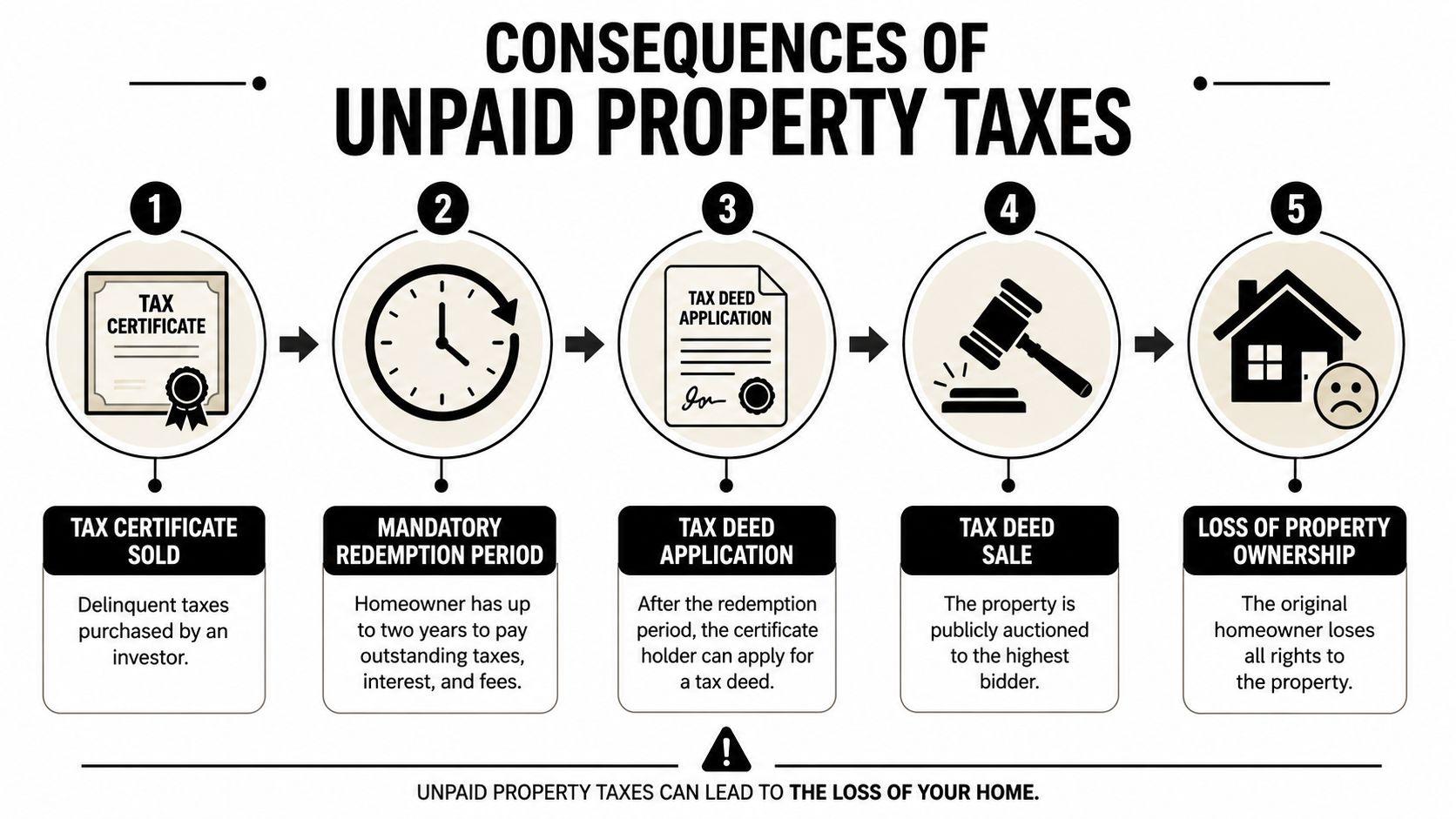
A tax lien arises from the unpaid taxes. The county then sells a tax certificate, which is not the house itself. It is the right tied to the delinquent tax debt.
Here's the clean version of the sequence:
- April 1: Taxes become delinquent and the statutory penalty applies.
- County enforcement begins: The property is treated as tax-delinquent collateral.
- Tax certificate sale: Investors bid to purchase the certificate tied to the unpaid taxes.
- Owner redemption remains possible: The owner can still cure the delinquency by paying what is required under the process.
Owners often relax too early at this stage because they hear, “Your home wasn't sold.” That's technically true, but it misses the point. The certificate sale is the gateway event that puts your property on a legal track toward a forced sale if the debt remains unresolved.
The tax certificate stage is your warning shot. It is not the end of the process. It is the point where private investors enter the file.
Why this process feels harsher in South Florida
In Miami-Dade and Broward, owners often have tangled title issues. Probate is common. So are vacant inherited homes, absentee owners, and family splits over whether to keep, rent, or sell. The county process doesn't slow down for any of that.
That's why the right question isn't “How did this happen?” The right question is “Has the certificate already sold, and what exact amount clears it today?”
Understanding the Consequences Tax Deeds and Foreclosure
You inherit a house in Miami-Dade with your brother and sister. Nobody opens the tax bill. Nobody agrees on whether to sell, rent, or keep it. Then the county file reaches the tax deed stage, and the family argument stops being the main problem. The property itself is now exposed to a forced public sale.
The redemption window closes faster than families expect
Florida law gives owners time to redeem before a tax deed application can be filed, and Cobb Cole's discussion of Florida property tax loss timelines explains that timeline in plain English. That deadline is long enough for a disciplined owner. It is short enough to trap families dealing with probate, title defects, vacant homes, and co-owner deadlock.
This is the pattern I see in South Florida. One heir assumes another heir paid the taxes. A personal representative is never formally appointed. One co-owner refuses to contribute unless the house is sold. Meanwhile, Miami-Dade or Broward keeps processing the file. The county does not pause enforcement because siblings are fighting or because probate is still unfinished.
Act early. Waiting for everyone to agree is how inherited property gets lost.
If you're dealing with inherited real estate outside Florida too, this article on handling Texas real estate probate is useful because it shows how tax liens complicate estate administration even when state procedures differ.
Tax liens outrank almost everything else on title
Unpaid property taxes create one of the strongest liens attached to real estate. The Florida Department of Revenue explains the tax certificate and tax deed process, including how delinquent taxes are enforced through sale procedures tied to the property itself, in its property tax oversight materials. In practice, that priority is why a mortgage, family dispute, or informal probate arrangement will not protect the house from a tax deed sale.
That point matters if you plan to refinance, transfer the property to heirs, or list it for sale. Buyers, title companies, and lenders treat unresolved tax debt as a serious title problem. If you need a practical explanation of how that affects a closing, read this guide on selling a house with a lien on it before closing.
A co-owner also cannot safely assume, “I only own half, so only half is at risk.” The tax problem attaches to the property, not to one heir's preferred share of responsibility.
What a tax deed case looks like near the end
Once a tax deed application is filed and the sale process starts, your room to fix the problem gets smaller and more expensive. Costs build. Notice issues become urgent. Family members who ignored the file suddenly want control, and they often show up too late.
If the property is inherited, get probate counsel involved at the same time you confirm the payoff with the tax collector. If co-owners are fighting, force the issue now. Either one owner advances the money and documents the contribution claim, or the family agrees to a sale before the county sells it for them.
That is the hard truth. Tax deed cases reward speed, paperwork, and cash. They punish delay.
Your Options for Resolving Back Property Taxes
Panic leads owners into bad choices. Strategy gets better results. You generally have three paths: work the issue directly with the county, raise money to pay it off, or sell the property before the situation worsens.
Comparison of Options for Resolving Back Property Taxes
| Option | Speed | Certainty of Success | Associated Costs | Best For |
|---|---|---|---|---|
| Contact the county tax collector and ask about available payment or procedural options | Moderate | Depends on your balance, timing, and status in the process | Taxes due, penalties, interest, and any required fees | Owners with enough income or cash flow to cure the debt |
| Challenge the assessment or review whether there is a legitimate valuation dispute | Slow to moderate | Limited, and only useful if there is a real basis to dispute value or process | Professional fees may apply, plus the tax issue still needs active management | Owners with a credible assessment issue, not owners simply behind on payments |
| Borrow, refinance, or use other financing to pay the delinquent taxes | Moderate | Depends on credit, equity, title condition, and lender requirements | Loan costs, interest, underwriting conditions, and possible delay | Owners with clean enough title and enough time |
| Sell through a traditional listing | Slow and uncertain | Lower when the property has title issues, probate complications, condition problems, or uncooperative heirs | Agent commissions, carrying costs, repairs, cleanup, and closing delays | Owners with time, cooperation, and a market-ready property |
| Sell the property as-is for cash | Fast | Higher when the goal is certainty, speed, and title resolution | Usually fewer transaction frictions, but the owner should still compare net proceeds carefully | Owners facing deadlines, inherited property disputes, liens, vacancy, or distress |
How to choose the least damaging path
Not every solution fits every file. If the balance is manageable and the title is clean, paying the debt directly is usually the simplest fix. If the property is tied up in probate or family conflict, simplicity disappears.
Assessment disputes can matter, but owners misuse them all the time. They file or threaten a challenge when the problem is nonpayment. If you think the tax value itself is wrong, this article on understanding property tax disputes gives a useful legal lens for separating a real assessment issue from a cash-flow problem.
Use these filters:
- Choose the county route if you can realistically cure the debt without creating another crisis next month.
- Choose financing if you have time, a cooperative lender, and title that won't collapse underwriting.
- Choose a sale if the lien is only one problem among many, especially with inherited houses, vacant homes, HOA issues, or deferred maintenance.
The wrong move is pretending every property deserves to be saved at any cost. Sometimes the smartest decision is to preserve your remaining equity and exit cleanly.
A Step-by-Step Action Plan for Homeowners
Your father's house in Miami-Dade is still in probate. Your sister wants to keep it. Your brother stopped returning calls. The tax bill did not pause for any of that. If you wait for the family to agree, the county process keeps advancing.
Start with verification, not assumptions
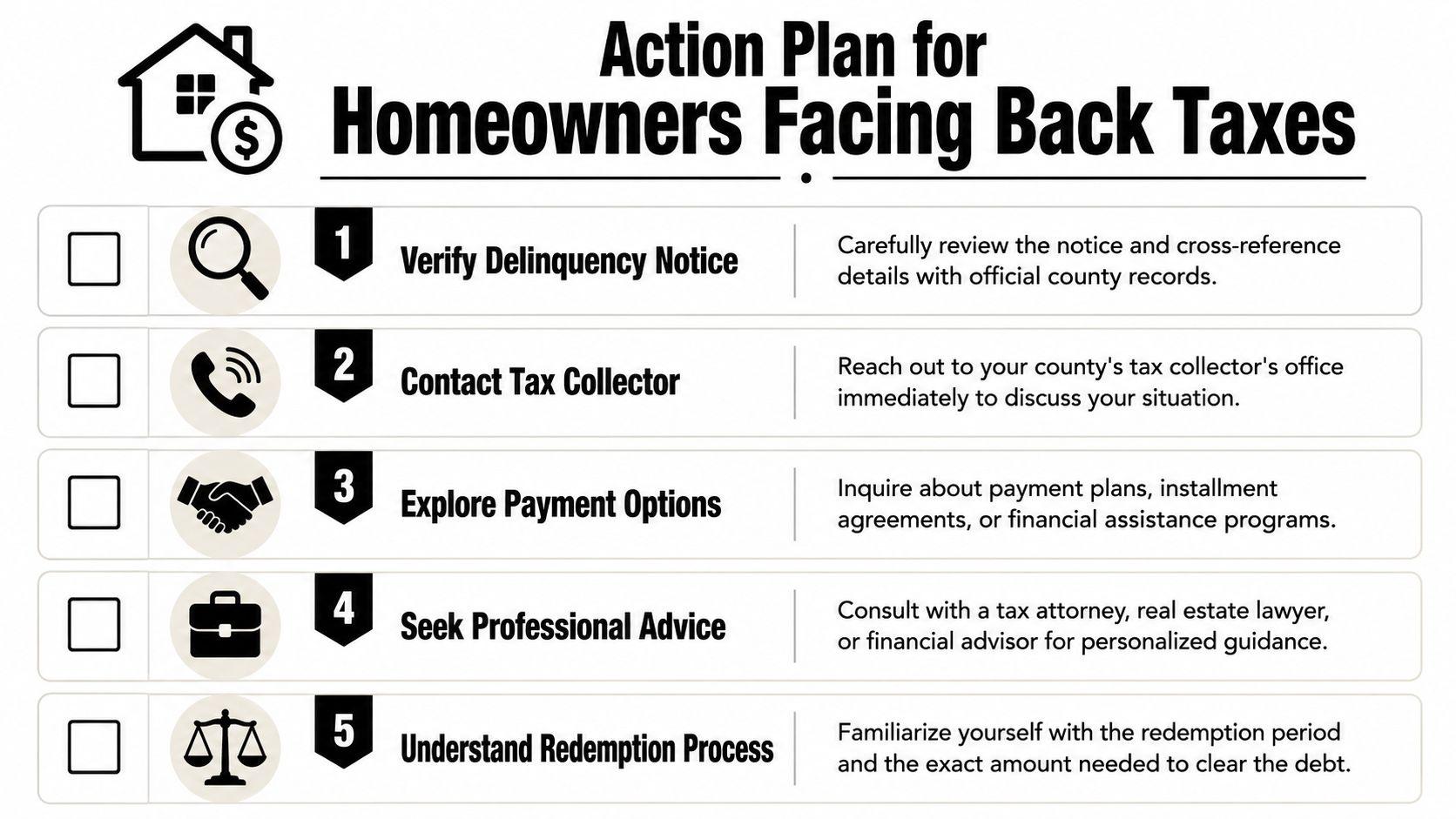
Start by pinning down the file. Inherited properties and jointly owned homes go sideways because people work from old bills, bad mail, and someone's memory of what was owed six months ago.
Get the exact payoff from the county. Contact the Miami-Dade or Broward tax collector and ask for the current amount due. Ask for the live payoff, including interest, fees, and any tax certificate activity.
Confirm the case stage. Find out whether the taxes are delinquent, whether tax certificates were sold, and whether a tax deed application has already been filed. Those are very different positions, with very different timelines.
Audit the ownership record. Check the owner name, folio or parcel number, mailing address, and legal description against the county record. In inherited property cases, this step matters more than people think. Notices often go to a deceased owner's old address, while heirs assume someone else is handling it.
Pull the probate and title status. If the property came through an estate, find out whether probate is open, whether a personal representative has authority to act, and whether all heirs agree. If there are co-owners, identify who has legal authority to sign, pay, or sell.
Immediate priority: Get the county payoff and case status in writing, or from the official online account, before you spend money or make promises to family members.
Choose the fastest realistic solution
Once you know the amount and the deadline, make a decision based on math and authority, not emotion.
- Pay it now if the amount is manageable and the title issues will not block the payment.
- Use short-term financing only if you can carry it without creating a second crisis.
- Push for a sale if the house also has probate friction, vacant-property risk, insurance problems, code violations, HOA debt, or repair issues.
- Force a co-owner conversation immediately if one heir is stalling. Delay by one person can sink the whole file.
Florida gives property taxes unusual power. As noted earlier, unpaid property tax claims sit ahead of most other liens in practical terms, which is why owners can lose control of the property faster than they expect. A mortgage balance does not protect you. Family equity does not protect you either.
Put one person in charge
A file with five decision-makers usually behaves like a file with none.
Choose one person to gather records, speak with the county, and track deadlines. For an inherited house, that is often the personal representative, a trustee, or the heir who is willing to do the work. If nobody has clear legal authority yet, get probate counsel involved at once. Do not let a cousin, sibling, or informal caretaker “handle it” without documents.
Use a short task list and assign names:
- county payoff request
- tax certificate and tax deed status check
- probate status check
- title review
- funding plan
- sale decision, if payment is not realistic
Act this week
Time kills options. If the debt can be cured, cure it. If it cannot, line up funding or list the property for sale before the file gets tighter and buyers get scarcer.
The worst approach is waiting for perfect agreement among heirs or co-owners. In Miami-Dade and Broward, inherited homes often sit vacant while relatives argue over sentimental value, reimbursement, or who should pay first. The county does not stop because the family is stuck. Act within days, not weeks.
Special Situations Inherited Property and Co-Owner Disputes
Inherited property is where back taxes on property become especially dangerous. The house may be vacant. Insurance may have changed. The probate case may still be open. Meanwhile, the county keeps billing the property, not the family drama.
Why inherited homes fall behind
A common South Florida file looks like this: a parent dies, one sibling lives nearby, another lives out of state, and nobody agrees on whether to keep the property. Mail still goes to an old address. Utilities stay on. The house sits. Taxes go unpaid.
That scenario is not rare, and it's more vulnerable than most owners realize. Tax foreclosures disproportionately impact heirs managing inherited homes, and tax offices can enforce collection against just one co-owner for the full amount, according to Local Housing Solutions' discussion of tax-delinquent property enforcement and heirs.
The tax collector is not required to settle disputes between heirs. The county's concern is payment.
When one heir gets stuck with the whole problem
This is the part most online guides skip. If several heirs or co-owners share responsibility, the county can still pursue the full tax debt against the property and effectively force one person to deal with it. That person may later seek reimbursement from the others privately, but that private fight doesn't stop tax enforcement.
That creates ugly outcomes:
- One heir pays everything to stop a sale and then has to chase siblings for contribution.
- Nobody pays because each person expects someone else to handle it.
- The property can't be sold easily because signatures, probate authority, or title corrections are still incomplete.
- A vacant house keeps deteriorating while the legal mess grows.
If your situation involves multiple heirs, this overview of selling inherited property with multiple owners is a practical next read because co-owner friction usually affects title strategy more than people expect.
One cooperative heir is enough to start solving the problem. One difficult heir is enough to make delay dangerous.
In Miami-Dade and Broward, inherited homes often carry stacked problems. Taxes are only one of them. Insurance gaps, HOA balances, old permits, or occupancy questions can all sit on the same file. If you're the executor or the sibling doing all the work, stop waiting for unanimous enthusiasm. Push for a decision while there is still equity to protect.
Local Resources and Contacts
When you're behind on property taxes, official county information matters more than secondhand advice from relatives, tenants, or neighbors. Start with the public offices that control the tax record and the property record.
Miami-Dade contacts
- Miami-Dade Tax Collector: Dariel Fernandez's office handles tax collection and delinquency administration. Use the Miami-Dade Tax Collector website to review payment information and account status.
- Miami-Dade Property Appraiser: Use the Miami-Dade Property Appraiser website to verify folio information, ownership data, and assessed value details.
- Miami-Dade County official site: The broader Miami-Dade County portal is useful for navigating related departments if your file also involves probate, code, or records issues.
Broward contacts
- Broward County Records, Taxes and Treasury Division: Start with the Broward County tax and treasury site for delinquency and payment information.
- Broward County Property Appraiser: Use the Broward Property Appraiser website to confirm parcel details and assessment records.
- Broward County official site: The Broward County portal can help with related county services.
State and practical guidance
- Florida legal reference: For a plain-language discussion of the tax timeline and redemption period, review the earlier-cited county and legal materials in this guide.
- Practical local help: If your issue also involves a sale because you're behind on taxes, this South Florida resource on selling when you're behind on taxes may help you weigh next steps.
Frequently Asked Questions About Back Property Taxes
Can I stop the process at the last minute?
Sometimes, yes. But “last minute” is a terrible strategy. If the file is still in a redeemable stage, payment of the required amount can stop further action. The problem is that owners often wait until they're also dealing with title defects, missing heirs, or funding issues.
Will my mortgage protect me from losing the house?
No. A mortgage does not make the tax problem disappear. Tax liens have stronger priority than most other encumbrances, which is exactly why lenders pay close attention when taxes go unpaid.
I live out of state. Can the county still move forward if I missed notices?
Yes. Snowbird status, rental status, and out-of-state ownership do not freeze the county process. If the mailing address on file is old or notices were ignored, the legal risk remains with the property.
What if my sibling refuses to help pay taxes on an inherited house?
The county doesn't have to wait for family agreement. In inherited property cases, one co-owner may end up carrying the immediate burden of resolving the delinquency and then pursuing reimbursement separately.
Is a tax certificate sale the same as losing the property?
No. It is not the same event. But it is the event owners underestimate most. Once the certificate is sold, the file is on a path that can lead to a tax deed application and public sale if the debt is not cured.
Should I keep the property at all costs?
No. Keep it only if you can do so without making the overall situation worse. If the house has back taxes, probate delays, insurance trouble, condition issues, and family conflict, preserving equity through a timely sale may be the smarter financial decision.
If you're dealing with back taxes on property in Miami-Dade or Broward and need a fast, realistic exit, Property Nation can help you evaluate the property, understand what has to be cleared at closing, and decide whether an as-is cash sale makes sense before the county process gets worse.