


You need to sell, but the calendar says wait. In South Florida, that advice can cost real money.
A homeowner in Miami-Dade or Broward might be carrying a property that already feels heavier every month. Insurance keeps climbing. The HOA is talking about another assessment. The roof is aging. The probate file is still moving through court. The market may still have buyers, but the property itself is becoming more expensive to hold than most owners expected.
That is the problem behind the worst time to sell a house. It isn't just October, January, or hurricane season. It's the moment your holding costs, legal exposure, and property-specific risks start eating more equity than you could reasonably gain by waiting.
This guide looks at the hard math, not generic seasonality. It treats timing the way investors in Miami-Dade and Broward do. A sale is a risk-management decision. If waiting creates more monthly loss, more repair risk, or more legal friction, then waiting is the expensive option.
Table of Contents
- At a Glance Navigating South Florida's Selling Seasons
- National Selling Seasons vs South Florida Reality
- Four Financial Headwinds Defining Your Personal Worst Time
- Evaluating Your Property in Miami-Dade and Broward
- Comparing Your Three Paths A Strategic Breakdown
- The Probate and Inherited Property Timing Trap
- Conclusion Making the Financially Sound Decision
- Frequently Asked Questions
At a Glance Navigating South Florida's Selling Seasons
If you're asking about the worst time to sell a house, you're usually not asking out of curiosity. You're asking because something changed. A job transfer hit. A family member passed away. A tenant stopped paying. Your insurer renewed at a number that doesn't make sense anymore. The HOA sent a notice that turned "maybe later" into "I need a plan now."
In Miami-Dade and Broward, the wrong way to make this decision is to rely on a national headline about spring being best and winter being worst. The better way is to calculate what waiting costs you. That means looking at insurance, taxes, HOA dues, special assessments, vacancy exposure, maintenance, and any legal timeline attached to the property.
Practical rule: The worst time to sell is when the property stops acting like an asset and starts acting like a liability.
That distinction matters more in 2026 South Florida than it did a few years ago. A house in Westchester, a condo in Hallandale Beach, and an inherited home in Hollywood all face different pressure points. One seller is worried about retail pricing. Another is worried about underwriting, condo financing, or a vacant-property insurance issue. Those aren't the same problem, so they shouldn't get the same advice.
National Selling Seasons vs South Florida Reality
National seasonality is real. It just isn't the whole story.
What national timing data actually shows
Bankrate's summary of ATTOM data found that homes sold nationally in May earned a 13.1% seller premium, while October was the weakest month at 8.8%, a 4.3 percentage point gap, and both September and November came in at 9.5% in the same seasonal slowdown (Bankrate's housing timing analysis). That is a meaningful spread. It shows why sellers who miss peak demand often feel the difference in price.
FastExpert adds a second signal. It reports that January is often the worst month to sell, with the lowest sale prices and fewest total sales, while homes listed in April can sell a full week faster and receive nearly 18% more views (FastExpert's month-by-month selling analysis). If you want a broader consumer-facing read on seasonal home selling trends, that framework helps explain why weak timing hurts both price and buyer activity.
The national takeaway is simple. Weak months don't just lower pricing power. They usually shrink attention, reduce urgency, and lengthen the sale.
Why Miami-Dade and Broward don't always follow the same script
South Florida doesn't freeze. Buyers can tour homes year-round. Lawns stay green. Waterfront and coastal demand doesn't disappear because the school calendar changes. Miami-Dade also attracts relocation buyers, international capital, and cash buyers who don't always behave like financed suburban family buyers in colder markets.
That doesn't mean seasonality vanishes. It means the penalty often shifts from pure calendar timing to property-specific friction. In Broward, an aging condo with budget pressure can struggle even when buyer traffic is active. In Miami-Dade, a clean single-family house in a strong school zone may still sell well outside the classic spring peak because the local buyer pool is different.
National timing data gives you a baseline. Local inventory, financing conditions, insurance underwriting, condo governance, and condition determine whether your specific property will feel a mild seasonal slowdown or a serious one.
Four Financial Headwinds Defining Your Personal Worst Time
A lot of South Florida owners wait for a stronger market and lose money while they wait.
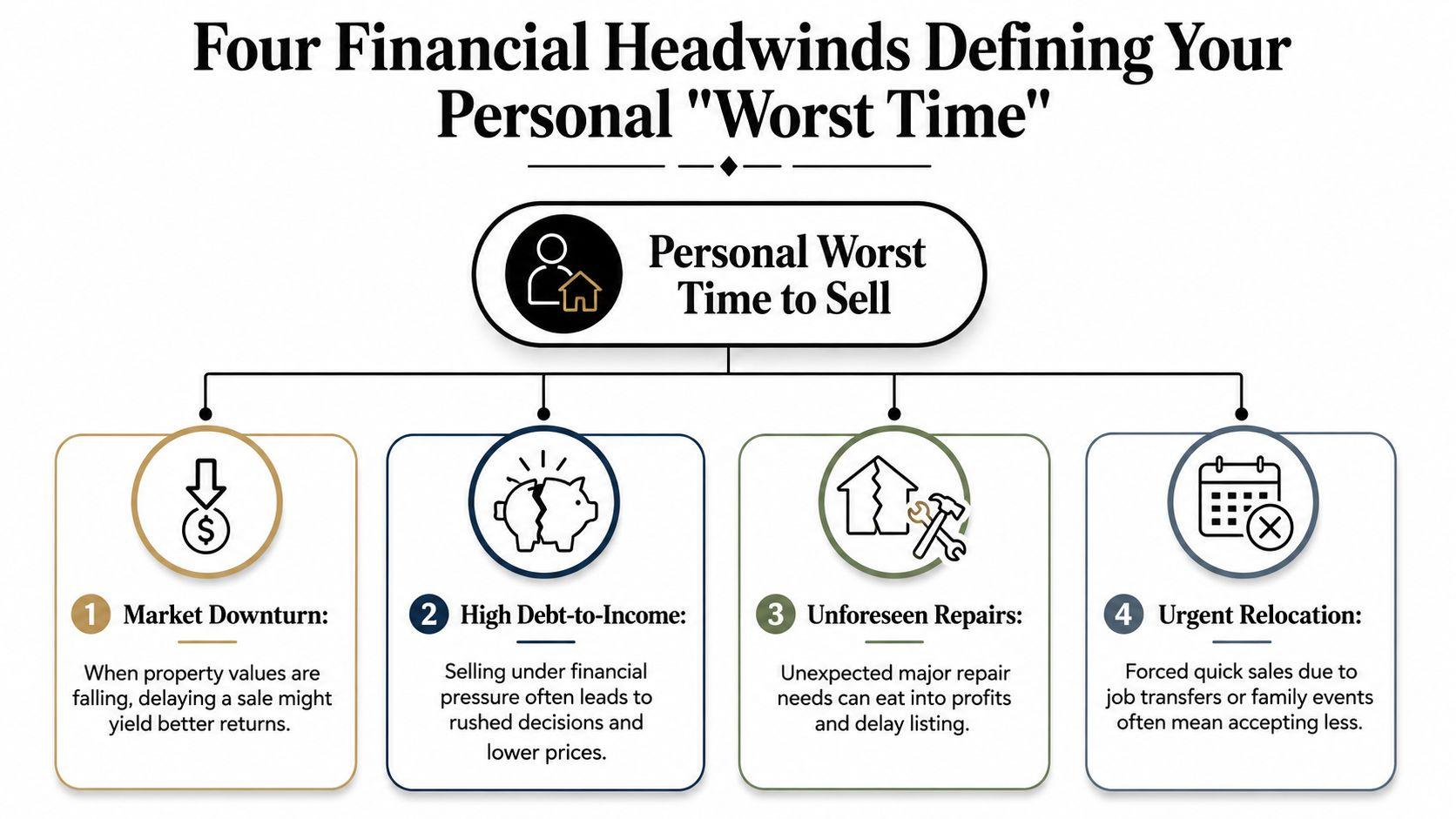
The monthly carrying-cost squeeze
In Miami-Dade and Broward, the worst time to sell often starts when the property begins draining cash faster than local pricing can recover. Owners feel it first through insurance. A renewal jumps, a carrier tightens underwriting, or a vacancy clause turns into a real problem. Older roofs, older electrical systems, prior claims, and properties that sit empty all raise the odds that ownership gets more expensive before a buyer ever appears.
Then the HOA side hits. In 2026, condo and townhouse sellers are dealing with more than monthly dues. Buyers and lenders read budgets, reserve studies, repair schedules, and board disclosures closely because new safety and reserve requirements have changed the math for aging buildings. One pending special assessment, one concrete restoration project, or one weak reserve line can shrink the buyer pool and push offers down. The unit may show well and still trade at a discount because the building file looks risky.
Repairs are the third pressure point. Roof work, cast-iron drain issues, electrical updates, water intrusion, mold remediation, and deferred maintenance all cost more in a soft market because you pay for the work and keep paying while the house is off schedule. Carrying costs do not pause while contractors argue over permits or buyers ask for credits.
Probate can become the fourth squeeze, especially with inherited property. Delays over heirs, title cleanup, homestead questions, or court timing can leave a house exposed to taxes, insurance, utilities, and association charges for months longer than a family expected. In South Florida, that delay has a real monthly price tag.
For owners weighing tax uncertainty on top of these costs, this guide on Florida 2026 property tax abolition and whether to sell now or wait adds useful context. It does not solve the carrying-cost problem. It shows why waiting on a political or policy outcome is usually not a financial plan.
When buyer friction gets layered on top
Once the property has a cost problem, buyer resistance makes it worse.
Cash buyers can still close in South Florida. Financed buyers are more payment-sensitive, more insurance-sensitive, and far less willing to absorb building risk or repair uncertainty. That matters in Miami-Dade and Broward because a lot of the friction is invisible from the curb. The issue is not just whether the kitchen is dated. The issue is whether the buyer can insure the home, whether the condo can clear lender review, and whether a looming assessment will wreck affordability after closing.
January and other slower periods can still hurt, as noted earlier, but the harder math in South Florida is personal rather than seasonal. If your insurance bill just reset higher, your HOA is discussing a special assessment, or probate is stretching out, waiting for a better month may cost more than a lower offer today.
Use this four-part test:
- Insurance exposure: Is your current policy stable, and would a new buyer face underwriting problems tied to roof age, claims history, condition, or vacancy?
- HOA and condo risk: Are there special assessments, reserve shortfalls, litigation, deferred maintenance, or lender concerns in the association documents?
- Repair burden: Can the property get through inspection and appraisal without major credits, repair demands, or financing trouble?
- Legal and timing drag: Is probate, title cleanup, heir coordination, tenant removal, or permit work likely to keep the property carrying costs alive longer than expected?
If two or more of those areas are weak, your personal worst time to sell is probably not next year or next season. It is the period where holding the property keeps stacking new costs against you.
Evaluating Your Property in Miami-Dade and Broward
A good decision starts with a blunt property review, not optimism.
Run a property stress test
Start with the items that can force discounts or kill contracts. Check the roof age, air-conditioning age, visible plumbing issues, water intrusion, electrical panel type, and signs of deferred maintenance. Then review your insurance status. If the carrier has already raised concerns, a future buyer and that buyer's insurer may raise the same concerns.
Next, read your HOA or condo documents like a buyer's underwriter would. Look for reserve language, discussion of concrete restoration, structural repair, litigation, roof replacement, elevator modernization, or facade work. In Broward and Miami-Dade, association paperwork can shape value as much as the unit itself. A clean kitchen remodel won't overcome a shaky budget or a looming assessment.
Field observation: In South Florida, many sellers focus on what the home looks like. Buyers, lenders, and insurers focus on what the property file looks like.
Then review title and legal status. Probate, open permits, code issues, liens, tenant occupancy, and municipal violations all affect timing. These items matter more in a weak market because buyers have options. When demand isn't rescuing every flawed listing, paperwork problems stay on the table longer.
Two South Florida examples
An unrenovated 1960s single-family home in Hollywood can still attract attention if the lot, location, and layout work. But if the roof is old, the electrical is outdated, and the insurer pushes back, the seller isn't just choosing a listing month. The seller is choosing whether to absorb repairs, credits, or a smaller cash-buyer pool.
A newer condo in Doral may show better on paper because the unit itself needs less work. But if the association is under financial strain or buyers worry about future assessments, the weak point moves from the unit to the building. That is why local context matters. As Mossy Oak notes, a coastal Florida listing follows different rhythms than inland property, and sellers need to analyze local sold data rather than rely only on national seasonality (Florida-specific timing context from Mossy Oak).
Use a simple pass-fail screen before deciding to wait:
- Property systems: Roof, AC, plumbing, electrical.
- Insurance readiness: Current policy terms, vacancy concerns, underwriting red flags.
- Association health: Reserves, assessments, litigation, maintenance backlog.
- Legal status: Probate, permits, violations, title clarity, tenancy.
- Market fit: Will your likely buyer be financed or cash?
If the property fails several of these checks, waiting often increases risk faster than it increases value.
Comparing Your Three Paths A Strategic Breakdown
Every seller in a weaker market has three broad options. List now. Wait and hold. Sell directly. None is perfect. Each has a cost profile.

Comparing Selling Strategies in a Down Market
| Factor | List Traditionally (MLS) | Wait & Hold | Sell Directly for Cash (Property Nation) |
|---|---|---|---|
| Speed | Usually slower. Depends on showings, financing, inspections, and closing timeline. | Slowest path. No immediate exit. | Fastest path. Built for sellers who need a defined closing window. |
| Certainty of Closing | Lower certainty. Buyer financing, appraisal, inspection, and HOA review can interrupt the deal. | No closing certainty because the sale is postponed. | Higher certainty when the buyer is ready to close without lender conditions. |
| Net Proceeds | Highest potential top-line price, but fees, repairs, credits, commissions, and carrying costs can reduce net. | Unknown future net. You keep paying to hold and may still sell into a weak market later. | Lower top-line price in many cases, but fewer transaction costs and fewer repair obligations can narrow the net gap. |
| Required Effort & Stress | Highest workload. Cleaning, showings, staging, repairs, negotiations, and buyer requests. | Ongoing management burden. You keep handling maintenance, bills, and uncertainty. | Lowest seller workload. Best for as-is property or complex timelines. |
| Risk Exposure to Holding Costs | Moderate. Exposure continues until closing. | Highest. You remain exposed to insurance, HOA, taxes, maintenance, and legal complications. | Lowest. You stop the monthly bleed sooner. |
How to choose the path that fits your risk
The MLS route works best when the property is financeable, the HOA package is clean, and the seller has time. It doesn't work well when the house needs heavy work, the condo documents raise questions, or the seller can't handle a failed contract.
Waiting only makes sense if the property is relatively stable to hold. If you're effectively becoming an involuntary landlord while you wait, you should read a plain-English landlord vs property manager guide to understand how much oversight ownership really requires. For many inherited homes, vacant homes, and distressed condos, "hold and wait" is not a passive option. It's active management with ongoing cost.
A direct as-is sale fits owners who value certainty over the possibility of squeezing out a higher list price. That tends to include damaged houses, inherited properties, tenant-occupied homes, and condos with document or assessment friction. If that matches your situation, reviewing how to sell a house as-is in Florida helps frame the trade-off clearly.
A smart sale strategy isn't about ego. It's about net outcome after time, friction, and risk.
The Probate and Inherited Property Timing Trap
Inherited houses create a different version of the worst time to sell a house. The danger isn't only a soft market. The danger is a property that keeps billing the estate while the legal process moves slowly.

Why inherited houses become expensive fast
A vacant inherited home in Miami-Dade or Broward can trigger issues quickly. Insurance carriers may treat vacancy differently. Utilities still need to stay on. The lawn still needs service. Water intrusion doesn't pause because the family is waiting on paperwork. If the property sits in an HOA, the dues and enforcement continue whether anyone lives there or not.
Probate also creates a decision lag. Heirs may disagree on repairs, pricing, cleanout, or whether to hold the property. During that delay, the house can deteriorate. A small leak becomes remediation. Deferred maintenance becomes buyer fear. The estate doesn't need a catastrophic event for equity to shrink. It just needs time and inaction.
Probate delay changes the timing equation
For inherited property, speed often matters more than seasonality. Neutral industry reporting notes that homes listed in December and January tend to take over 50 days to sell, compared with roughly 40 to 43 days for May through July listings, and that winter listings may get 1% to 1.5% less of asking price than late spring or early summer comparables (Neighbors Bank's market-timing review). That combination hurts more in probate because every extra week carries legal, insurance, maintenance, and coordination costs.
This is why heirs should think in terms of estate preservation, not aspirational pricing. A longer listing period isn't just an inconvenience. It can mean another month of vacancy oversight, another insurance payment, another tax bill cycle, more utility expense, and more chance of a title or cleanup issue surfacing before closing.
For families trying to understand the process, this guide on selling inherited property in Florida is useful because it focuses on the transaction mechanics, not just broad probate theory.
Use a simple probate timing screen:
- Vacancy risk: Is the property empty, and does that affect insurance or physical upkeep?
- Estate cash drain: Are heirs advancing costs each month to keep the home afloat?
- Family alignment: Can all decision-makers agree on repairs, pricing, and timing?
- Property condition: Will waiting improve the outcome, or just increase exposure?
If the estate is losing money every month, the market calendar becomes secondary.
Conclusion Making the Financially Sound Decision
The worst time to sell a house isn't always a month on the calendar. In South Florida, it's often the point where waiting stops being strategic and starts being expensive.
Use closing math, not hope
Write down every monthly cost tied to the property. Insurance. Property taxes. HOA dues. Special assessments if applicable. Utilities. lawn service. Pool service. Maintenance. Vacancy oversight. Mortgage payment if there is one. Then add any near-term repair item you already know is coming.
That number is your cost of delay. It is real. It doesn't care whether you think the market might improve. It doesn't pause while a probate file moves, while an HOA board finalizes a project, or while an insurer asks for updates.
Zillow reports that listing in the last two weeks of May can add 1.6%, or about $5,600 for the typical U.S. home, compared with the annual baseline (Zillow's best-time-to-sell analysis). That matters because it shows timing can affect value. But for many Miami-Dade and Broward owners facing heavy carrying costs, that seasonal upside may be smaller than the guaranteed cost of holding a problem property for several more months.
The financially sound move is the one that protects net proceeds after all frictions are counted. Sometimes that is a well-prepared MLS listing. Sometimes it is waiting briefly to resolve a fixable issue. Sometimes it is exiting fast to stop ongoing loss. The right answer isn't emotional. It's arithmetic.
Frequently Asked Questions
Is hurricane season the worst time to sell a house in South Florida?
Not automatically. Hurricane season can affect buyer psychology, insurance questions, and showing activity, but the bigger issue is whether the property has storm-related vulnerabilities. If the roof, windows, drainage, or prior-claim history raise concerns, those issues matter more than the month itself.
Are condos riskier to sell than single-family houses in Miami-Dade and Broward?
Often, yes. A condo sale depends on the unit and the association. Buyers, lenders, and insurers may examine reserves, assessments, maintenance history, and governance. A single-family home usually has fewer association-based variables, even if it needs physical repairs.
Should I wait if my house needs repairs?
Only if the repairs are manageable, clearly improve marketability, and don't expose you to larger monthly loss while you wait. In South Florida, sellers often underestimate the cost of delay, especially when insurance, HOA pressure, or vacancy risk is already present.
Does probate make timing more important?
Yes. Probate adds legal steps, family coordination, and carrying costs. If the inherited house is vacant, outdated, or expensive to insure, delay can steadily reduce estate value.
Does selling fast create tax issues?
It can, depending on ownership history, occupancy, basis, inheritance status, and gain. Florida doesn't have a state capital gains tax, but federal tax treatment still matters. Before selling, review the basics of capital gains tax in Florida real estate and get situation-specific tax advice.
If you're in Miami-Dade or Broward and the property is becoming too expensive, too complicated, or too risky to keep, Property Nation offers a direct local option. The company buys houses as-is across South Florida, works with inherited homes, distressed properties, tenant issues, liens, and outdated houses, and gives sellers a way to compare certainty against the ongoing cost of waiting.