


Your Broward or Miami-Dade maintenance bill shows up again. You haven't used the week in years. The reservation rules are frustrating, the annual charges keep coming, and every online listing you check seems disconnected from what owners receive. At that point, owners don't need another glossy resale pitch. They need a financial triage plan.
That's the right frame for anyone trying to sell a Florida timeshare in 2026. This isn't a condo sale. It isn't a standard second-home listing. It's a contract-driven exit problem shaped by resort rules, Florida consumer law, transfer costs, and a resale market that often punishes delay.
Property owners in South Florida run into this constantly. A Fort Lauderdale owner assumes there must be value because the original purchase price was high. A Miami-Dade owner assumes a paid-off timeshare should be easy to unload. Both assumptions can cost real money if they trigger more maintenance fees, more assessments, and more exposure to resale scams.
At a glance
- Start with the contract, not the listing. You need to know whether you own a deeded interest, a week, or points with transfer restrictions.
- Use completed sales, not asking prices. Listings can mislead. Closed transfers are the benchmark that matters.
- Treat this as a cost-control decision. For many owners, the best outcome is not maximizing sale price. It's ending future liability.
- Avoid upfront-fee resale pitches. They're a recurring risk in this space.
- Choose the exit path that fits the contract. Sale, deed-back, surrender, donation, or legal exit each works in different situations.
Table of Contents
- Your 2026 Roadmap for Selling a Florida Timeshare
- First Assess Your Ownership and the Resale Reality
- Comparing Your 2026 Timeshare Exit Options
- The Professional Path for Unsellable Timeshares
- Assembling Documents and Navigating the Transfer
- Your Florida Timeshare Exit FAQ
- Can I still sell a Florida timeshare if it's paid off
- Am I still liable for maintenance fees while it's listed
- Should I accept an unsolicited buyer offer
- Is a deed-back better than trying to sell
- How do I verify a resale or exit company
- What tax result should I expect
- What if the timeshare came through probate or an estate
- What is the safest goal in most cases
Your 2026 Roadmap for Selling a Florida Timeshare
In South Florida, owners often approach a timeshare exit the same way they'd approach selling a condo or inherited house. That's the first mistake. A timeshare sits inside its own legal box. The resort's governing documents, the purchase contract, transfer procedures, and ongoing fee liability matter more than curb appeal or list-price strategy.
That distinction is especially important for owners in Broward County. A rising carrying cost can turn a marginal asset into a recurring drain fast. If you've looked at broader Florida property sales and assumed the same playbook applies here, it doesn't. A traditional home sale follows one set of steps. A timeshare exit follows another. If you want a contrast with ordinary residential dispositions, review how a standard Florida home sale process works.
The first decision isn't price
Most frustrated owners ask, “How much can I sell it for?” The better opening question is, “Is a market sale realistic at all?” If the answer is weak, your job becomes limiting future losses, not chasing a number that won't materialize.
That's why the roadmap starts with triage:
- Pull the contract and identify the ownership form.
- Confirm restrictions that affect transfer, resort approval, or buyer benefits.
- Check actual sold prices for the same resort or club.
- Calculate continuing costs while you wait.
- Choose the exit path that has the cleanest odds of resolution.
Practical rule: If each extra billing cycle costs more than your likely net recovery, waiting isn't strategy. It's drift.
What works and what usually fails
Owners get traction when they stay narrow and document-driven. They fail when they rely on listing sites, verbal promises, or “guaranteed buyer” calls.
The practical winners tend to do three things well:
- They verify every restriction early. Transfer bans, right of first refusal procedures, or club rules can derail a deal late.
- They budget for the whole exit. Closing costs, resort fees, and unpaid charges can erase already-thin proceeds.
- They keep every communication in writing. That matters if the resort, resale broker, or exit company changes position.
The practical losers tend to do the opposite. They accept a flattering price opinion. They pay to “advertise” the week. They assume being paid off means being marketable.
For 2026, the strongest mindset is blunt but useful. You are not selling a dream purchase. You are solving an unwanted obligation. That shift makes better decisions possible.
First Assess Your Ownership and the Resale Reality
Before you try to sell a Florida timeshare, identify the legal character of what you own. That sounds basic, but many owners still describe a points contract as if it were deeded real estate, or assume a floating week transfers like a simple condo interest. It doesn't.
What you actually own controls your options
A deeded timeshare interest usually ties to a real property interest, even if the use rights are heavily controlled by the resort documents. A points-based product often functions more like a club structure with usage privileges, internal rules, and limited transfer appeal. A fixed or floating week can sit somewhere in between from a practical resale standpoint.
For valuation, the distinction matters because buyers aren't just evaluating the resort. They're evaluating restrictions, reservation priority, annual obligations, and transfer friction. Some contracts also trigger a resort review or a right of first refusal process before a resale can close. If your transfer path feels clogged, compare that to other title problems in real estate, where a hidden encumbrance can stop a clean closing. The same logic applies here, even though the asset is different. Property owners familiar with title obstacles may recognize the parallel in dealing with property transfers involving liens.
Why the resale market feels worse than owners expect
Florida isn't a fringe timeshare market. It remains one of the largest U.S. timeshare markets, with about 24% of the nation's timeshare purchases concentrated in the state, and the average original U.S. timeshare transaction price rose to $23,940 in 2022. That original-sale figure is not a guarantee of resale value in a saturated market, as summarized from industry data in this Florida timeshare market overview.
That single fact explains a lot of owner frustration. There is a large installed base of product in Florida. Buyers have options. Older contracts compete against developer inventory, newer club offerings, and owners who are trying to get out.
Completed sales matter. Asking prices often reflect owner hope, not market clearance.
That's why realistic pricing starts with closed transactions at your exact resort or within the same vacation club. Anything else is noise. If the resort has weak buyer demand, rising annual obligations, or inconvenient booking rules, the market can push value down to almost nothing.
There's also a practical carry-cost issue. In South Florida, owners already understand how insurance pressure can distort ownership economics in shared properties. If you want a plain-English explanation of one related risk category in common-interest ownership, this overview of HO6 condo insurance is useful context. The lesson carries over. Shared-property cost structures can change the economics faster than owners expect.
Use a short checklist before you go any further:
- Identify the asset type. Deeded week, floating week, or points membership.
- Read the transfer language. Look for approval requirements, fee obligations, and benefit limitations.
- Pull sold comparables. Not active listings. Not owner forum guesses.
- Estimate the cost of delay. If another cycle of fees exceeds probable net proceeds, resale may be the wrong path.
Comparing Your 2026 Timeshare Exit Options
A Miami-Dade owner calls after paying another maintenance bill and asks the question I hear every week. "Should I try to sell, or am I about to throw more money at a dead end?" That is the right question in 2026. This decision is financial triage first, sales strategy second.
Florida timeshare exits should be compared the same way you would compare any draining asset. Start with net outcome, legal risk, time, and whether the option ends future liability. The cleanest result is not always a sale. It is the exit that stops the bleeding at the lowest total cost.
Florida law still treats timeshares as vacation products, not wealth-building assets. That matters because many owners approach resale expecting a real estate play, then run straight into transfer restrictions, low demand, and fee drag. If a resale company gets involved, commissions and closing charges can wipe out what little value remains, as discussed in this review of Florida timeshare resale realities.
Florida Timeshare Exit Options Comparison 2026
| Exit Option | Typical Cost | Success Probability | Timeline |
|---|---|---|---|
| Direct resale by owner | Usually low out-of-pocket at first, but can expand once transfer and resort costs appear | Low to moderate, depending on resort demand and contract terms | Uncertain |
| Licensed resale broker | Potential commission if a sale occurs, plus transaction costs | Moderate only if the contract has real buyer demand | Moderate to long |
| Resort deed-back or surrender | Varies by resort and account status | Often stronger than open-market resale when the resort cooperates | Moderate |
| Donation | Limited and highly situation-specific | Low, because many charities won't accept burdensome contracts | Uncertain |
| Attorney or exit company | Upfront professional fee is common | Often better when resale demand is weak and the objective is release, not profit | Moderate |
How each option plays out for a Miami-Dade owner
Direct resale by owner
Owner-to-owner resale works only when the contract has a real buyer pool and the resort transfer process is manageable. Exposure is not demand. A listing can sit for months while annual fees, special assessments, and reservation deadlines keep working against you.
The pricing lesson is simple. Buyers care about today's burden, not your original purchase price. That same principle shows up in Endless Storage's guide to selling, even though the asset is different. The market clears where buyers see usable value and limited hassle.
Licensed resale broker
A legitimate broker can help if the resort, season, or points system already has resale traffic. That is a narrow category. On weak contracts, a broker may improve presentation and screening, but cannot manufacture demand where none exists.
Owners in South Florida understand this from ordinary real estate. Even investors using cash home buyers in Florida know speed only exists when there is a willing market and a price that reflects the asset's condition. Timeshares are harder because the buyer is taking on recurring obligations, not just buying a deed.
Resort deed-back or surrender
This is often the smartest early call, especially for older contracts with little resale activity. Many resorts will review a surrender request if the account is current and the owner has followed the contract rules. Some refuse. Some impose fees. Some accept only certain inventory types.
Pride gets in the way here. Owners want a sale because it feels like control. In practice, a surrender can be the lower-cost result if the alternative is another year of fees while a listing goes nowhere.
If projected net sale proceeds are near zero, a deed-back request belongs near the top of the list.
Donation
Donation sounds attractive until the receiving party reviews the actual obligation. Charities usually reject contracts with high annual fees, poor booking utility, transfer hurdles, or weak resale value. A timeshare that is hard to sell is usually hard to donate for the same reasons.
Attorney or exit company
This option makes sense when your realistic goal is release, not profit. The right professional can review the contract, confirm whether the resort has a surrender path, identify transfer barriers, and document the exit properly. The wrong company collects an upfront fee and delivers little more than phone calls and generic promises.
For a frustrated owner trying to sell a Florida timeshare, the actual comparison is not "Which path sounds best?" It is "Which path ends liability with the least additional loss?" That answer is often less glamorous than resale, but far more useful.
The Professional Path for Unsellable Timeshares
Some timeshares don't need better marketing. They need a controlled exit strategy. That's the category many older Florida contracts fall into, especially when the annual burden keeps arriving and resale demand stays weak.

When a legal or managed exit makes more sense
The Florida Attorney General warns sellers to be extremely cautious of unsolicited offers and companies demanding large upfront fees to “list” or “sell” a timeshare, which are common red flags for scams, as summarized here in guidance on timeshare sale scam warning signs.
That warning creates an important distinction. An upfront fee for vague resale promises is one thing. A clearly defined professional fee for legal review, contract analysis, document handling, and negotiation is another. The difference is whether the service is concrete, reviewable, and tied to an actual exit process.
A professional path makes sense when:
- The contract has little or no resale traction. You've checked sold activity and found no realistic buyer market.
- The annual charges are the main problem. Every delay keeps the liability alive.
- The resort documents are difficult. Approval requirements, transfer restrictions, or account issues make a normal sale unlikely.
- You need finality. You care more about release than price.
Here's a video that gives useful context on timeshare exit concerns and consumer risk.
How to screen professional help in Florida
The right professional should start by reviewing your contract, ownership history, payment status, and resort correspondence. They should explain whether the target is deed-back, negotiated surrender, dispute-based termination, or another remedy tied to the contract terms. If they skip that analysis and jump straight to a guarantee, walk away.
Use this screening standard:
- Demand a written scope. You should see what they will do, not just what they hope happens.
- Check whether they discuss transfer mechanics. Serious professionals talk about documents, resort response, and release proof.
- Ask how they handle communication records. A paper trail matters.
- Avoid “buyer already waiting” scripts. That language often shows up in bad resale pitches.
The safest professional help doesn't sound exciting. It sounds precise.
For many owners, especially those carrying an older contract they no longer use, a managed exit is the more financially disciplined choice. Chasing a market sale can feel proactive. In the wrong case, it only extends the problem.
Assembling Documents and Navigating the Transfer
Once you have a buyer, a deed-back approval, or a negotiated release path, paperwork becomes everything. A timeshare transfer fails when owners assume the verbal deal is the deal. It isn't. The file has to support the handoff from start to finish.
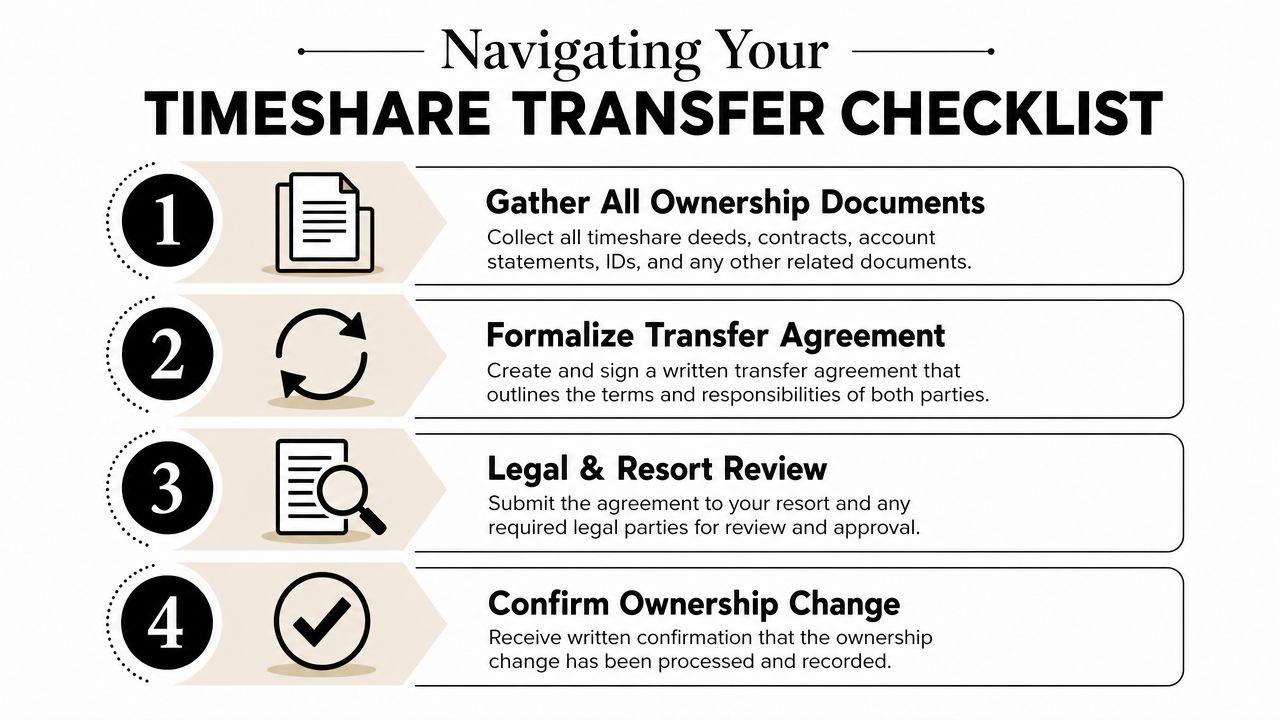
A practical Florida timeshare resale workflow starts with verifying ownership and contract restrictions, then checking actual sold prices, and budgeting for all transfer, title, and resort fees to avoid surprises at closing, as outlined in this timeshare resale workflow guide.
The document package you need
Start by assembling the core ownership file:
- Purchase documents. Pull the original contract, membership papers, amendments, and any recorded deed if one exists.
- Account records. Gather maintenance fee statements, special assessment notices, payoff information, and proof of current status.
- Resort correspondence. Save transfer instructions, approval requirements, and forms the resort requires.
- Identity and authority documents. If an owner died, became incapacitated, or ownership changed through estate administration, authority paperwork matters.
That last point trips families often. If title authority is tangled because of death planning or ownership succession, legal transfer questions can overlap with broader estate tools. For context on one Florida estate-planning device and how title consequences can ripple into later transfers, this discussion on how to secure your Cumming, GA family home offers a useful example of why deed structure matters.
What happens at transfer and closing
One of the most important items is the estoppel letter. In plain terms, it is the resort's written statement of the account status. It should identify the ownership, confirm outstanding balances if any, and show what must be paid or completed before transfer.
You may also need a right of first refusal waiver if the contract gives the resort the option to step into the proposed deal. Without that clearance, a buyer can wait while the resort decides whether to match the terms.
Use a simple closing checklist:
- Confirm seller authority and exact ownership names.
- Order estoppel information from the resort.
- Clear account issues before documents are drafted.
- Get transfer approval or waiver if the contract requires it.
- Use proper forms for signatures, acknowledgments, and closing instructions.
If you need a reference point for document organization and signature workflow, keep a folder similar to a professional Florida real estate forms checklist. The asset type is different, but disciplined paperwork wins in both settings.
Your Florida Timeshare Exit FAQ
Can I still sell a Florida timeshare if it's paid off
Yes, but being paid off doesn't create buyer demand. Many owners discover their timeshare has near-zero resale value because maintenance fees, restrictions, and oversupply suppress buyer interest. A major gap in many guides is that they explain how to list a timeshare, but not whether a realistic market exists for that specific contract, as explained in this analysis of why some timeshares don't sell.
Am I still liable for maintenance fees while it's listed
Usually yes. Liability typically continues until the transfer or release is fully completed under the resort's process. That's why owners in Broward and Miami-Dade need to think in terms of total carrying cost, not just listing strategy.
Should I accept an unsolicited buyer offer
Treat unsolicited offers with skepticism, especially if the company quickly pivots to a listing fee, marketing fee, or urgency pitch. Legitimate transactions stand up to documentation, written terms, and verification.
Is a deed-back better than trying to sell
Sometimes, yes. If the realistic resale market is weak and the resort will accept a surrender or deed-back, that path can be financially cleaner than holding the contract while searching for a buyer. The right answer depends on your resort, account status, and transfer rules.
How do I verify a resale or exit company
Ask for a written service agreement, a clear explanation of what they will do, and a document list they need from you. Be cautious if the presentation centers on guaranteed results, secret buyer networks, or broad promises without contract review.
What tax result should I expect
Tax treatment depends on the structure of the exit, whether there is debt involved, and how the transaction is documented. That question needs accountant or tax-law review tied to your specific file. Owners shouldn't assume a transfer, release, or forgiven obligation will be treated the same way in every case.
What if the timeshare came through probate or an estate
Then authority becomes critical. Before any sale or surrender, confirm who has legal power to sign and whether estate administration documents are required. This issue comes up often when family members in South Florida inherit unwanted vacation interests and assume informal agreement among heirs is enough.
What is the safest goal in most cases
The safest goal is usually not “get my money back.” It's “end this obligation correctly.” For many owners trying to sell a Florida timeshare, that distinction is the difference between resolution and another year of avoidable fees.
If you're sorting through a difficult property situation in Florida and want a straightforward local team that understands complex transfers, distressed ownership, probate issues, liens, and fast closings in Miami-Dade and Broward, Property Nation is a practical resource to keep on your list.