


In South Florida, the price per square foot to remodel home projects often starts above national cosmetic pricing and commonly lands around $40 to $150+ per square foot for many real-world jobs, with broader U.S. renovation ranges running $15 to $60 per square foot for standard work and up to $150 per square foot for high-end finishes. In Miami-Dade and Broward, standard projects frequently exceed $40 per square foot, and once structural changes, systems work, or code-driven upgrades enter the picture, costs rise fast.
If you’re standing in an outdated house in Hollywood, Hialeah, Pembroke Pines, or Fort Lauderdale trying to decide whether to renovate or exit, the confusion usually starts with one question: what will this cost me? That question gets harder in South Florida because cosmetic work is only part of the budget. Insurance-driven repairs, permit review, HOA rules, probate delays, and older electrical or plumbing systems can turn a clean estimate into a stressful moving target.
A square-foot number helps, but only if you understand what it hides. A repaint-and-flooring job isn’t the same as replacing wiring, opening walls, or bringing an older property in Miami-Dade or Broward up to current expectations for insurability and resale. Owners dealing with inherited homes, liens, deferred maintenance, or properties damaged by age and moisture feel that pressure the most.
Table of Contents
- At a Glance Your Remodeling Budget Blueprint
- Deconstructing Remodel Costs Per Square Foot in South Florida
- The Hidden Factors Driving Your Final Bill
- How to Accurately Estimate Your Remodel Project
- The Critical Decision Remodel vs Selling As-Is
- Navigating Florida’s 2026 Homeowner Landscape
- Frequently Asked Questions About Remodeling Costs
At a Glance Your Remodeling Budget Blueprint
Most owners don’t start with a spreadsheet. They start with a house that feels tired, a contractor quote that feels vague, and a growing concern that one repair will expose three more.
That is why price per square foot matters. It isn’t a final bid. It’s the quickest way to separate a manageable project from one that can strain savings, financing, or patience. In South Florida, that distinction matters more because homes often need more than finishes. They need systems work, code compliance, and materials that hold up to humidity and local building standards.
For context, national renovation costs for a typical home sized 1,250 to 1,600 square feet span $19,472 to $88,327, with an average of $52,135, and standard renovations usually fall in the $15 to $60 per square foot range, while high-end finishes can reach $150 per square foot according to Angi’s house renovation cost guide. Those broad numbers become more expensive in Miami-Dade and Broward once you add local labor pressure, moisture-resistant materials, and permit friction.
A working budget needs three layers:
- Baseline scope: Are you repainting and replacing finishes, or opening walls and replacing systems?
- Property condition: Older wiring, aging HVAC, plumbing issues, and prior unpermitted work change the job immediately.
- Exit strategy: If the property is distressed, inherited, lien-heavy, or time-sensitive, the smartest financial move might not be renovation at all.
Practical rule: Use square-foot pricing to decide whether a remodel deserves deeper planning. Don’t use it to assume the first quote is affordable.
If you want a grounded planning framework before requesting bids, Flacks Flooring advice on renovation budgets is a useful companion because it reinforces the discipline most owners skip. Define scope first, then materials, then labor, then contingency.
Deconstructing Remodel Costs Per Square Foot in South Florida
A South Florida owner gets a quote that sounds manageable at first. Then the job shifts from paint and flooring to cabinets, tile, plumbing changes, permit drawings, and moisture-related repairs, and the cost per square foot stops behaving like a simple average.
That is the core problem with square-foot pricing. It works as a screening tool, but it hides where the actual money goes. In this market, dry rooms usually stay closer to the lower end of a budget range. Kitchens, bathrooms, laundry areas, and any project that opens walls usually do not.
What the baseline numbers really mean
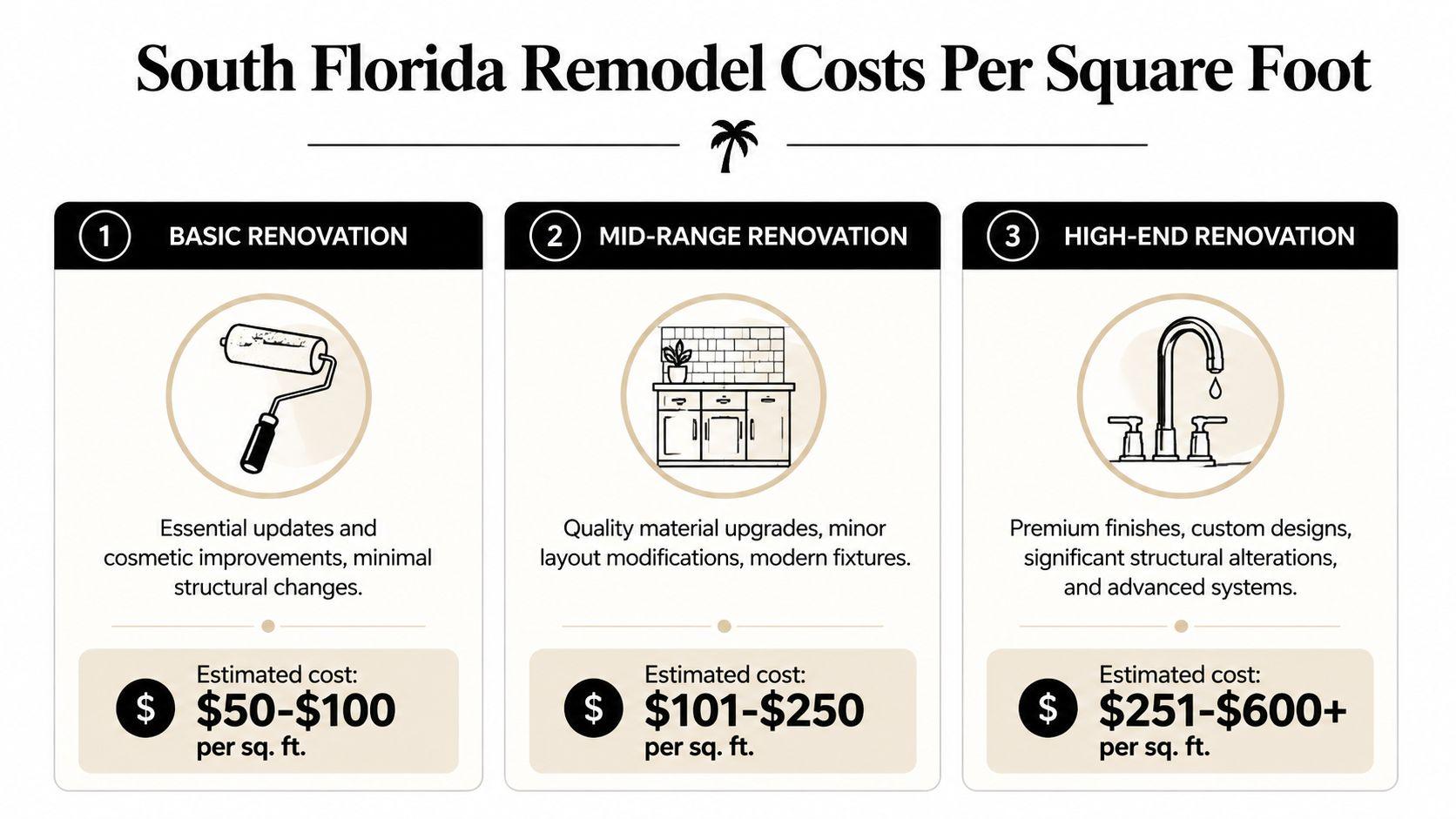
For planning purposes, South Florida remodels usually fall into three bands:
| Remodel tier | Typical South Florida planning range | Usually includes | What often pushes it higher |
|---|---|---|---|
| Basic cosmetic | $40 to $70+ per sq. ft. | Paint, flooring, fixtures, surface-level updates | Moisture damage, old subfloors, dated wiring |
| Mid-range | $70 to $150+ per sq. ft. | Better finishes, kitchen and bath work, some layout changes | Permit review, trade coordination, system upgrades |
| High-end or major rework | $150+ per sq. ft. | Custom finishes, structural work, major system replacement | Engineering, code compliance, specialty labor |
Those ranges are planning bands, not bid numbers. A 1,400-square-foot house does not remodel the same way from room to room, and South Florida adds extra pressure through labor availability, inspection standards, and material choices that hold up better in humid conditions.
The national market supports the idea that scope changes cost fast. JLC’s 2024 Remodeling Cost vs. Value report shows a midrange major kitchen remodel at $79,982 and an upscale major kitchen remodel at $158,530, while a midrange bathroom remodel averages $25,251 and an upscale bathroom remodel averages $78,840, based on contractor-reported project costs across U.S. markets in JLC’s Cost vs. Value report. Those are national figures, but they help explain why South Florida budgets climb quickly once a project includes wet-area work and finish upgrades.
How project scope changes the math
A cosmetic kitchen update and a true kitchen remodel share the same footprint but not the same cost structure. If the cabinets stay, the plumbing stays, and the electrical plan stays, the square-foot number stays more predictable. Once any of those move, the project starts carrying demolition, trade sequencing, inspections, and patch-back work.
HomeAdvisor’s room-based renovation guide places kitchen remodels at $14,598 to $41,495 and bathroom remodels at $6,639 to $17,622, with living room renovations at $2,500 to $15,000 and bedroom renovations at $1,500 to $5,500, according to HomeAdvisor’s room renovation cost guide. In South Florida, distressed homes often start above the low end because water intrusion, aging electrical panels, cast iron plumbing, and prior owner shortcuts are common.
That is why two homes with the same square footage can produce very different bids.
Older houses are the biggest swing factor. A clean cosmetic update in a 1998 house is one budget. A 1960s house in Miami-Dade with galvanized lines, an older roof line, and unpermitted past work is another budget entirely. Owners dealing with probate, liens, vacancy, or major deferred maintenance should compare renovation spending against a direct sale before committing. This breakdown of how Florida cash home offers are calculated in 2026 helps show what buyers usually price in when they take on those risks themselves.
Kitchens also deserve separate scrutiny because they distort the whole-house average. Cabinets, countertops, electrical additions, appliance requirements, and layout changes can consume a disproportionate share of the total budget. For a grounded room-level reference, The Cabinet Coach on remodeling expenses breaks down where those line items tend to expand.
The practical takeaway is simple. Use price per square foot to sort projects into rough budget tiers. Do not use it to assume your South Florida remodel will stay on budget once kitchens, baths, or older systems enter the scope.
The Hidden Factors Driving Your Final Bill
A South Florida owner starts with a cosmetic budget, then opens one wall and finds aluminum branch wiring, an undersized panel, and framing that needs an engineer before work can continue. That is how a manageable remodel turns into a financing problem.

Fixed-cost systems that crush smaller projects
Electrical, HVAC, and structural prep often hit as lump-sum costs, not tidy square-foot math. A small house can still need a full panel replacement, new ductwork, engineering, permits, and multiple inspections.
RSMeans notes that residential remodel pricing gets pushed higher by MEP work, structural corrections, and local labor conditions, which is why system-heavy projects break the simple average many owners start with (RSMeans cost data guide). In South Florida, that pressure is stronger because licensed trades, permit time, and storm-related code requirements add cost before finishes even arrive.
Owners usually spend their mental budget on what they can see. Cabinets, tile, flooring, and paint feel like the project. Service upgrades, load calculations, air distribution changes, and engineer-stamped drawings feel like overhead. They still have to be paid for.
South Florida costs that show up after demolition starts
The second problem is compliance. Final numbers rise when the house cannot legally or safely support the remodel that looked affordable on paper.
The usual triggers are predictable:
- Insurance-driven repairs: Older electrical components, aging roofs, and outdated plumbing can affect insurability, even if the remodel scope started as cosmetic.
- Code-triggered upgrades: Moving walls, changing windows or doors, or altering mechanical systems can pull more of the house into review.
- Permit cleanup: Unpermitted prior work often has to be exposed, corrected, and reinspected before new work can move ahead.
- Association and municipal delays: HOA approvals, product submittals, and local review cycles can stretch the timeline and raise carrying costs.
One delay can cost more than owners expect. While permits sit, the meter keeps running on taxes, insurance, utilities, interest, and sometimes vacant-property maintenance.
South Florida owners also run into a softer cost that still hits hard. Decision fatigue. Every revision to scope, materials, or layout creates change orders, and change orders rarely favor the owner.
That is why I tell distressed-property owners to underwrite the house they own, not the finished product they want to see. If the property has deferred maintenance, title problems, inherited condition issues, or major systems near failure, compare renovation spending against the economics of how ugly house buying companies work in real transactions.
For owners who still want to price the project carefully before choosing, Exayard construction estimating software can help organize scope, assumptions, and revision costs. The right move is not always remodeling first. In plenty of South Florida deals, selling as-is preserves more equity than chasing a renovation budget that keeps expanding.
How to Accurately Estimate Your Remodel Project
An estimate should produce a range you can act on. If it only gives you one optimistic number, it isn’t useful.

Build a range before you call anyone
Start with the exact area you plan to renovate. Use a laser measure, tax record, survey, or prior appraisal to confirm livable square footage. Then separate the house into categories. Kitchens and bathrooms belong in one mental bucket. Bedrooms, hallways, and living areas belong in another.
Once you have the square footage, create three scenarios using the planning bands already discussed:
- Low scenario: Cosmetic work only.
- Middle scenario: Better finishes plus likely trade work.
- High scenario: Full scope including unpleasant surprises.
For software-minded owners, a platform like Exayard construction estimating software can help organize assumptions, line items, and scope changes before contractor bids start arriving.
A simple South Florida estimating workflow
Here is a practical sequence that works better than asking one contractor for a lump sum.
- Measure first: Confirm the footprint of the exact areas being touched.
- Price by scope, not hope: Apply a cosmetic, mid-range, and major-rework range to those areas.
- Request detailed bids: Get at least three licensed and insured local contractor proposals with line-item descriptions.
- Stress-test the assumptions: Ask each contractor what is excluded. That question is often more important than the total.
- Create a decision range: Compare the highest likely cost against your cash reserves, financing options, and timeline.
A rough example helps. Take a 1,500-square-foot home in Davie. If the work is mostly cosmetic and lands near the lower South Florida planning range, the budget may look very different from a job that includes kitchen and bath upgrades, electrical corrections, HVAC work, and permit-driven revisions. The point isn’t to force a fake precise number. The point is to build a realistic spread before you sign anything.
Field note: The best estimate is the one that exposes risk early. Owners get into trouble when they buy based on the most flattering number on the page.
This walkthrough can help you think through investor logic too, especially if the house is rough enough that renovation may not be the best path. See how ugly houses companies really work for a practical look at how distressed-property buyers evaluate condition, repair load, and exit options.
This short video gives a useful visual on estimating mindset and project planning:
The Critical Decision Remodel vs Selling As-Is
The hard part isn’t understanding construction. It’s deciding whether construction is the right move at all.
For a 2,500-square-foot home in Florida, a mid-to-high-end remodel can cost $150,000 to $375,000, and when post-hurricane code upgrades required in Miami-Dade and Broward are added, costs can exceed $250 per square foot according to Block Renovation’s square-foot remodeling guide. That same guidance is especially relevant for owners dealing with probate or liens, because delayed financing and legal friction make a large remodel much harder to execute.
When remodeling still makes sense
A remodel can still be rational if the house is structurally sound, the title is clean, the owner has liquidity, and the project is driven by long-term occupancy rather than a short-term need to solve a property problem.
It also helps when the owner has time. Time to vet contractors. Time to handle permits. Time to absorb delays. Time to discover what sits behind walls without panicking.
When certainty matters more than upside
A different rule applies to inherited houses, vacant rentals, pre-foreclosure situations, lien problems, and homes with years of deferred maintenance. In those cases, owners usually aren’t buying a remodel. They’re buying uncertainty.
Here is the cleanest side-by-side view.
| Factor | Major Remodel | Selling As-Is for Cash |
|---|---|---|
| Total Cost | Open-ended. Visible work plus hidden repairs, compliance, and carrying costs | Known sooner. No repair budget required |
| Timeline | Depends on bidding, permits, labor availability, inspections, and change orders | Typically faster and simpler |
| Financial Risk | High if systems, title issues, probate, or code-driven work appear mid-project | Lower because the seller avoids renovation exposure |
| Required Effort | High. Contractor management, approvals, selections, cleanup, and oversight | Low. Fewer moving parts |
| Best For | Owners with liquidity, patience, and a stable property | Owners prioritizing speed, simplicity, or problem resolution |
That trade-off becomes sharper when the house is already difficult. If your property is outdated, cluttered, inherited, tied up in probate, or carrying legal or financial baggage, the remodel decision isn’t just about returns. It’s about whether the project creates more strain than value.
For a deeper breakdown of that choice, this guide on renovate a house for sale or sell as-is is a helpful companion.
Navigating Florida’s 2026 Homeowner Landscape
A South Florida remodel can go sideways before demolition starts. The budget on paper may cover finishes and labor, but the main pressure often comes from insurance requirements, permit review, association rules, and code-triggered repairs that show up after plans are submitted.

Insurance, code, and approval friction
In South Florida, owners rarely get to treat a remodel as a simple cosmetic project. A kitchen update can expose outdated wiring. Window replacement can raise questions about permits, product approvals, and hurricane standards. A roof near the end of its life can block affordable insurance even if the inside of the house looks fully updated.
That is where budgets start to drift.
Miami-Dade and Broward owners usually run into the same pressure points:
- Insurance underwriting: New finishes do not offset an old roof, aging plumbing, or unsafe electrical components.
- Code compliance: Once walls open or plans go in, some jobs expand to meet current standards instead of old conditions.
- HOA and condo restrictions: Approval timelines, work-hour limits, elevator reservations, and material rules can slow production and raise labor cost.
- Permit exposure: Small projects can become larger ones if inspectors require corrections tied to life safety or structural work.
I see owners underestimate this part all the time. They budget for what they want to improve, not for what the property will force them to correct first. On distressed houses, that difference can be the whole deal.
In South Florida, a remodel budget often includes construction cost, insurance-driven repairs, municipal compliance work, and months of carrying expense while the job is still unresolved.
Why inherited and distressed homes stall out
Inherited houses have a different problem set. The property may need work, but the family may not agree on scope, budget, or timing. Probate can delay authority to sign contracts or sell. Vacant homes can also pick up code issues, leaks, mold, or security problems while everyone is still deciding what to do.
That creates a hard math problem. Owners can spend money just to get the house insurable, permitted, and stable before any value-add work begins. If the property also has liens, deferred maintenance, or title issues, the remodel starts looking less like an investment and more like a holding cost with no clear ceiling.
For owners in that position, selling as-is is not a last resort. It is often the cleaner financial decision, especially when cash flow is tight or the repair scope is still unclear. If broader policy changes are part of your timing decision, this breakdown of Florida 2026 property tax abolition and whether to sell now or wait is worth reviewing.
Frequently Asked Questions About Remodeling Costs
Will a $50,000 kitchen remodel add $50,000 to my home’s value
A kitchen remodel changes buyer perception more than it returns dollar for dollar. In South Florida, I see owners spend heavily on cabinets, counters, and appliances, then get little credit for those choices if the roof is old, the electrical panel is outdated, or the windows do not meet current insurance expectations.
Buyers pay for a house that feels financeable, insurable, and move-in ready. They do not pay retail for your contractor invoice. If the property is distressed, money spent on a kitchen often gets overshadowed by the systems the next buyer or insurer cares about first.
For resale, the better question is not “What did I spend?” It is “What problem did I remove, and will the next buyer value it?”
Can I use a HELOC to fund my remodel in 2026
You can, if the lender likes both your equity position and the condition of the property. In South Florida, that second part trips people up. Lenders in high-velocity hurricane zones often want recent 4-point inspections, wind mitigation documentation, clear title, and a house that is already insurable. Distressed homes, inherited properties, and houses with old roofs, cast iron plumbing, knob-and-tube wiring, or open permits can have a hard time getting through that process.
A HELOC also changes the risk, not the scope. You still have permit delays, change orders, rising insurance costs, and carrying expenses while the work is going on. If the project runs long, you are paying interest on a house you may still not be able to list at the number you expected.
How does a remodel affect taxes and insurance
Insurance is usually the bigger issue in Florida. A remodel can trigger updates that expose older components elsewhere in the house. You open a wall for one repair and now the insurer, city, or contractor flags electrical, plumbing, or structural work that also needs attention before the property is considered acceptable.
Property taxes can change too, especially if the county records show meaningful improvements or a higher assessed value after permit closure. Homestead rules, reassessment timing, and municipal records all matter here, so the actual cost is not just the construction bill. It is the ongoing monthly ownership cost after the job is done.
Is it cheaper to remodel a condo in Brickell than a house in Hollywood
Cost per square foot does not answer that by itself.
A Brickell condo may have less square footage, but the building can require approvals, licensed and insured trades, elevator reservations, restricted work hours, floor protection, higher disposal costs, and association deposits. That slows labor and adds soft costs fast.
A house in Hollywood gives you more control over access and scheduling, but you may be responsible for roof issues, drainage, exterior cracks, old windows, aluminum wiring, septic or sewer surprises, and city compliance items. Condo projects often cost more to execute. Houses often carry more hidden scope. The cheaper option depends on what is behind the walls and who controls the approval process.
What if the home is inherited and still full of belongings
That usually turns a remodel into an operations problem before it becomes a construction project. Someone has to get legal authority to sign, sort personal property, deal with heirs who may disagree, and secure the house while decisions drag on. In South Florida, vacant inherited homes also attract mold, leaks, code notices, and theft faster than families expect.
I have seen families spend months and real money just getting an inherited property emptied, stabilized, and ready for contractor bids. If cash is tight or the house has deferred maintenance, selling as-is can preserve more value than funding a long cleanup and remodel with no firm ceiling.
If you’re looking at an outdated, inherited, damaged, or problem property in Miami-Dade or Broward and don’t want to take on a costly remodel, Property Nation offers a direct as-is option. You can skip repairs, showings, and cleanout stress, get a fair cash offer, and choose a closing timeline that fits your situation.