


If you're holding a house in Miami-Dade or Broward that you need to sell fast, the pressure usually isn't abstract. It's a foreclosure deadline. It's an inherited property stuck in probate. It's an HOA violation letter, an insurance problem, a tenant who won't leave, or a house that needs more work than you can realistically take on.
In that situation, a Guaranteed Cash Offer can be a practical tool. It can also be misunderstood. Some offers are clean, direct purchases. Others are dressed-up contracts loaded with escape clauses, lien surprises, or lease-back language that shifts risk back to the seller. The difference matters more in South Florida than it does in a simpler market because local sales often collide with HOA compliance, title issues, and probate procedure at the same time.
Precision matters. A homeowner in Broward dealing with an inherited condo doesn't need marketing language. They need to know what happens to unpaid assessments, how a buyer evaluates an as-is property, whether the offer will change after a walkthrough, and how Florida's 2026 rules affect timing.
Table of Contents
- Your Guaranteed Cash Offer At-a-Glance
- What a Guaranteed Cash Offer Actually Means
- How a Guaranteed Cash Offer Is Generated
- The Benefits and Risks for Florida Sellers
- Navigating 2026 Florida Laws in Miami-Dade and Broward
- Your Checklist for Verifying a Legitimate Offer
- Frequently Asked Questions About Guaranteed Offers
Your Guaranteed Cash Offer At-a-Glance
A Guaranteed Cash Offer is a direct purchase proposal from a cash buyer that gives the seller a defined price and a short path to closing, usually without listing the property publicly, making repairs, or waiting on mortgage approval. For many South Florida owners, that matters because delay is often the most expensive part of the sale.
According to the National Association of Realtors, 32% of all U.S. home purchases in 2025 were completed as all-cash transactions, up from the pre-2020 norm of 25%, which confirms that cash sales are no longer a fringe option but a major part of the market (NAR all-cash purchase trend).
At a glance
- What it is: A direct as-is purchase offer with a defined price and an accelerated closing path.
- Who it fits: Owners facing foreclosure, probate, liens, tenant problems, code issues, or a house that isn't ready for the MLS.
- Why sellers choose it: Speed, certainty, fewer moving parts, and no need to repair or stage the property.
- What to watch: The contract language matters more than the headline price.
- Local relevance: In Miami-Dade and Broward, HOA violations, condo rules, title defects, and insurance friction can turn a normal listing into a prolonged transaction.
A real guaranteed cash offer isn't automatically the best option for every seller. If your house is updated, easy to finance, and you have time, the open market may produce a higher gross price. If you need certainty and control, the cash route often solves problems that a retail buyer and lender won't touch.
For a plain-language breakdown of the basic model, review what a cash offer on a house means.
Practical rule: Judge the offer on net proceeds, contract terms, and closing certainty. Don't judge it on the headline number alone.
What a Guaranteed Cash Offer Actually Means
The word guaranteed causes confusion because sellers often assume it means unconditional. In practice, it usually means the buyer is committing to purchase without financing and appraisal contingencies, subject to a short due diligence review and a clear title path. That distinction is critical.
The core difference is contingency risk
A traditional buyer usually relies on a lender, an appraisal, and extended inspection negotiations. Each of those steps can fail. A legitimate guaranteed cash offer removes the biggest failure point, which is the financing chain. That changes the transaction from "sale pending lender approval" to "sale pending limited buyer verification."
This is also where sellers should separate a local direct buyer from a national template-driven buyer and from a standard MLS listing. These options can all lead to a sale, but they carry different forms of risk.
Sale Method Comparison
| Factor | Guaranteed Cash Offer (Property Nation) | Traditional MLS Listing | National iBuyer |
|---|---|---|---|
| Timeline to close | Typically fast, with a short contract-to-close period | Usually longer because buyer financing, appraisal, and inspection periods add time | Often fast at the start, but can become more rigid after review |
| Seller costs and commissions | Often structured to avoid commissions and reduce seller-side transaction friction | Commonly includes agent commissions, prep costs, and possible repair credits | May avoid showings, but fee structures and post-inspection deductions need review |
| Repair responsibility | Usually sold as-is | Sellers often handle repairs, credits, or buyer repair demands | Often as-is in concept, but adjustment requests can follow the assessment |
| Offer certainty | High if proof of funds is real and walk-away terms are narrow | Lower because financing and appraisal can derail the contract | Varies by company policy and market conditions |
| Flexibility | Often useful for probate, liens, inherited homes, tenant issues, and cluttered properties | Better for homes that show well and can wait for the right retail buyer | Usually strongest on standardized homes within a narrow buy box |
A serious seller should ask one direct question: What can cause this offer to change or terminate? If the answer is vague, the guarantee is weak.
A strong cash contract is simple to read. A weak one hides the real contingencies in addenda, inspection rights, assignment language, or undefined title objections.
Another point that gets missed is operational fit. In Miami-Dade and Broward, many difficult properties don't fail because there isn't a buyer. They fail because the transaction is too messy for a financed buyer. Condos with association issues, inherited homes with unresolved paperwork, and houses with deferred maintenance often need a buyer who can handle complexity, not just a buyer who likes the property.
How a Guaranteed Cash Offer Is Generated
Most homeowners imagine a cash offer as a guess, a low-ball number, or a pitch designed to get them under contract first and renegotiate later. A legitimate process is more technical than that. It relies on fast valuation work, local comparables, title review, and a focused property assessment.

The valuation starts with data, not a listing pitch
The first pass usually pulls public records, recent neighborhood sales, property type, square footage, bed-bath count, ownership profile, and any visible risk flags. In Miami-Dade and Broward, that review also needs to account for hyper-local differences such as condo restrictions, flood exposure, deferred maintenance patterns, and transaction velocity in the immediate area.
The process is fast because the buyer isn't preparing a retail marketing campaign. The buyer is underwriting risk. The model described in industry analysis uses a rapid, data-driven valuation in place of a long inspection cycle, and the offer remains legally binding unless a short assessment finds repair costs above a defined threshold, typically 10% to 15% of the offer price, or a severe title defect blocks closing (how Florida cash home offers are calculated in 2026).
The walkthrough confirms risk, it doesn't recreate a retail inspection
The walkthrough should answer a narrow set of questions:
- Condition accuracy: Does the house generally match what the seller disclosed?
- Major system exposure: Is there a material issue that changes the risk profile?
- Access and occupancy: Is the property vacant, tenant-occupied, inherited, or cluttered in a way that affects closing logistics?
- Title-related practicality: Are there visible signs of unpermitted additions, boundary concerns, or use issues that need a title or legal review?
That review isn't supposed to become a fishing expedition.
A clean operator uses the walkthrough to verify the underwriting assumptions. A weak operator uses it to manufacture price reductions after the seller is emotionally committed.
The fastest offers come from standardized processes, not shortcuts. Speed usually means the buyer already knows what risks it will accept before anyone enters the house.
When the valuation is credible, the seller can compare it to their likely net from a traditional sale. That's the right benchmark. Gross retail value is only one number in the decision. Time, repairs, carrying costs, legal risk, and closing certainty matter just as much when the property has complications.
The Benefits and Risks for Florida Sellers
A guaranteed cash offer solves a very specific problem. It converts a property with uncertainty into a transaction with a defined timeline. For the right seller, that is the primary benefit.

Where the model works best
The largest advantage is transactional certainty. A guaranteed cash offer removes financing and appraisal contingencies, which cuts the average closing timeline by about 50% compared with financed purchases and can allow closings in 7 to 14 days (NAR-backed closing timeline summary). That matters if the seller is dealing with deadlines, vacant property risk, or legal pressure.
In practical terms, this model tends to work best for:
- Inherited homes: The family doesn't want to repair, clear out, and market the property.
- Distressed ownership situations: Foreclosure pressure, divorce, or unresolved debt leaves little room for a failed contract.
- Landlords exiting rentals: The owner wants speed and doesn't want to prep the property for multiple showings.
- Homes with condition issues: The house won't compete well in retail condition without upfront capital.
The process is also easier on the household. There are no public showings, no repeated cleaning cycles, and no waiting for a financed buyer's lender to finish underwriting.
A seller who does want to test the retail market first may still benefit from preparation. If that route is on the table, Set The Stage for a quicker sale offers useful guidance on how presentation affects buyer response and price pressure.
Later in the process, this video gives a concise overview of how these fast-sale decisions often play out in real life.
Where sellers need to be careful
The trade-off is straightforward. A cash buyer usually values the property based on current condition, risk, and resale economics, not on the highest possible retail outcome under ideal conditions. That means the gross price may come in below what a fully exposed MLS sale could produce.
That doesn't mean the lower gross always means a worse decision.
Sellers often overestimate what a complicated property will bring after months of carrying time, prep work, repair demands, credits, and closing risk. The right comparison is this: What will I put in my pocket, and how certain is that outcome?
Navigating 2026 Florida Laws in Miami-Dade and Broward
South Florida sellers are dealing with more than market timing. In 2026, legal compliance issues can affect whether a property closes at all. The pressure is especially sharp in condos, HOA communities, inherited properties, and homes with unresolved insurance problems.

HOA and condo issues can stop a traditional sale cold
Under Florida's revised 2026 HOA statutes, Section 720.303, a sale involving pending violations or association-related financial issues requires formal lien certification and disclosure. In a traditional sale, that can create delay, document back-and-forth, and last-minute fallout if the buyer or lender doesn't like what appears in the association file.
The local impact is real. Under the cited market summary, a buyer can absorb those issues as-is and bypass the usual delay path, and Miami-Dade HOA fines average $2,450 per violation (Florida HOA cash-offer comparison and statute discussion).
For sellers in Miami-Dade and Broward, that matters in three common situations:
- Open violations: Exterior maintenance, architectural changes, or unapproved work.
- Association balances: Unpaid dues, fees, or assessments.
- Condo document friction: Delayed responses from management or incomplete records that disrupt contract timelines.
A financed buyer often becomes cautious when an association file raises questions. A cash buyer still cares, but can structure the risk differently.
Probate and insurance problems require a different closing strategy
Probate adds another layer. Heirs and personal representatives often need a sale method that is straightforward to document and fast to execute once authority is established. In practice, that means a clean contract, a buyer that can close on schedule, and a title process that can coordinate with the estate attorney.
Insurance is the other issue that sellers underestimate. In South Florida, insurance friction affects both sides of a transaction. A retail buyer may struggle with coverage availability, underwriting questions, or concerns about the property's condition. A direct as-is cash transaction often avoids that financing-linked insurance bottleneck because the buyer isn't trying to satisfy a mortgage lender's property condition requirements.
In Miami-Dade and Broward, the hardest part of a difficult sale usually isn't finding someone interested. It's getting every legal, title, association, and insurance requirement aligned before the deal expires.
This is why local execution matters. The same property that looks impossible on the MLS can close cleanly when the buyer already expects title work, HOA cleanup, and probate coordination from the start.
Your Checklist for Verifying a Legitimate Offer
The safest way to approach any guaranteed cash offer is to assume the contract matters more than the advertisement. Good buyers won't object to scrutiny. Weak buyers usually will.
Contract terms that deserve immediate scrutiny
HUD has warned that nearly 40% of as-is offers in high-distress markets include non-standard terms such as lease-back clauses, and those structures can cause sellers to lose 15% to 25% of their home's value. The clearest red flag is any term that converts the sale into a disguised rental instead of a true purchase (proof of funds and offer verification guidance).
That warning is especially relevant in South Florida, where stressed sellers are often presented with documents that look like a cash sale but function like a delayed possession deal with equity erosion built in.
Watch for these terms:
- Lease-back language: You sell now but remain as a tenant under terms that reduce your control.
- Option fee provisions: The buyer pays for the right, not the obligation, to buy later.
- Deferred purchase price: Some of your proceeds are delayed or made conditional.
- Assignment clauses: The buyer can sell the contract to someone else without your approval.
- Broad inspection escape rights: The buyer can cancel for almost any reason.
What to verify before you sign
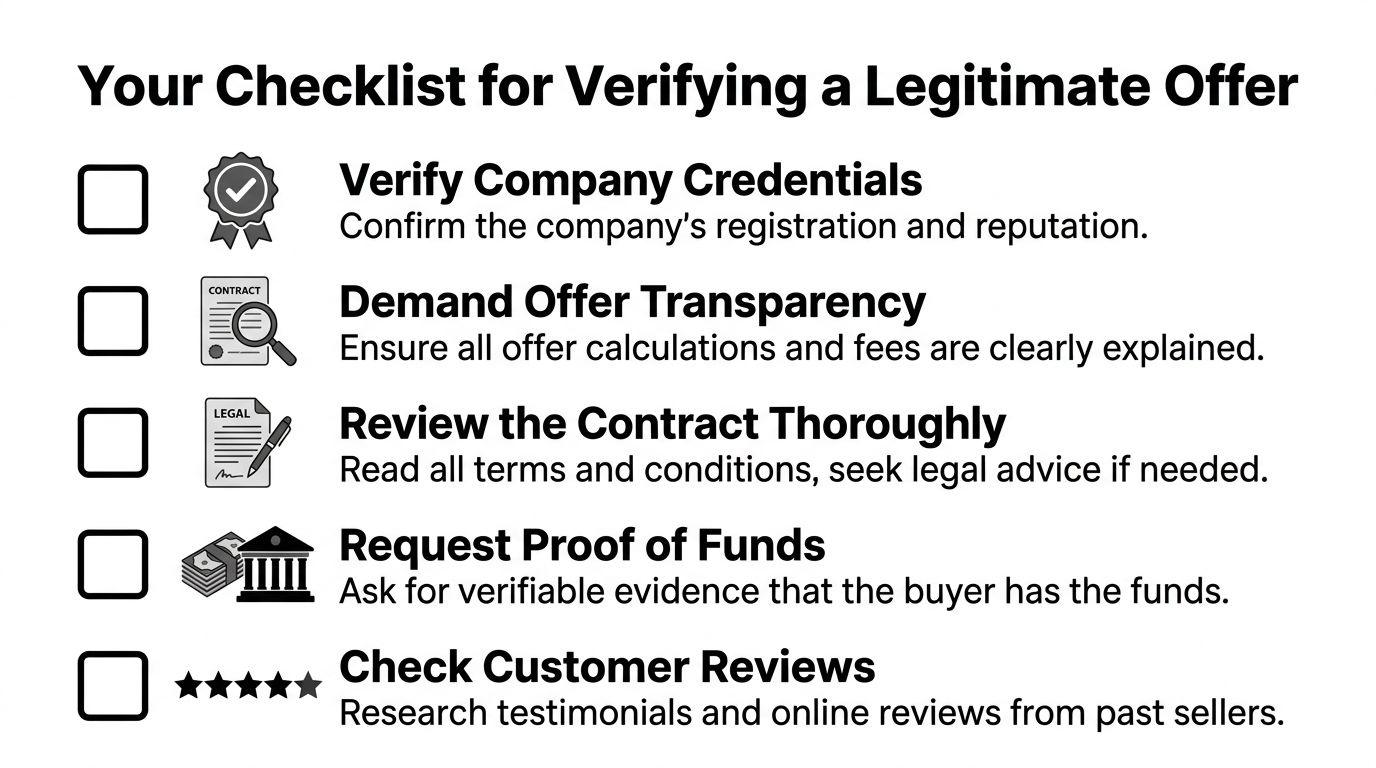
Use a practical checklist and insist on direct answers.
- Ask for proof of funds: If the buyer can't verify available capital, the certainty isn't real.
- Ask whether the contract is assignable: If it is, you may be dealing with a wholesaler rather than the end buyer.
- Ask what happens with liens and title defects: The answer should be explicit, not verbal and vague.
- Read every addendum: Problem language is often buried outside the first page.
- Check business records and reviews: Confirm the company exists, operates locally, and has a visible track record.
Seller protection step: If a company says the offer is guaranteed, ask them to point to every clause that allows them to reduce the price or terminate.
A credible buyer welcomes that question. An unreliable one tries to move past it quickly.
Frequently Asked Questions About Guaranteed Offers
Can a guaranteed cash offer still change after the walkthrough
Yes, it can. The key question is why. A legitimate buyer should limit changes to material issues that were not known at the time of the initial offer, such as major repair exposure above the contract threshold or a severe title problem. If the buyer uses ordinary wear, cosmetic issues, or vague "market changes" to renegotiate, that is a warning sign.
How are tax liens, HOA liens, and contractor judgments handled
This should be addressed before you sign. A 2025 study found that 72% of as-is cash offers in Florida were revised after undisclosed liens were discovered, so sellers need a clear answer on whether the offer is net and the buyer will pay the liens, or whether lien payoff will be deducted from the final proceeds (are cash home buyers legit).
What if the property is in probate right now
A cash sale can still work, but the transaction must match the estate's legal status. The buyer, title company, and probate attorney need to align on who has authority to sign, what court approval is required, and when the property can transfer. In practice, cash buyers tend to be better equipped for this because they can wait for legal clearance without adding lender deadlines to the file.
Will a guaranteed cash offer work if the house has insurance issues
Often, yes. Insurance complications are a major obstacle in financed deals because the lender may require coverage or condition remediation before closing. A direct cash sale often avoids that lender-driven hurdle. The title and condition review still matter, but the transaction isn't dependent on a retail borrower's mortgage approval path.
Is a guaranteed cash offer always the best choice
No. If your property is in excellent condition, easy to insure, free of lien issues, and you have time to market it, a traditional sale may produce a better gross result. A guaranteed cash offer is strongest when certainty, speed, and legal simplicity matter more than chasing the highest possible headline price.
If you're weighing a high-stakes sale in Miami-Dade or Broward, Property Nation offers a local, direct approach built for inherited homes, lien issues, probate complexity, tenant problems, and true as-is conditions. Request a clear offer, review the terms carefully, and compare your real net outcome before deciding.