


You open the mail, see a code notice from Miami-Dade or a city in Broward, and your mind goes straight to the same questions every owner asks. Is this already a lien. Can I still sell. How bad is this going to get.
That reaction is normal. A code enforcement lien sits at the intersection of county procedure, city enforcement, title issues, and real money. For many South Florida homeowners, the stress isn't the original violation. It's the chain reaction that follows once the issue isn't cleared quickly.
In Miami-Dade and Broward, this matters most when you need to sell. A code case that looks administrative on paper can become a recorded claim against the property, and that changes how buyers, title companies, and lenders treat the house. If you're dealing with an unpermitted addition in Hialeah, an exterior maintenance problem in Hollywood, or a roof or fence issue in Pembroke Pines, the process is different from an ordinary bill.
Table of Contents
- At a Glance Understanding Your Situation
- What Is a Code Enforcement Lien
- How a Lien Halts a Traditional Home Sale
- Your Resolution Options A Comparison
- The True Costs and Timelines Involved
- Navigating the Process in Miami-Dade and Broward
- The Hassle-Free Exit Sell Your House As-Is
- Frequently Asked Questions About Florida Liens
- Can I sell a house if the code enforcement lien hasn't been paid yet
- Does fixing the code violation automatically remove the lien
- Is the county always the one enforcing the case
- Should I list the house first and deal with the lien once I find a buyer
- What if the house also has unpermitted work, probate issues, or HOA problems
At a Glance Understanding Your Situation
You get a notice from Miami-Dade County or a Broward city, then a second letter, then a hearing date. A few weeks later, you are trying to figure out whether you need a contractor, a permit, a lawyer, or a buyer who will take the house as-is. That confusion is common, especially when the property already has other title issues such as tax claims or a property lien type that affects closing.
What matters first is the file status. If the case is still in the notice stage, the problem may still be a repair and paperwork issue. If the local board or magistrate has already entered an order and it has been recorded, the problem has shifted into a sale problem. Title companies, lenders, and many retail buyers treat recorded code liens as a closing condition that has to be cleared, reduced, or paid.
South Florida owners usually have five practical paths:
- Correct the violation and clear the file: This makes sense when the repair is affordable, permits are available, and you have time to wait for reinspection and written compliance.
- Review whether the case can still be challenged: Sometimes the issue is the notice, the scope of the violation, or fines that kept running after compliance.
- Ask for a reduction or settlement: Miami-Dade and many Broward municipalities may consider a payoff request, but the process takes follow-up and approval is not automatic.
- Try to sell through the lien: This can work if the lien amount is manageable and the buyer, title company, and city all cooperate before closing.
- Sell the property as-is to a direct buyer like Property Nation: This is often the cleanest exit when the house needs work, the code file is messy, or you cannot wait through permits, hearings, and municipal sign-offs.
Owners often compare a code lien to other claims that can delay a sale. A contractor dispute, for example, creates a different kind of title problem. This mechanics lien on property guide is useful for seeing how lien types differ, but code enforcement cases usually involve a separate local process with inspectors, compliance deadlines, and fine reduction requests.
My practical advice is simple. Do not wait until you list the house to find out how bad the file is. In Miami-Dade and Broward, delay usually means more fines, more municipal paperwork, and fewer clean sale options. If your goal is to be done with the property, not spend months fixing it, an as-is sale is often the better exit rather than the last resort.
What Is a Code Enforcement Lien
A code enforcement lien usually starts with an ordinary property problem that sat too long. In South Florida, I see this with unpermitted bathroom additions in Hialeah, overgrown vacant houses in Miami Gardens, illegal fence or driveway work in Broward, and open permits that were never closed after a remodel.
The first document is rarely the lien itself. It is usually a notice of violation, a civil notice, or a hearing notice telling the owner what needs to be corrected, by when, and what proof the city or county expects.

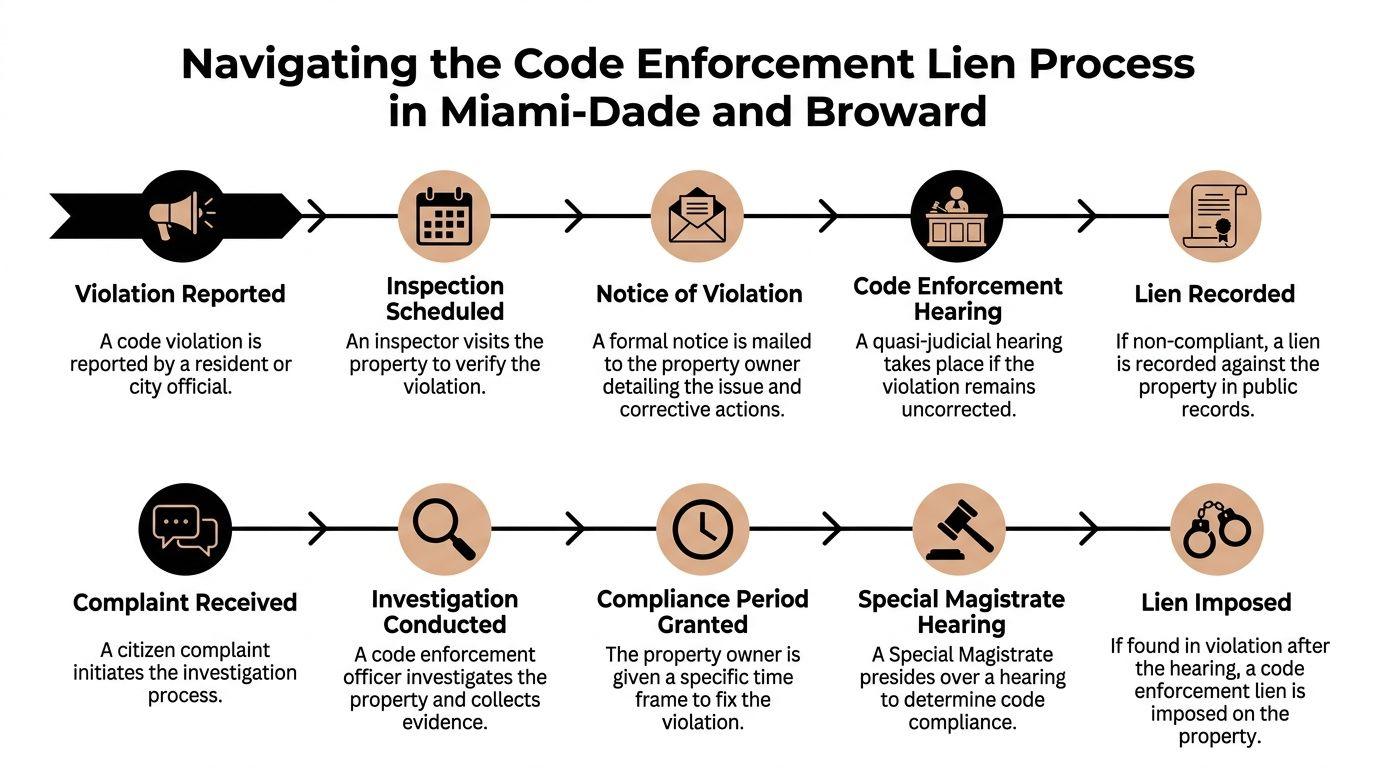
How the process usually unfolds
If the violation is not cured on time, the file can move to a Code Enforcement Board or Special Magistrate. In Miami-Dade and Broward, that is the point where the case gets more expensive and less flexible. A hearing can lead to an order, a compliance deadline, and daily fines that keep running until the property is brought into compliance or the city confirms the violation is cured.
Once that order is entered and recorded through the local process, the problem attaches to the property, not just the owner. That is the moment many sellers realize they are dealing with more than a code ticket. They now have a title problem with a dollar amount attached.
In practical terms, a code enforcement lien is the local government's recorded claim against the property after an unresolved code case reaches the fine stage. It sits in the public record until it is released, satisfied, or otherwise resolved through the municipality's process.
Why the lien matters more than the ticket
Owners often lump all liens together, but the source of the claim matters. A municipal code lien is different from a tax lien, a judgment lien, or a contractor dispute. If you want a plain-English comparison, this Property Nation guide to different types of property liens lays out the categories clearly. For contrast with contractor claims, this mechanics lien on property guide helps show why a city code case follows a different path.
What matters financially is simple. A warning notice can often be fixed with paperwork, cleanup, permits, or repairs. A recorded lien usually means fines, hearing history, compliance proof, payoff requests, and time.
That time has a cost. In 2026, Miami-Dade County and Broward cities still follow their own code workflows, fee schedules, and release procedures, so there is no single fast fix. Some owners should clear the file and keep the house. Others are better off choosing an exit and selling the property as-is to Property Nation before more money goes into permits, contractors, attorneys, or vacant carrying costs.
How a Lien Halts a Traditional Home Sale
A recorded code enforcement lien creates what real estate professionals call a cloud on title. In plain terms, title is no longer clean enough for an ordinary financed closing to move smoothly.
When a buyer signs a contract and applies for a mortgage, the lender doesn't rely on the seller's memory. The lender orders title work. The title company searches the public record, reviews recorded claims, and checks whether anything must be cleared before it can insure the transfer.
What title companies actually see
If the code enforcement lien is recorded, it shows up in that title review. Once it appears, the problem shifts from “Can the seller explain this?” to “Will title insure over it, and will the lender allow it?” In most ordinary residential deals, the answer is no until the lien is resolved or otherwise handled in a form everyone accepts.
That's why owners are often shocked when their buyer seems calm for weeks and then suddenly demands payoff documents, compliance proof, municipal letters, or an extension. The buyer didn't change position randomly. The title search finally reached the file.
If you want a simple primer on why this underwriting step matters, this overview of understanding title insurance protection helps explain the lender and closing side of the process.
Why financed buyers usually stop
A financed buyer depends on three parties staying aligned:
- The lender: The bank wants a property that can secure the loan without unresolved title issues.
- The title company: The insurer wants known claims satisfied, released, or otherwise cleared before issuing a policy.
- The buyer: The buyer wants certainty that they aren't inheriting a municipal problem after closing.
If one of those parties gets uncomfortable, the closing can freeze.
In Miami-Dade and Broward, this happens constantly with inherited homes, vacant rentals, and houses that had work done years ago without final permits. Sellers assume the violation is “old,” so it won't matter. Title doesn't care whether the problem feels old. Title cares whether the record is still active and whether the lien payoff and release path is clear.
Closing reality: A traditional buyer can love the house and still walk away because their lender and title company won't sign off.
Cash buyers sometimes have more flexibility, but even then, the lien affects pricing, timing, and closing mechanics. Nobody buys around uncertainty for free.
Your Resolution Options A Comparison
When a code enforcement lien is already interfering with your plans, you need a strategy, not just a phone call. Some options are clean but expensive. Others sound attractive but drag on because the city file, permit history, and title requirements don't line up neatly.
The right choice depends on your cash position, your urgency, and whether the underlying violation can still be cured without major work.
Code Enforcement Lien Resolution Options Compared
| Resolution Method | Typical Speed | Estimated Cost | Complexity | Best For |
|---|---|---|---|---|
| Pay in full | Fast once payoff is confirmed | High because you satisfy the full demand plus related charges if applicable | Low to moderate | Owners with funds available who need clean title quickly |
| Appeal the violation | Slow and procedural | Variable | High | Owners with strong factual or procedural grounds and time to fight |
| Negotiate a reduction | Moderate to slow | Lower than full payoff if successful | Moderate to high | Owners who can document hardship, compliance, or settlement reasons |
| Bond over the lien | Case-specific | Variable and often layered | High | Owners with legal guidance and a transaction that justifies complexity |
| Wait it out | Unpredictable | Risk can grow over time | Low at first, then high | Almost never the best choice when a sale is pending |
The article on how to remove a lien gives a broader framework, but code liens deserve their own analysis because local enforcement bodies don't operate like private creditors.
How to choose the least painful path
Paying in full is the most direct route. If the amount is manageable and the city can produce a clear payoff and release process, this often removes the obstacle fastest. What doesn't work is paying without confirming exactly what document will be recorded afterward to show satisfaction.
Appealing can make sense if the notice was defective, the violation was already corrected, or the wrong party was cited. But owners often overestimate how forgiving appeal windows are. If too much time has passed, the case may be less about overturning the order and more about reducing the financial damage.
Then there's negotiation, which many owners prefer because it feels practical. Sometimes it is. Sometimes it turns into weeks of document chasing, old permit research, photos, inspections, and repeated outreach to municipal staff who need internal approvals before discussing reduction.
Bonding over the lien is a more technical path. It can help in special situations, but it isn't a homeowner shortcut. It usually requires transaction-specific advice, disciplined paperwork, and a title company that's comfortable with the structure.
Finally, waiting is the path people take by default when they're overwhelmed. It almost never strengthens your position if you need to sell in Miami-Dade or Broward. The file doesn't become easier because you stopped opening the letters.
- Use the pay route when speed matters more than saving money.
- Use the appeal route only when you have a real procedural or factual basis.
- Use negotiation when the lien amount feels disconnected from the property's current reality.
- Use a legal workaround only if a professional has already confirmed the closing can support it.
The True Costs and Timelines Involved
The most expensive part of a code enforcement lien is often the part the owner doesn't see at first. People focus on the original violation. The primary burden usually comes from the file getting older, more layered, and harder to clear.
A lien case can require money in several directions at once. You may have repair costs to cure the underlying issue, permit costs to legalize prior work, contractor invoices to bring the property into compliance, and title-related closing friction when you try to sell.
Costs that owners often miss
Here's where homeowners in Miami-Dade and Broward get caught off guard:
- Permitting cleanup: If the violation involves unpermitted work, the city may want plans, applications, inspections, or licensed contractor corrections before it will recognize compliance.
- Administrative drag: Older files often require multiple departments to update status, especially when code, building, and records don't match perfectly.
- Property carrying costs: Mortgage payments, taxes, insurance, HOA obligations, and utilities keep running while the file is unresolved.
- Transaction spillover: Buyers ask for extensions, title companies request more documentation, and deals can collapse while you're still spending money to keep the property afloat.
If you need a side calculator for property-related transaction expenses during a pending sale, this tool to estimate rental property expenses can help frame the broader carrying-cost picture.
Why timeline risk is expensive
The timeline isn't only about government speed. It's also about dependency. One missing inspection result, one unreleased old permit, or one municipal response delay can hold up the entire chain.
That matters more in South Florida than many owners realize. Insurance pressure, vacant-house maintenance, storm exposure, probate deadlines, and HOA enforcement can all keep running while you wait on code resolution. The lien file may be only one problem on paper, but in practice it interacts with everything else attached to the house.
Owners usually ask, “What will this cost me to fix?” The better question is, “What will it cost me to keep this property while I'm trying to fix it?”
A slow file is rarely neutral. It keeps the property in limbo, and limbo costs money.
Navigating the Process in Miami-Dade and Broward
Local process matters. A general Florida answer won't help much if your house is in Miami-Dade and the payoff requires one workflow, while your property in Broward is inside a city that handles records, hearings, and permitting differently.
The core issue is simple. You need to identify the enforcing authority, the current case status, and the exact document path needed to clear title. The steps aren't identical across South Florida municipalities.
Miami-Dade workflow
Miami-Dade is the cleaner starting point because the county provides a direct online route for searching and payment. As of 2026, Miami-Dade County allows property owners to search for code enforcement liens and pay them online through their official portal, but negotiation for reduction still requires direct contact with the Lien Collection section through the county's code enforcement lien search and payment service.
That means owners should separate two tasks:
- Search and verify whether a lien is active and what the portal shows.
- Contact the right office if you're trying to negotiate rather than pay.
If the property also has open permit history or unpermitted work, this guide on selling a house with unpermitted work is worth reading because code files and permit files often overlap.
Broward workflow
Broward is more fragmented because many cases run through individual municipalities such as Hollywood, Plantation, Pembroke Pines, Fort Lauderdale, or Coral Springs, even though county-level systems and permit portals may still be part of the overall research path.
That means you need to confirm:
- Which city issued the case
- Whether the Special Magistrate or code board already entered an order
- Whether the violation is cured but the lien release paperwork still hasn't been processed
- Whether building and code records agree with each other
In practice, Broward owners waste the most time when they call the wrong office first. They contact code when they need records, records when they need building, or building when the problem is a magistrate order waiting for lien resolution language. Start with the case number, the property address as shown in county records, and a request for the current status in writing.
In Broward, the process is often less about one portal and more about matching the right city department to the exact stage of the file.
If you're handling an estate property, vacant rental, or house with old alterations, get the municipality-specific trail before you put the property under a conventional contract.
The Hassle-Free Exit Sell Your House As-Is
Some owners don't want another round of inspectors, contractors, permit applications, extensions, and buyer anxiety. That's a valid decision, especially when the house also has probate issues, insurance problems, HOA pressure, vacancy, or deferred maintenance.

An as-is sale can be the cleanest exit because it changes the question. Instead of asking how you personally will untangle every line item before selling, you structure the transaction around the property's current condition and the lien's current status. That's often the practical route when the traditional market won't tolerate uncertainty.
Why this exit works when the file is messy
Direct-sale buyers who are used to lien cases don't expect a showroom house or a perfect municipal history. They evaluate the property, the title obstacles, and the work needed after closing. That can remove the repair-before-listing trap that keeps many Miami-Dade and Broward owners stuck.
If you're weighing that route, this article on whether you can sell a house with a lien on it helps clarify the transaction side.
A visual overview of the direct-sale process can help if you're comparing options:
The main benefit isn't just speed. It's certainty. You avoid listing prep, repeated showings, lender conditions, and the risk that a retail buyer backs out after title uncovers what you already knew was there.
Frequently Asked Questions About Florida Liens
Can I sell a house if the code enforcement lien hasn't been paid yet
Sometimes, yes. But the sale structure matters. In a traditional financed closing, unresolved municipal liens usually create major title and lender resistance. In a direct or cash transaction, the lien may be addressed through closing if the parties and title company can document a workable payoff path.
Does fixing the code violation automatically remove the lien
No. Correcting the condition and clearing the recorded lien are related, but they aren't the same step. A property can be brought into compliance while the public record still shows an outstanding lien or unreleased order. Always confirm what release or satisfaction document will be recorded.
Is the county always the one enforcing the case
No. In South Florida, many code cases are municipal. That's especially important in Broward, where city-specific procedures often control the hearing, compliance review, and lien handling.
Should I list the house first and deal with the lien once I find a buyer
Usually not. That approach creates contract risk. Title problems discovered after the property goes under contract can trigger delays, amendments, price cuts, or cancellation.
What if the house also has unpermitted work, probate issues, or HOA problems
That's common. These cases rarely come one at a time. A smart strategy looks at the whole file, not only the lien. If the property has several layers of complexity, an as-is sale may be more realistic than trying to solve each issue before marketing the home.
If you need a practical exit instead of a long municipal cleanup, Property Nation buys houses across Florida in as-is condition, including properties with lien issues, title complications, probate problems, and unpermitted work. You can request a cash offer, skip repairs and showings, and choose a closing timeline that fits your situation.