


You're probably here because a normal listing doesn't fit your situation. The house may be inherited. The tenant may have stopped cooperating. The HOA may be pushing for documents, fees, or repairs you don't want to manage. In Miami-Dade and Broward, that pressure gets worse when insurance questions, probate paperwork, and title issues start piling up.
That's why the search for cash buyers near me is rarely just about speed. It's about finding someone who can close in South Florida, with the right title team, the right legal coordination, and a realistic understanding of what happens when a property has liens, estate issues, open permits, condo restrictions, or a board that wants everything in writing.
Table of Contents
- At-a-Glance Your Guide to Finding Cash Buyers in South Florida
- Identifying Reputable Local Cash Home Buyers
- Comparing Buyer Types Local Investor vs iBuyer vs Wholesaler
- The Vetting Process A Checklist for South Florida Homeowners
- Navigating Complex Sales Probate Liens and 2026 Florida Laws
- FAQ Your Questions on Selling for Cash in Florida Answered
At-a-Glance Your Guide to Finding Cash Buyers in South Florida
South Florida isn't a side market for cash purchases. It's one of the clearest examples of how important cash remains. In early 2025, Miami reached a 43.0% cash-sale share, which means nearly half of sales closed without traditional financing, according to Realtor.com's cash-sale trend report. That matters if you own in Miami-Dade or Broward, because it means serious cash demand is already part of the local market structure.
For many sellers, the issue isn't whether cash buyers exist. The issue is whether the buyer is real, local, funded, and capable of handling a complicated Florida closing. There's a major difference between a direct buyer with capital and a call center that ties up your property under contract while looking for someone else to take the deal.
In this market, a useful approach starts with a short list of buyers who understand South Florida transaction friction. That includes probate administration, HOA estoppel and approval timing, title defects, insurance-driven buyer hesitation, condo or single-family compliance issues, and tenant-occupied properties. If the buyer glosses over those details, you should assume the process will get messy later.
If you want a baseline for how direct cash buyers operate across the state, review Florida cash home buyers and compare their process against any company you're considering locally.
Practical rule: In Miami-Dade and Broward, a fast offer is easy to promise. A clean closing is harder. Judge the buyer by their process, not their headline.
What sellers usually need most
- A real cash buyer: Someone who can show proof of funds and coordinate with a local title company or attorney.
- A clear answer on condition: Whether the buyer will purchase as-is, including outdated, damaged, cluttered, or tenant-occupied property.
- A realistic timeline: Not fantasy closing dates. A buyer should explain what title work, payoff statements, HOA documents, and estate paperwork may affect timing.
- Straight pricing logic: A professional buyer should explain how repairs, legal complexity, holding costs, and resale risk affect the offer.
- Local competence: Miami-Dade and Broward deals often turn on municipal records, condo and HOA requirements, insurance concerns, and title cleanup.
At a glance
You'll leave this guide with:
- A way to identify credible local buyers
- A side-by-side breakdown of investor, iBuyer, and wholesaler models
- A practical vetting checklist
- A Florida-specific look at probate, liens, HOA issues, and insurance friction
- Direct answers to the most common cash-sale questions
Identifying Reputable Local Cash Home Buyers
The fastest way to get in trouble is to confuse visibility with credibility. A company can rank for cash buyers near me and still have no actual buying operation in Miami-Dade or Broward. Start with evidence you can verify.

Start with local evidence, not ads
Search for signs of a real South Florida footprint. That means local closings, local title coordination, and familiarity with municipal and county-level issues. In practice, sellers should look beyond the website and ask where the buyer has closed, which title company or attorney they use, and whether they regularly handle Miami-Dade and Broward transactions.
You can also ask professionals who see failed deals up close. Probate attorneys, estate attorneys, title agents, and real estate attorneys know which buyers perform and which ones retrade, disappear, or assign contracts at the last minute. That referral path is often better than a search result.
Public records can help too. If a buyer claims they close directly, there should be a pattern of deeds, transfers, or entity activity that supports that claim. You're not looking for perfect branding. You're looking for transaction reality.
A serious local buyer won't act annoyed when you ask who closes their files, how they verify title issues, or whether they buy with their own capital.
If you want a practical breakdown of warning signs, review whether cash home buyers are legit and compare that checklist against the companies on your list.
Who should be on your shortlist
A strong shortlist usually includes three types of contacts:
- Direct local buyers: These are the most useful when the property has legal or physical complexity and the seller needs flexibility.
- Title or probate professionals: They can tell you who closes cleanly and who causes delays.
- Buyer references tied to your situation: Inherited home. tenant issue. HOA problem. deferred maintenance. The right buyer for one scenario may be the wrong buyer for another.
Be careful with companies that avoid direct answers to basic operational questions. If they can't explain their inspection process, deposit process, contract terms, or local closing workflow, they probably don't control the deal.
What usually doesn't work
Some sellers focus on who gives the highest initial verbal offer. That's a common mistake. Weak buyers use optimistic numbers to secure the contract, then lower the price after inspection, title review, or document collection. In South Florida, where condo associations, municipal records, and insurance-related questions can complicate the file, vague promises usually collapse under real due diligence.
The better standard is simple. Ask who is buying, where the funds come from, who handles title, what contingencies remain, and how they deal with HOA balances, probate documents, or open issues. If the answer is muddy, move on.
Comparing Buyer Types Local Investor vs iBuyer vs Wholesaler
A seller in Miami Gardens inherits a house with an old roof, a past-due HOA balance, and a sibling still sorting out probate paperwork. A seller in Coral Springs has a clean, owner-occupied house built in the 2000s with no title issues. Both owners may search for "cash buyers near me." They should not be talking to the same type of buyer.
The business model behind the offer affects price, timing, and whether the deal survives contact with title, insurance questions, condo or HOA paperwork, and Florida legal requirements.
Cash Buyer Comparison Investor vs iBuyer vs Wholesaler
| Factor | Local Investor (e.g., Property Nation) | iBuyer (e.g., Opendoor) | Wholesaler |
|---|---|---|---|
| Primary model | Buys directly for investment or resale | Uses a centralized system to buy homes that meet narrow criteria | Puts property under contract, then tries to assign it |
| Best fit | Inherited homes, outdated houses, properties with liens, tenant issues, HOA debt, or title complications | Homes in good condition with fewer legal or physical problems | Sellers who understand assignment risk and can tolerate less certainty |
| Condition tolerance | Broad | Narrower | Depends on whether an end buyer is found |
| Offer approach | Prices repairs, holding costs, legal complexity, and resale risk directly | Uses formula-based pricing and service fees for homes inside its criteria | Often starts with a high number, then depends on finding a buyer at that spread |
| Closing certainty | Usually stronger if the buyer is purchasing with its own funds | Usually consistent if the property qualifies and stays within guidelines | Less certain because the original party may not be the one bringing money to closing |
| Handling probate, liens, or title issues | Often better suited to difficult files | Often less flexible | Limited unless an end buyer accepts the issue |
| Negotiation style | Based on scope of work, days to close, legal friction, and exit risk | Process-driven, with less room for exceptions | Contract-first in many cases |
| Who controls the closing | The actual buyer and its title team | The platform and its closing process | Often depends on assignment or double-close structure |
How these models actually perform in South Florida
In Miami-Dade and Broward, the wrong buyer type can waste weeks.
A local investor usually works best when the file has moving parts. Probate is a good example. In Florida, the personal representative may need court authority before a sale can close, and the timeline depends on whether the estate is formal administration, summary administration, or still missing documents. An investor who closes locally will usually know how to coordinate with the probate attorney, title company, and heirs without pretending the file is cleaner than it is.
The same goes for HOA and condo issues. Estoppel letters, transfer approvals, unpaid assessments, special assessments, and open violations can hold up a closing in South Florida. A real local buyer accounts for that early. An out-of-market platform or a wholesaler often treats those items as surprises, then tries to renegotiate once the title work comes back.
Insurance is another dividing line in 2026. Older roofs, prior claims, polybutylene or cast iron plumbing, and four-point inspection problems can affect resale risk fast in this market. A direct investor will price that in on day one. An iBuyer may decline the property outright or revise terms if the house falls outside its underwriting standards.
That does not mean local investors are always the best financial outcome. They are often the best fit for difficult properties and compressed timelines. If the house is clean, insurable, and easy to finance, an iBuyer or traditional listing may produce a stronger net. Sellers considering that trade-off should compare the speed and certainty benefits of selling to home investors against the upside of putting time and money into prep work.
That prep work is where many sellers underestimate cost. If your alternative to a cash sale is fixing the house first, review the operational side of managing your home renovation. In South Florida, permit history, contractor availability, insurance requirements, and municipal reinspection delays can turn a simple plan into a longer hold than expected.
Wholesalers belong in a separate category. Some are honest about their role and disclose the assignment clause clearly. Others tie up the property first and look for a buyer later. If you need a sale to fund a move, stop HOA enforcement, resolve an inherited property, or avoid carrying costs on a vacant house, that difference matters.
Ask the direct question early: “Are you buying this yourself, or are you assigning the contract?” In this market, that answer tells you a lot about who is taking the risk.
The Vetting Process A Checklist for South Florida Homeowners
A real buyer won't mind scrutiny. The wrong buyer will try to rush you past it.
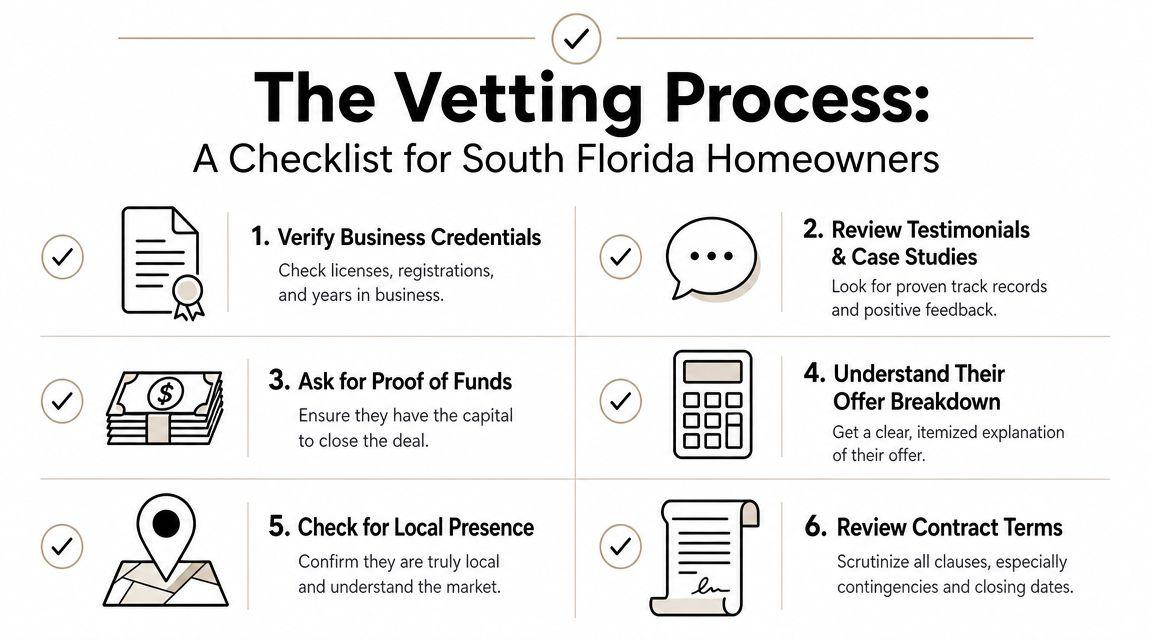
What to request before you sign anything
Start with the one document that cuts through most nonsense. A legitimate cash buyer should provide verifiable proof of funds, such as recent bank statements or a formal letter from their financial institution, and should be ready to work with a reputable local title company or attorney, as outlined in this guidance on how cash buyers work.
That document request should happen before you sign a contract, not after.
Then review the contract itself. Look for inspection periods, cancellation language, assignment clauses, and who chooses the closing agent. In South Florida, those details matter because a file can turn on estoppels, payoff statements, municipal searches, probate authority, and HOA or condo document timing.
For sellers debating between selling and fixing, the biggest mistake is underestimating project management. If you're considering repairs first, this guide to managing your home renovation is a practical reference for vetting contractors before you commit to that path.
A buyer should also explain how they reached the number. If the offer is a black box, expect trouble later. For a useful framework, review how Florida cash home offers are calculated in 2026.
Questions that expose weak buyers fast
Use direct questions. Don't soften them.
- Who is buying the property? If the answer drifts into “partners,” “acquisition desk,” or “disposition team,” ask whether the contract is being assigned.
- Can you close with this title issue or HOA balance still pending? A real buyer will explain process, not dodge.
- Which local title company or attorney handles your closings? Buyers who close regularly already have a system.
- What does your inspection change? Some buyers use inspection as a renegotiation tool rather than a verification step.
- Have you handled probate, tenants, open permits, or code issues in Miami-Dade or Broward before? Specific answers matter.
Here's a short visual checklist to keep those conversations grounded:
Red flags that deserve a hard stop
Some warning signs are immediate.
- Refusal to show funds: That's disqualifying.
- Promises of ultra-fast closing with no title review: Even cash deals still need documentation and title work. Unrealistic speed claims are a red flag.
- No local closing team: South Florida deals need local coordination.
- Pressure to sign before questions are answered: Professional buyers don't need confusion to make a deal work.
If the buyer can't explain the contract in plain English, don't give them control of your timeline.
Navigating Complex Sales Probate Liens and 2026 Florida Laws
The hardest properties to sell are exactly where experienced cash buyers can help. Not because they wave away legal issues, but because they know which issues can be solved before closing, which are paid through closing, and which require authority documents before anyone can sign.

Independent guidance notes that cash-investor services are designed for properties with complications such as title issues, tenant problems, or distressed conditions, and that their value is creating a path to closing despite those hurdles, as described in this overview of cash buyers for complicated properties.
Probate and inherited property in Florida
In Florida, inherited property sales often turn on authority. The personal representative must have the right court documents. If the estate is still being administered, title won't solely rely on family agreement. The closing team usually needs to confirm who has authority to sign, whether additional court approval is required, and whether creditors or estate administration issues remain open.
That's where many retail buyers back away. They want a clean seller, a standard disclosure package, and a simple closing timeline. Probate rarely looks like that.
In Miami-Dade and Broward, probate sales also create practical complications. The heirs may live out of state. The house may be full of personal property. Utility service may be inconsistent. The insurance situation may be unsettled. A direct cash buyer can often work within that reality because the transaction doesn't depend on lender underwriting or a buyer's move-in timetable.
Probate doesn't prevent a sale. Missing authority, unresolved title questions, and poor coordination prevent a sale.
Liens HOA issues insurance and occupied properties
Liens are common in distressed transactions. HOA balances, contractor claims, municipal fines, and other encumbrances don't always kill the deal. Often, they need payoff verification and proper settlement through closing. The key is whether the buyer and title team understand how to clear the path rather than pretending the issue doesn't exist.
HOA and condo matters are especially important in South Florida. Estoppel amounts, transfer requirements, application timing, violation notices, and special assessment exposure can all affect closing. In 2026 Florida practice, boards and associations are paying close attention to documentation and property condition. That means a buyer who ignores association process can delay everyone.
Insurance is another pressure point. In Broward and Miami-Dade, older roofs, prior claims, vacancy, wind concerns, and property condition can complicate insurability. A financed buyer may hit a wall if the insurer or lender objects to condition or documentation. A cash purchase can reduce that friction because the transaction doesn't rely on a lender's insurance checklist in the same way.
Occupied properties raise a different set of issues. Tenants may deny access. They may be behind on rent. They may have lease terms that complicate a retail sale. A direct cash buyer can sometimes buy with the tenancy in place if the economics and legal review support it. That's far different from a standard owner-occupant buyer who wants the property vacant, clean, and easy to insure.
FAQ Your Questions on Selling for Cash in Florida Answered
Do cash buyers always pay less
Often, yes. Speed and certainty usually come with a pricing trade-off. A University of California San Diego study found that all-cash home buyers paid, on average, 10% less than mortgage buyers, according to UC San Diego's summary of the research.
That doesn't mean every cash offer is fair. It means the discount exists because the seller is usually avoiding financing contingencies, repair demands, appraisal pressure, and delay risk. The right question isn't “Is this below retail?” The right question is “What am I avoiding, and what is that certainty worth in my situation?”
Can I sell as-is and leave unwanted items behind
In many direct cash transactions, yes. “As-is” usually means the buyer accepts the property in its current condition, subject to the contract terms. That can be useful when the house has old furniture, deferred maintenance, storm wear, clutter, or contents from an estate.
You should still confirm exactly what stays, what gets removed, and whether the contract addresses personal property. Clear writing prevents arguments later.
What if the house is in probate or has title issues
Those issues don't automatically stop the sale. They do change the process. Probate requires the right estate documents and signing authority. Title issues usually require review by the closing agent to determine what must be cleared, paid, or documented before transfer.
The practical difference with a strong cash buyer is tolerance for complexity. They're usually evaluating whether the issue is solvable, not whether the house is picture-perfect.
How fast can a legitimate cash deal close
Cash purchases typically close in about 1 to 2 weeks, and Zillow-based reporting cited by AmeriSave says all-cash homes close about 14 days faster than financed purchases, according to AmeriSave's review of cash purchase timing.
That said, local complexity still matters. Probate, HOA estoppels, liens, title defects, and occupancy issues can extend the schedule. A professional buyer will give you a realistic window, not a fantasy one.
Should I take the first cash offer I get
Usually not. Buyer type affects both the offer and the reliability of closing. Some buyers are pricing clean, eligible homes. Others are pricing heavy repair risk or legal complexity. Some are true buyers. Some are only intermediaries.
If your house is livable but dated, or if it has a fixable issue rather than a major one, comparing offers is smart. The spread between buyers can be meaningful because their business models are different.
A good cash offer is not just a number. It's a number attached to a buyer who can actually perform.
If you need a direct assessment of a house in Miami-Dade or Broward, including probate property, inherited homes, liens, HOA issues, tenant situations, or major deferred maintenance, Property Nation offers a local cash-sale option built around real closings, clear terms, and flexible timing.